Teaching & Learning
- LSU defers generative AI rules for coursework to the course instructor
- Using AI to complete assignments without instructor authorization is treated as academic misconduct
- The university provides sample syllabus statements (e.g., prohibition, permitted use, permitted use with attribution) and advises students to consult their instructor when unsure
“Instructors have the autonomy to determine their own policies on the use of generative AI tools in their courses... If you are unsure whether the use of an AI tool is permissible, ask your instructor for clarification.”
“What Does Academic Misconduct Look Like? ... ‘Using artificial intelligence to complete assignments... when not authorized by the professor.’”
- Using artificial intelligence to complete tests or other assessments is considered academic misconduct unless explicitly authorized by the course instructor
“What Does Academic Misconduct Look Like? ... ‘Using artificial intelligence to complete assignments or tests when not authorized by the professor.’”
- LSU library guidance states generative AI can support learning activities (e.g., brainstorming, summarizing, editing), but students must follow instructor-specific rules and verify AI-provided information
“Generative AI... can be a helpful tool for things like brainstorming, summarizing, and editing.”
“LSU students are expected to produce their own work. Always follow your instructor's guidelines on using AI.”
- LSU does not publish a separate code-generation rule in the cited sources; however, its academic misconduct examples include using AI to complete “assignments” without instructor authorization, which would apply to programming assignments when not authorized
“What Does Academic Misconduct Look Like? ... ‘Using artificial intelligence to complete assignments or tests when not authorized by the professor.’”
Research
- LSU provides “MikeGPT,” a secure enterprise AI platform for faculty and staff, and promotes its use for tasks including analyzing data (positioned as supporting administrative and academic work)
“Faculty and staff across all LSU campuses can now log in to mikegpt.lsu.edu... to explore how this technology can streamline workflows, manage projects, analyze data, and support a wide range of administrative and academic tasks.”
Academic Integrity
- When AI use is allowed, LSU guidance includes an attribution expectation: the library guide instructs users to cite AI tools used, and LSU provides a sample syllabus statement for “Permitted Use with Attribution” requiring citation of AI-generated materials
“ALWAYS cite any AI tool you use to generate text, images, music, or other content for an assignment.”
“‘Permitted Use with Attribution’: Students are welcome to use AI in this course but are required to cite any AI-generated materials (including text, images, etc.).”
- LSU explicitly treats unauthorized AI use (to complete assignments or tests) as academic misconduct, making it subject to the university’s standard academic integrity enforcement and disciplinary processes
“What Does Academic Misconduct Look Like? ... ‘Using artificial intelligence to complete assignments or tests when not authorized by the professor.’”
Institutional & Administrative
- LSU provides all active faculty and staff access to “MikeGPT” (an LSU enterprise AI service) for work purposes
- For teaching, LSU states instructors have autonomy to set course-level policies governing student use of generative AI tools
“This service is currently available at no cost to all active LSU faculty and staff.”
“Instructors have the autonomy to determine their own policies on the use of generative AI tools in their courses.”
- LSU states its contract ensures the university retains ownership of data and that LSU data will not be used to train OpenAI models
- LSU’s approved enterprise AI platform for faculty and staff is “MikeGPT,” described as an LSU-specific OpenAI enterprise instance designed for security and privacy
“MikeGPT is a custom, LSU-specific version of the OpenAI enterprise platform. Built with security and privacy top-of-mind, MikeGPT ensures that our proprietary data remains ours.”
“LSU's contract with OpenAI ensures the University retains ownership of all data and that our data will not be used to train OpenAI models.”
- LSU Faculty Senate Resolution 23-01 established a standing “Generative AI (GAI) Committee” to develop a guiding framework and resources, engage the university community on ethical implications, and make recommendations for responsibly integrating generative AI into teaching, research, service, and administrative processes
“This committee is charged with developing a guiding framework and resources to support faculty members as they adapt their teaching, research, and service activities to advances in GAI; to engage the University community in conversations about the ethical implications of GAI... and to make recommendations about how to responsibly integrate GAI into the University’s administrative processes.”
DocuMark: Responsible AI Use for Academic Integrity
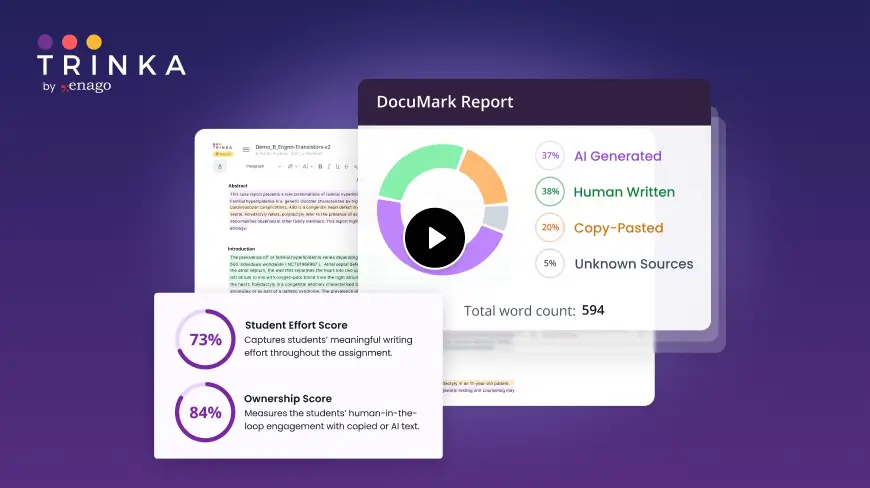
Knowing your institution's AI policy is step one. DocuMark helps enforce it fairly by empowering universities to manage AI-generated content, prevent cheating, and support student writing through responsible AI use.
Common Questions About Louisiana State University's AI Policies
Louisiana State University has defined AI policies in 10 of 12 categories, with an overall coverage score of 83%.
When AI use is allowed, LSU guidance includes an attribution expectation: the library guide instructs users to cite AI tools used, and LSU provides a sample syllabus statement for “Permitted Use with Attribution” requiring citation of AI-generated materials.
LSU explicitly treats unauthorized AI use (to complete assignments or tests) as academic misconduct, making it subject to the university’s standard academic integrity enforcement and disciplinary processes.
LSU’s approved enterprise AI platform for faculty and staff is “MikeGPT,” described as an LSU-specific OpenAI enterprise instance designed for security and privacy. LSU states its contract ensures the university retains ownership of data and that LSU data will not be used to train OpenAI models.