Teaching & Learning
- The university does not have a single, prescriptive rule for all courses
- If the instructor's policy is unclear, students are required to ask for clarification before using AI
- Loyola Marymount University's policy is that students must follow their instructor's specific guidelines regarding the use of AI tools for coursework
For coursework, before using any AI tool, it is important to first learn about your instructor's policy on using AI tools in your specific course. ... If you're not sure about the professor’s policy, be sure to ask them for guidance. Always check your course syllabus or ask your professor for their specific class policy on using generative AI tools. Instructors can allow students to use AI tools if they provide certain guidelines...
- The provided materials do not state a university-wide rule on student AI use during exams or quizzes, but they do show that exam and quiz materials can be used as evidence in academic honesty cases and that proctoring-related software evidence may be used in those cases
Evidence can take many forms including (but not exclusive to) personal accounts related to direct observations of student behavior as well as papers, creative works, lab reports, exams, and quizzes.
Evidence includes that obtained through the recent adoption of honesty-promoting software such as Turnitin and video-based evidence produced from lockdown-browsers (e.g., Respondus) and synchronous virtual meeting spaces (e.g., Zoom) for proctoring varied forms of student assessment.
- LMU states institutionally that students should develop skills for effective and ethically sound engagement with generative AI as part of their education, but the provided sources do not define a specific operational policy for student study-help use
As a Catholic institution grounded in the Jesuit and Marymount education traditions, LMU is committed to fostering mission-aligned engagements with GenAI, which will, of necessity, now be one part of any college student’s holistic education. We have an obligation to develop our collective capabilities around GenAI so that we can help students develop their own skills for effective and ethically sound engagements with GenAI.
Research
- However, the provided sources do not set a specific university-wide rule on using AI to draft or edit manuscripts, theses, or dissertations
- LMU provides research-oriented AI resources and indicates that Microsoft Copilot with Data Protection may be used for research-related work, including researching insights
LMU's AI-Generated Tools for Academic Research The William H. Hannon Library’s guide to AI-powered research tools. Features ethical use guidelines, suggestions for which tools to use for different research tasks, and detailed information on Connected Papers and Consensus. Available to all faculty and staff, at no additional cost.
In addition, Microsoft Cop ilot wi th Data Protection cites its generated content with verifiable citations, is designed to assist organizations in researching industry insights and analyzi ng data, and has the capability to provide visual answers including graphs and charts.
- LMU makes Microsoft Copilot with Data Protection available to faculty, students, and staff and states that it is designed to help analyze data
- The provided sources do not specify a separate research-policy standard governing AI use for data collection, analysis, or synthetic data generation
Microsoft Copilot with Data Protection, a generative AI-powered platform designed and created specifically for organizations, i s now available for LMU faculty, student, and staff through our Microsoft 365 L icense.
In addition, Microsoft Cop ilot wi th Data Protection cites its generated content with verifiable citations, is designed to assist organizations in researching industry insights and analyzi ng data, and has the capability to provide visual answers including graphs and charts.
- LMU’s research integrity policy broadly covers misconduct in all research and creative activity and states that the university will review, investigate, and resolve allegations
- The task force announcement also states that LMU intends to develop principles, guidelines, tools, and practices for ethical and skillful academic and scholarly use of generative AI, but the provided materials do not define AI-specific rules for grant proposals, IRB applications, or ethics declarations
Loyola Marymount University (LMU) is committed to maintaining a scholarly environment that promotes the highest ethical standards in the conduct of research and any creative activity. The University strongly condemns misconduct in any aspect of research or creative activity and will inquire into and, if necessary, investigate and resolve promptly and fairly all instances of alleged misconduct in accordance with this policy .
This policy outlines Loyola Marymount University’s administrative process in response to an allegation of research misconduct in all areas of research and creative activity, regardless of the funding source.
To this end, this task force will be asked to generate principles, guidelines, tools, and practices that can help individuals engage ethically and skillfully with GenAI for academic and scholarly purposes:
Academic Integrity
- Instructors determine whether any special citation or acknowledgment is required for authorized AI use in their class
- Students must check their course syllabus or ask their professor for the specific policy on citing or acknowledging the use of AI tools
Should I cite content I get from an AI tool? Always check your course syllabus or ask your professor for their specific class policy on using generative AI tools. Instructors can allow students to use AI tools if they provide certain guidelines, such as requiring students to cite or acknowledge that they used an AI tool. If you are authorized to use AI for a class assignment, be sure to confirm with the instructor whether any special citation or acknowledgment is required.
- LMU places the burden on the instructor to provide evidence that an academic honesty violation is more probable than not
- The university recognizes evidence from Turnitin, lockdown browsers, and Zoom-based proctoring, and the faculty and student FAQ documents describe the allegation, meeting, decision, sanction, filing, and appeal process for suspected violations
The AHP affirms that the burden shall fall upon the Instructor to provide evidence that it is more probable than not that the Student has committed the alleged academic honesty violation.
Evidence includes that obtained through the recent adoption of honesty-promoting software such as Turnitin and video-based evidence produced from lockdown-browsers (e.g., Respondus) and synchronous virtual meeting spaces (e.g., Zoom) for proctoring varied forms of student assessment.
A: First, refer to the Academic Honesty Policy for guidance and then gather the available evidence and send an email to the involved Student within 5 business days upon discovering the suspected violation and be sure to copy your appropriate supervisor.
A: You will then render a decision as to whether or not a violation occurred. If you decide a violation occurred and sanction the Student, you must, within 5 business days, complete and submit the Academic Honesty Violation Form to the Provost’s Office and send a copy to the Student.
A: Respond via email within 5 business days. Agree to meet as soon as possible in-person or remotely (as needed) to hear/see the evidence and provide your response to the allegations. If you do not respond to this initial email within 5 business days, your Instructor unilaterally makes a determination and will file the Academic Honesty Violation Form with the Provost.
Institutional & Administrative
- No specific policy governs AI use for grading or feedback
- LMU provides several AI tools for faculty and staff, including research aids, Adobe generative AI, Microsoft Copilot, and Zoom AI Companion
- The university explicitly suggests faculty can use AI to create syllabi and lesson plans, and staff can use it for tasks like analyzing data, generating reports, writing emails, and summarizing documents
How can I use AI as an LMU faculty or staff member? Faculty can leverage AI to create syllabi, assignments, and lesson plans, as well as use it as a teaching tool in their classes. Staff can use AI to research and analyze data, generate reports, write emails, summarize long documents, create presentations, and more.
- LMU also warns that other web AI tools may expose private data and states that users should never place personally identifying information in any AI tool
- For Zoom AI Companion, LMU states that Zoom does not use meeting content to train Zoom’s or third-party AI models, and the feature is off by default and must be enabled by the host
- LMU identifies Microsoft Copilot with Data Protection as an LMU-available AI platform for faculty, students, and staff and states that it protects user and university data, does not save chat data, and does not make chat data available to Microsoft or other large language models for training
Microsoft Copilot with Data Protection, a generative AI-powered platform designed and created specifically for organizations, i s now available for LMU faculty, student, and staff through our Microsoft 365 L icense.
Previously branded as Bing Chat Enterprise (BCE), Microsoft Copilot with Data Protection ensures that university data is protected against threats. In Microsoft Copilot with Data Protection, user and university data is protected–chat data is not saved, and chat data will not be available in any capacity to Microsoft or other large language models to train their AI tools against.
Using Copilot protects confidential LMU information, whereas using other AI tools on the web may expose our private data and your personal information to the public, however, you should never place any personal identifying information (PII) in any AI tool. (Remember that LMU policies on security, privacy, and fair use still apply when using any AI tool.)
As a reminder, Zoom does not use any of your audio, video, chat, screen-sharing, attachments, or other communications like customer content (such as poll results, whiteboard, and reactions) to train Zoom’s or third-party artificial intelligence models.
These features are off by default, and can be activated with the following steps:
- LMU has established a task force on generative AI as part of its broader strategic response to GenAI
- The university states that GenAI engagement should be mission-aligned, principled, and grounded in deep intellectual inquiry, and that the task force will develop principles, guidelines, tools, and practices for ethical and skillful academic and scholarly use
Among the key components of LMU’s current Strategic Plan is the idea that, by “embracing the spirit of adaptability that has defined Ignatian education for centuries, we will innovate together across boundaries of all kinds to continually improve in research, teaching, and preparing students for the challenges ahead.”
The advent of generative artificial intelligence (GenAI), and its rapid implementation across culture, society, and the economy, urges us to embrace our Ignatian capacity for principled and reflective adaptation. Faithful to our mission that engages the signs of the times, GenAI innovation ought to be grounded in deep, intellectual inquiry.
As a Catholic institution grounded in the Jesuit and Marymount education traditions, LMU is committed to fostering mission-aligned engagements with GenAI, which will, of necessity, now be one part of any college student’s holistic education.
To this end, this task force will be asked to generate principles, guidelines, tools, and practices that can help individuals engage ethically and skillfully with GenAI for academic and scholarly purposes:
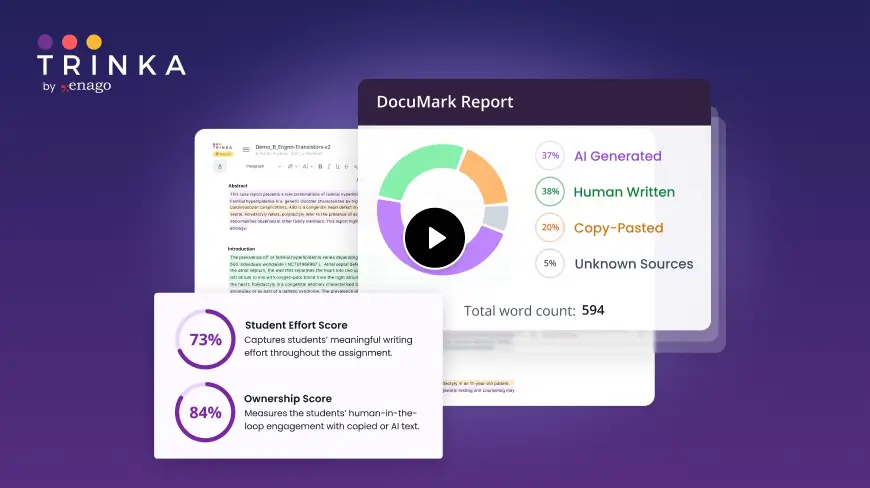
DocuMark: Responsible AI Use for Academic Integrity
Knowing your institution's AI policy is step one. DocuMark helps enforce it fairly by empowering universities to manage AI-generated content, prevent cheating, and support student writing through responsible AI use.
Common Questions About Loyola Marymount University's AI Policies
Loyola Marymount University has defined AI policies in 11 of 12 categories, with an overall coverage score of 92%.
Students must check their course syllabus or ask their professor for the specific policy on citing or acknowledging the use of AI tools. Instructors determine whether any special citation or acknowledgment is required for authorized AI use in their class.
LMU places the burden on the instructor to provide evidence that an academic honesty violation is more probable than not. The university recognizes evidence from Turnitin, lockdown browsers, and Zoom-based proctoring, and the faculty and student FAQ documents describe the allegation, meeting, decision, sanction, filing, and appeal process for suspected violations.
LMU identifies Microsoft Copilot with Data Protection as an LMU-available AI platform for faculty, students, and staff and states that it protects user and university data, does not save chat data, and does not make chat data available to Microsoft or other large language models for training. LMU also warns that other web AI tools may expose private data and states that users should never place personally identifying information in any AI tool. For Zoom AI Companion, LMU states that Zoom does not use meeting content to train Zoom’s or third-party AI models, and the feature is off by default and must be enabled by the host.