Teaching & Learning
- Using AI in a way that breaches the brief or presenting AI output as their own work is treated as academic misconduct
- Work submitted must still be their own and they remain responsible for checking accuracy, bias, and proper acknowledgment
- Students may use generative AI in coursework only when their assessment brief allows it, and they must follow any task-specific limits
Generative AI can be used in assessments where your tutor has made this clear to you in your assessment brief.
Your tutor will explain what use of generative AI is and isn't acceptable in your assessment. They may state that AI is: allowed in all tasks, not allowed in any tasks, allowed in specific tasks or only allowed to a certain level.
As a student, you need to understand and follow the rules your tutor has set in the assessment brief for use of generative AI. If you don't follow the rules, your use of generative AI may be considered academic misconduct.
All submitted work should be your own. This means that your work should not be generated by AI and handed in as if it is your own original piece of work.
If you choose to use AI tools to support your work, the final submission must still be your own work.
Using AI-generated content in your assignment without checking that it is factually correct or acknowledging where it came from is poor academic practice, and may be considered academic misconduct.
- Students must comply with those rules, and misuse can be treated as academic misconduct
- The university-wide assessment regulations also prohibit cheating, personation, and unauthorised aids in examinations
- Use of generative AI in assessments is determined by the assessment brief, which may allow, forbid, or limit it for particular tasks
Generative AI can be used in assessments where your tutor has made this clear to you in your assessment brief.
Your tutor will explain what use of generative AI is and isn't acceptable in your assessment. They may state that AI is: allowed in all tasks, not allowed in any tasks, allowed in specific tasks or only allowed to a certain level.
As a student, you need to understand and follow the rules your tutor has set in the assessment brief for use of generative AI. If you don't follow the rules, your use of generative AI may be considered academic misconduct.
The following are examples of the use of unfair means: ... using prohibited items or material in an examination or introducing any such item or material into an examination venue; ... obtaining or seeking to obtain unauthorised access to unseen examination questions and using or attempting to use such questions in any examination; ... acting dishonestly in relation to any assessment, examination or research activity that may confer an advantage to which the student would not otherwise have been entitled.
- Students are expected to use this support critically because AI can be inaccurate or biased
- The guidance distinguishes supportive study use from submitting AI-generated work as their own
- The university permits students to use AI tools to support study and learning, including understanding concepts, identifying key words, summarising text, and language support
There are a number of ways in which generative AI tools can be useful in your studies, such as helping you to:
understand difficult concepts
identify key words or topics from your notes
generate summaries from long articles or chapters
overcome barriers to learning such as language or disability support
Generative AI can make mistakes. It can provide inaccurate information, be misleading and create content that is discriminatory or biased.
As a student, it's important to be aware of these limitations and use AI tools carefully and critically.
Your use of generative AI should be to support your own work, not replace it.
Research
- For publications, researchers are expected to acknowledge AI support where used
- AI cannot be credited as an author, and researchers remain accountable for the accuracy and originality of the work
- The university requires disclosure of generative AI use in theses and dissertations, including naming the tool, explaining how it was used, and confirming responsibility for the final text
If you use generative AI in a thesis or dissertation, then the use of AI should be acknowledged in your work, and details on the support received from AI should be clearly outlined in the relevant methods section and any supplementary information. This should include, but not necessarily be limited to, the name and version of the model or tools, a description of the information and queries asked of the AI, and how the AI-generated output was used in the final version of the thesis or dissertation. It should also be made clear that the final wording and arguments are the author's own and are the result of carrying out independent checks for originality, accuracy, and integrity.
If AI has been used to support the drafting or editing of a publication, this should be properly acknowledged according to the publication process in the relevant field and as per the journal guidelines. This may include any support in drafting the publication, language translation or editing for style and readability.
No aspect of AI may be credited as an author.
Researchers are ultimately responsible and accountable for the content of the work.
- The university allows AI use in research data and analysis only with safeguards
- Researchers must not enter data into external AI systems if that would breach confidentiality, privacy, consent, or data-sharing terms
- They are also responsible for checking outputs for validity, bias, and legal or ethical compliance before using them in analysis or dissemination
Researchers should not use AI tools in any way which could compromise confidentiality, privacy or copyright obligations, and should not put data and information into AI tools if this would compromise any duty of confidentiality, any individual privacy, any data sharing agreements, any research agreements or contracts, or if this would breach any terms or conditions associated with consent from research participants.
Any use of AI tools should be disclosed and explained as appropriate to the research context and discipline.
Outputs from AI tools should be checked and verified before using them in analysis, dissemination or as the basis for decision making. It is the responsibility of the researcher to ensure the accuracy and appropriateness of outputs and to identify any errors or bias.
Researchers should be mindful of legal and ethical obligations when using AI tools, including but not limited to data protection legislation, copyright law, and obligations under contracts and funding conditions.
- The research integrity framework also ties all research to honesty, rigour, transparency, and accountability
- The university requires researchers to use AI consistently with research integrity, ethics, legal obligations, and participant consent
- Any AI use should be disclosed as appropriate to the discipline and context, and researchers remain accountable for outputs and decisions based on them
Any use of AI tools should be disclosed and explained as appropriate to the research context and discipline.
Outputs from AI tools should be checked and verified before using them in analysis, dissemination or as the basis for decision making. It is the responsibility of the researcher to ensure the accuracy and appropriateness of outputs and to identify any errors or bias.
Researchers should be mindful of legal and ethical obligations when using AI tools, including but not limited to data protection legislation, copyright law, and obligations under contracts and funding conditions.
Researchers should not use AI tools in any way which could compromise confidentiality, privacy or copyright obligations, and should not put data and information into AI tools if this would compromise any duty of confidentiality, any individual privacy, any data sharing agreements, any research agreements or contracts, or if this would breach any terms or conditions associated with consent from research participants.
The University seeks to foster an environment and culture where good conduct in research is promoted and embedded, where all forms of research misconduct are prevented, and where allegations of misconduct are investigated and resolved.
The key principles of honesty, rigour, transparency and open communication, care and respect, and accountability as outlined in the Concordat are reflected in the University values and in the way in which the University carries out all activities linked to research.
Academic Integrity
- In research contexts, AI use should also be disclosed and explained appropriately
- The university provides a specific format for citing AI and requires details such as the tool name, date, version, prompt, and output
- Students are required to acknowledge and reference generative AI when they use it in assessed work, following tutor instructions and the university's referencing format
If you choose to use AI tools to support your work, the final submission must still be your own work. You should also acknowledge your use of AI in line with the instructions in your assessment brief.
You should cite and reference all generative AI content used in your work.
If your tutor has told you that you can use generative AI in your assessment, then you should acknowledge this in your work by citing and referencing all content generated using AI.
Reference format for generative AI content
Name of AI tool (Year) Version [Generative AI]. Prompt. Date the output was generated.
For example:
OpenAI (2023) GPT-4 [Generative AI]. Explain what reference and citation mean in academic writing. 24 October.
Any use of AI tools should be disclosed and explained as appropriate to the research context and discipline.
- Undisclosed or unauthorised AI use may be treated as academic misconduct under the university's misconduct procedures
- The provided sources do not set out a specific institutional position on named AI detection systems, but they do define penalties and enforcement routes for unfair means
- The misconduct policy expressly includes use of paraphrasing and content-generation tools to avoid detection or produce work, and it allows concerns to be investigated through academic misconduct processes
If you don't follow the rules, your use of generative AI may be considered academic misconduct.
Using AI-generated content in your assignment without checking that it is factually correct or acknowledging where it came from is poor academic practice, and may be considered academic misconduct.
The following are examples of the use of unfair means: ... using prohibited items or material in an examination or introducing any such item or material into an examination venue; ... acting dishonestly in relation to any assessment, examination or research activity that may confer an advantage to which the student would not otherwise have been entitled.
Use of software such as paraphrasing tools, machine translators, essay mills or other technology, either to avoid detection of unfair practice or to produce work for an assessment, where this is either expressly forbidden or has not been explicitly allowed.
The University may investigate concerns that a student has committed academic misconduct in relation to assessments and / or examinations. Any student found to have committed academic misconduct, as defined by this policy, may be subject to one or more penalties under this policy.
Institutional & Administrative
- No specific rule in the provided sources addresses grading, recommendation letters, or feedback in detail
- The guidance warns staff not to rely on AI to make decisions and not to upload personal, confidential, or commercially sensitive information into public tools
- Staff are told they may use generative AI to support teaching and administrative work, but they must remain responsible for reviewing outputs and protecting data
Generative AI can support staff in a range of activities, including teaching preparation, administrative tasks, communications and content creation.
You remain responsible for any content you create or share using AI tools, and should review outputs carefully for accuracy, bias, and appropriateness.
Do not use generative AI tools to make decisions on behalf of the University.
Do not input confidential, personal or commercially sensitive information into publicly available AI tools.
You must ensure that any use of University information complies with data protection, information security and confidentiality requirements.
- The provided sources do not identify a university-approved AI platform list
- Research guidance adds that data must not be entered into AI systems where this would breach consent, privacy, contracts, or data-sharing obligations
- The university prohibits entry of confidential, personal, or commercially sensitive information into publicly available AI tools, and requires compliance with data protection, confidentiality, and information security rules
Do not input confidential, personal or commercially sensitive information into publicly available AI tools.
You must ensure that any use of University information complies with data protection, information security and confidentiality requirements.
Personal data shall be:
(a) processed lawfully, fairly and in a transparent manner in relation to data subjects;
...
(f) processed in a manner that ensures appropriate security of the personal data.
Researchers should not use AI tools in any way which could compromise confidentiality, privacy or copyright obligations, and should not put data and information into AI tools if this would compromise any duty of confidentiality, any individual privacy, any data sharing agreements, any research agreements or contracts, or if this would breach any terms or conditions associated with consent from research participants.
- However, the provided sources do not describe a formal university AI strategy, committee, or roadmap for AI adoption
- The university has published institution-level guidance and principles for AI use in study, staff work, and research, emphasizing responsible use, disclosure, accountability, and legal compliance
Manchester Met has developed guidance on the use of generative AI in assessments.
Generative AI can support staff in a range of activities, including teaching preparation, administrative tasks, communications and content creation.
Any use of AI tools should be disclosed and explained as appropriate to the research context and discipline.
Researchers are ultimately responsible and accountable for the content of the work.
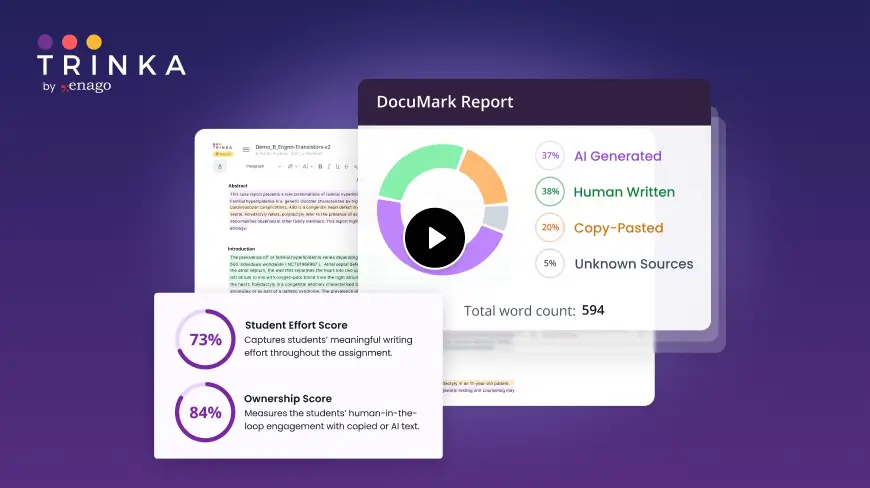
DocuMark: Responsible AI Use for Academic Integrity
Knowing your institution's AI policy is step one. DocuMark helps enforce it fairly by empowering universities to manage AI-generated content, prevent cheating, and support student writing through responsible AI use.
Common Questions About Manchester Metropolitan University's AI Policies
Manchester Metropolitan University has defined AI policies in 11 of 12 categories, with an overall coverage score of 92%.
Students are required to acknowledge and reference generative AI when they use it in assessed work, following tutor instructions and the university's referencing format. The university provides a specific format for citing AI and requires details such as the tool name, date, version, prompt, and output. In research contexts, AI use should also be disclosed and explained appropriately.
Undisclosed or unauthorised AI use may be treated as academic misconduct under the university's misconduct procedures. The misconduct policy expressly includes use of paraphrasing and content-generation tools to avoid detection or produce work, and it allows concerns to be investigated through academic misconduct processes. The provided sources do not set out a specific institutional position on named AI detection systems, but they do define penalties and enforcement routes for unfair means.
The university prohibits entry of confidential, personal, or commercially sensitive information into publicly available AI tools, and requires compliance with data protection, confidentiality, and information security rules. Research guidance adds that data must not be entered into AI systems where this would breach consent, privacy, contracts, or data-sharing obligations. The provided sources do not identify a university-approved AI platform list.