Teaching & Learning
- Marquette Law separately states that AI is prohibited in preparing assignments unless the course instructor authorizes it
- The default university position is that students using generative software without permission, acknowledgement/citation, and faculty approval are in violation of the Honor Code
- Marquette does not set one uniform university-wide classroom rule; coursework rules are generally left to instructors, colleges, or departments, and students are expected to follow the specific course policy
Marquette does not have a unified AI policy in favor of instructional flexibility (please be aware your college or department may have its own guidelines).
If educators do not provide any guidance for students regarding potential uses of these technologies, then the default of the university is that students using generative software without permission, without proper acknowledgement and citation, and without faculty approval are in violation of the Honor Code.
Students deserve clear articulations of local expectations (what instructors encourage, prohibit, and find acceptable) and, perhaps most importantly, why these specific expectations exist in this specific local context (of this assignment or course or program).
Academic Regulation 901(2) defines “cheating” to include “[u]sing artificial intelligence writing programs, chatbots, or similar AI-driven technologies not authorized by the course instructor in taking an examination, test, or quiz, or in preparing any assignment for any class in the Law School or University,”
- At Marquette Law, using AI in an examination, test, or quiz is prohibited unless authorized by the course instructor
- More broadly, Marquette encourages instructors to set assessment-specific rules and provides model categories ranging from no AI use to limited or broader allowed use depending on the assignment
Academic Regulation 901(2) defines “cheating” to include “[u]sing artificial intelligence writing programs, chatbots, or similar AI-driven technologies not authorized by the course instructor in taking an examination, test, or quiz, or in preparing any assignment for any class in the Law School or University,”
Below are some recommended visual conventions (please feel free to cut and paste into your own documents) to signal to students how and when to appropriately use generative AI in your classes, whether this is an overall disposition or you want to consider differentiating this by assessment.
AI-FREE ASSIGNMENT | No AI use allowed
AI-LIMITED ASSIGNMENT | You can use AI within Guidelines
AI-FRIENDLY ASSIGNMENT | Use Responsibly
- Marquette encourages educators to teach students how to interact with AI and treats this as part of student literacy development
- The university materials also indicate that AI may be allowed for limited learning support such as ideation, organization, and information gathering when the assignment guidelines permit it
Talking with and teaching your students how to interface with technology—whether that’s GenAI or another form of technology–is foundational to a teaching practice that will prepare students for the literacies they will need in their future, whether inside or outside the classroom.
You can use AI within the guidelines provided in the assignment. Examples include:
* Ideation and Research (AI can be used to help generate ideas, organization and information gathering)
Speaking with and teaching students about how to interact with technology—whether generative software or other forms of contemporary digital technology–is foundational to a teaching practice that will help students develop the literacies they will need in their future studies and careers.
- Marquette does not publish a single institution-wide programming rule in the provided sources; instead, the materials direct instructors to set local policies
- The sample syllabus materials include models that permit AI-assisted programming with required crediting, testing, and explanation, while another sample prohibits generating new content with prompt-based AI tools unless the instructor or assignment specifically allows it
Students deserve clear articulations of local expectations (what instructors encourage, prohibit, and find acceptable) and, perhaps most importantly, why these specific expectations exist in this specific local context (of this assignment or course or program).
Statement on the Use of AI-Assisted Programming Tools
Large language models, such as ChatGPT (chat.openai.com) are rapidly changing the tools available to people writing code. Given their use out in the world, the view we will take in this class is that it does not make sense to ban the use of such tools in our problem sets or projects. For now, here is my guidance on how these can and should be used in our class:
First and foremost, note that output from ChatGPT can often be confidently wrong! Run your code and check any output to make sure that this actually works.
If you use ChatGPT or similar resources, credit it at the top of your problem set as you would a programming partner.
Where you use direct language or code from ChatGPT, please cite this as you would information taken from other sources more generally.
Do not generate new content with prompt-based AI tools like ChatGPT or CodePilot without permission from instructors unless specifically allowed by the assignment.
Instructors reserve the right to request an oral explanation of answers.
Research
- Marquette Law separately states that using AI-enabled legal research databases or other AI research tools for research is not included in the cheating rule unless the instructor restricts that use
- Marquette's university-wide AI task force is explicitly reviewing AI use in research, but the provided sources do not define a specific operational policy for using AI in research data collection, analysis, or interpretation
Marquette University has established a university-wide artificial intelligence task force to guide the responsible use of generative AI across campus. The task force brings together faculty and staff from across disciplines to assess how emerging AI tools are being used in teaching, research, operations and student success/wellness.
The AI Task Force is composed of an executive committee and five work groups: teaching and learning, clinical-based teaching and learning, research, operations, and student success/wellness.
The regulation further states that “[u]sing legal research databases or other research tools utilizing artificial intelligence technologies to conduct research does not come within this meaning unless such use is restricted by the course instructor.”
Academic Integrity
- Sample syllabus materials also require citing AI-generated text and code, including details such as the model, date/time, and prompt
- In classroom guidance, Marquette recommends that AI language inserted into assignments be cited and that AI used freely in an assignment should still be cited
- Marquette requires acknowledgement and citation when AI use is permitted; without permission, proper acknowledgement and citation, and faculty approval, the default university position treats student use as an Honor Code violation
If educators do not provide any guidance for students regarding potential uses of these technologies, then the default of the university is that students using generative software without permission, without proper acknowledgement and citation, and without faculty approval are in violation of the Honor Code.
Limited Word Usage (AI language can be inserted but cited within an assignment)
You can use AI in this assignment at will, but it should be cited.
1. Cite any text that the AI generated (even if you edited it) with a bibliography entry that includes the name and version of the AI model that you used, the date and time it was used, and includes the exact query or prompt that you used to get the results.
2. Cite, as described in rule 1, any code that you had it generate for you.
- Marquette cautions faculty that AI detectors are unreliable on their own because they can produce both false positives and false negatives
- When reporting suspected unattributed AI use, instructors are told to provide explicit rationales and specific examples, and Marquette's sample syllabus materials include referral for honor code violation when course AI rules are not followed
If your allegation includes suspicion of unattributed use of generative software, please ensure that your report includes explicit rationales with specific examples of what you suspect to be unattributed material.
Please note: "AI detectors" offer both false positives and false negatives, so their findings as evidence of misconduct are less reliable in the absence of other evidence.
If you fail to follow these rules, that will be an honor code violation and you will be referred to the Honor Council.
Institutional & Administrative
- Marquette's safe-use guidelines apply to faculty and staff as well as students
- The institution also directs faculty to communicate local classroom expectations clearly and early
- Faculty and staff must protect university data, use secure and vetted platforms, follow university policies and tool-provider terms, and verify AI-generated content before dissemination
Guidelines for Safe and Responsible Usage of Generative AI at Marquette University
For Faculty, Staff, and Students
These guidelines apply to all faculty, staff, and students and aim to protect university data, ensure content accuracy and ownership, maintain academic integrity, and provide protocols for procuring and acquiring AI tools.
Faculty, staff, and students must adhere to university policies and procedures when using generative AI tools. This includes using secure platforms to prevent unauthorized disclosure of university data to GenAIs.
Users are responsible for verifying the accuracy of content generated by AI tools. Generative AI can produce plausible yet incorrect information; thus, it is essential to cross-reference AI outputs with reliable sources and ensure factual accuracy before dissemination.
This means that students need and deserve clear articulations of what your expectations are (what you encourage, what you prohibit, and what you find acceptable) and why.
- Marquette requires faculty, staff, and students to protect sensitive university data when using generative AI
- The guidelines also require secure platforms and note that ITS monitors use on university-owned equipment and serves as a resource for reviewing provider terms and restrictions
- Users must not enter PII, ePHI, confidential student records, or proprietary university information into AI systems, and confidential or controlled information must not be uploaded into tools that have not been properly vetted and reviewed
GenAI tools must be used in a manner that protects the sensitivity and confidentiality of university data. Users must ensure that data fed into AI systems does not include personally identifiable information (PII), electronic personal health Information (ePHI), confidential student records, or proprietary university information.
Faculty, staff, and students must adhere to university policies and procedures when using generative AI tools. This includes using secure platforms to prevent unauthorized disclosure of university data to GenAIs. IT Services will use available tools to monitor the usage of GenAI tools on university-owned equipment to ensure that Confidential or Controlled information is not uploaded into GenAIs that have not been properly vetted and reviewed.
Furthermore, when using GenAI tools, any input or activity must strictly adhere to the terms of service and use policies established by the tool providers. Review these terms as they outline the acceptable use of each respective tool and any restrictions. IT Services (ITS) will serve as a resource for you in reviewing these terms.
- Marquette has established a university-wide AI task force to guide responsible AI use across campus and to recommend updates to policies, procedures, and support structures
- The task force covers teaching and learning, clinical-based teaching and learning, research, operations, and student success/wellness, and its work is guided by principles including Jesuit mission and values, ethical and inclusive AI use, and data management and security
Marquette University has established a university-wide artificial intelligence task force to guide the responsible use of generative AI across campus. The task force brings together faculty and staff from across disciplines to assess how emerging AI tools are being used in teaching, research, operations and student success/wellness.
Charged with identifying where existing policies, procedures and support structures should be updated or adapted, the task force will focus on ensuring that AI adoption at Marquette is responsible, effective and aligned with the university’s Catholic, Jesuit mission. Its work will help clarify shared expectations, identify needed resources and recommend next steps as AI technologies continue to evolve.
The AI Task Force is composed of an executive committee and five work groups: teaching and learning, clinical-based teaching and learning, research, operations, and student success/wellness.
The task force’s work will be guided by four foundational principles: Jesuit mission and values; leadership and campus alignment; ethical, inclusive and responsible AI use; and data management and security.
DocuMark: Responsible AI Use for Academic Integrity
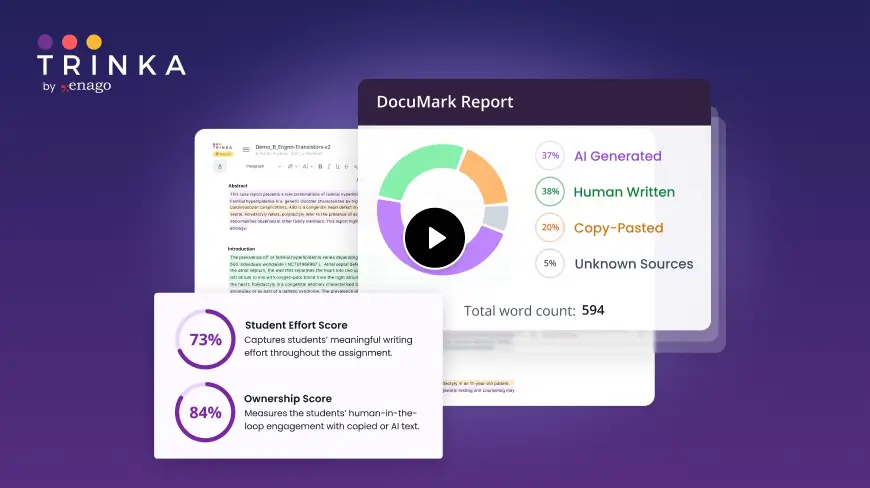
Knowing your institution's AI policy is step one. DocuMark helps enforce it fairly by empowering universities to manage AI-generated content, prevent cheating, and support student writing through responsible AI use.
Common Questions About Marquette University's AI Policies
Marquette University has defined AI policies in 10 of 12 categories, with an overall coverage score of 83%.
Marquette requires acknowledgement and citation when AI use is permitted; without permission, proper acknowledgement and citation, and faculty approval, the default university position treats student use as an Honor Code violation. In classroom guidance, Marquette recommends that AI language inserted into assignments be cited and that AI used freely in an assignment should still be cited. Sample syllabus materials also require citing AI-generated text and code, including details such as the model, date/time, and prompt.
Marquette cautions faculty that AI detectors are unreliable on their own because they can produce both false positives and false negatives. When reporting suspected unattributed AI use, instructors are told to provide explicit rationales and specific examples, and Marquette's sample syllabus materials include referral for honor code violation when course AI rules are not followed.
Marquette requires faculty, staff, and students to protect sensitive university data when using generative AI. Users must not enter PII, ePHI, confidential student records, or proprietary university information into AI systems, and confidential or controlled information must not be uploaded into tools that have not been properly vetted and reviewed. The guidelines also require secure platforms and note that ITS monitors use on university-owned equipment and serves as a resource for reviewing provider terms and restrictions.