Teaching & Learning
- Use of generative AI for classwork is at instructor discretion
- Unauthorized AI use may be treated as an Honor Code violation, and students remain responsible for the accuracy and integrity of submitted work
- Students may use AI only when a faculty member allows it under course-specific limits; if no policy is given, students are told to assume AI use is forbidden unless permission is granted
Some of your faculty may invite you to use generative AI tools in your classes (often with restrictions or limits) and some faculty may restrict their use entirely.
Your faculty should include a syllabus statement indicating what is allowed and what is not allowed. As with other unauthorized aid, failure to comply with class policies prohibiting generative AI use could be construed as an Honor Code violation, which could result in disciplinary action. If a professor has not specified their policy on generative AI use, you should assume that it is forbidden unless the professor grants you permission verbally or in writing.
You are responsible for the accuracy and integrity of any work you submit, including any work that was created with support of an AI tool.
Some of your faculty may invite you to use generative AI tools in your classes (often with restrictions or limits) and some faculty may restrict their use entirely. Most of your faculty will have included a syllabus statement indicating what is allowed and what is not allowed. As with other unauthorized aid, failure to comply with class policies on generative AI use could be construed as an Honor Code violation, which could result in disciplinary action.
If a professor has not specified their policy on generative AI use, you should assume that it is forbidden unless the professor grants you permission verbally or in writing. You are responsible for the accuracy and integrity of any work you submit, including any work that was created with the support of an AI tool.
- Middlebury does not publish a standalone AI-specific examination policy
- Exam integrity is governed by the general Honor Code, which requires students to write, sign, and adhere to the pledge on all examinations
- Because unauthorized AI use would constitute unauthorized aid, any AI use on exams not explicitly permitted by the instructor would be an Honor Code violation subject to disciplinary action
Honor Code Pledge: The Honor Code pledge reads as follows: "I have neither given nor received unauthorized aid on this assignment." It is the responsibility of the student to write out in full, adhere to, and sign the Honor Code pledge on all examinations, research papers, and laboratory reports. Faculty members reserve the right to require the signed Honor Code pledge on other kinds of academic work.
As with other unauthorized aid, failure to comply with class policies prohibiting generative AI use could be construed as an Honor Code violation, which could result in disciplinary action. If a professor has not specified their policy on generative AI use, you should assume that it is forbidden unless the professor grants you permission verbally or in writing.
- Middlebury encourages students to learn about and engage critically with generative AI, and students have access to several AI tools through their credentials
- However, the sources do not create a separate university-wide rule specifically permitting AI for private studying; classroom use still depends on faculty policy
As a student at Middlebury, you have access to several generative AI tools with your Middlebury credentials.
Middlebury is committed to helping our students engage critically with generative AI tools and to learn about their potential benefits and harms. We encourage you to participate in events and other learning opportunities that will deepen your understanding of generative AI tools.
In addition to learning about generative AI and AI in some of your courses, you may participate in related workshops and student-sponsored events. Training modules on generative AI are also available on LinkedIn Learning (log in with your Middlebury credentials for access). If you are looking for guidance from fellow students, DLINQ’s Interns are available to support you as you explore the potential and appropriate use of generative AI technologies.
- Middlebury does not publish a standalone policy specific to AI-assisted code generation
- Students should consult individual course syllabi for programming-specific AI permissions
- General AI guidance applies: faculty set course-specific rules for all AI use including programming tasks, and unauthorized AI assistance in coding assignments defaults to an Honor Code violation
Some of your faculty may invite you to use generative AI tools in your classes (often with restrictions or limits) and some faculty may restrict their use entirely. If a professor has not specified their policy on generative AI use, you should assume that it is forbidden unless the professor grants you permission verbally or in writing. You are responsible for the accuracy and integrity of any work you submit, including any work that was created with support of an AI tool.
Research
- Middlebury does not publish a dedicated AI policy for research writing and manuscript preparation
- Faculty and students are encouraged to consult library resources for responsible AI use in research contexts
- However, the institution's research librarians have published reflections and resources on information literacy and AI relevant to research writing, and the general AI guidance warns against inputting sensitive or personal data into AI tools, which would apply to unpublished manuscript content
Yes. There are concerns about the data that forms the foundation of the AI model and there are concerns about the privacy of your interactions with the model as well as any information you share. Some of these concerns may be addressed in the terms of service. We strongly discourage you from putting any personal information in generative AI models.
Proprietary research data and manuscripts, before public release.
Storage: Must be stored on secure, Middlebury-approved systems with appropriate access controls (e.g., password protection, multi-factor authentication). Cloud storage must be approved and configured for security.
Sharing: Sharing is restricted to authorized internal parties. External sharing requires explicit approval and appropriate data sharing agreements.
- The provided sources do not give AI-specific rules for research data analysis, but they do impose data-handling requirements that would apply when using tools in research contexts
- Public data may be stored on publicly accessible platforms, while sensitive and regulated research data must stay on secure, Middlebury-approved systems with restricted sharing and, for regulated data, documented stewardship and registration with Information Security
Public data is information that is intended for public consumption or is readily available to the general public. Its unauthorized disclosure would have little or no adverse impact on Middlebury, its operations, or individuals.
* Publicly available research data (after appropriate review and release)
* Storage: Can be stored on any Middlebury-approved system or publicly accessible platforms.
Sensitive data is information that is not intended for public release, and whose unauthorized disclosure, alteration, or destruction could have a moderate adverse impact on Middlebury, its operations, or individuals. This data typically requires protection to ensure confidentiality, integrity, and availability.
* Proprietary research data and manuscripts, before public release.
* Storage: Must be stored on secure, Middlebury-approved systems with appropriate access controls (e.g., password protection, multi-factor authentication). Cloud storage must be approved and configured for security.
* Sharing: Sharing is restricted to authorized internal parties. External sharing requires explicit approval and appropriate data sharing agreements.
Regulated data is information subject to specific legal, regulatory, or contractual obligations, whose unauthorized disclosure, alteration, or destruction would result in adverse impact, including significant financial penalties, legal liabilities, reputational damage, and harm to individuals. This data requires the highest level of protection.
Please reach out to Middlebury Information Security with any questions related to regulated data. Any use or storage of regulated data must be documented by the data steward. It must include a plan for data lifecycle and retention and must be registered with the Middlebury Information Security Team.
- The provided sources do not state AI-specific rules for grant proposals, IRB applications, or research ethics declarations
- They do state that research involving human subjects requires IRB review when the listed criteria are met, and classroom-based human-subjects activities may or may not need IRB approval depending on the circumstances
If your answer to all of the following questions is “yes,” then you must apply for IRB approval of your research.
Is IRB approval needed for classroom-based research activities?
It depends. Many courses involve student activities that would be considered human subjects research if they were occurring outside of the classroom context. The IRB has developed guidance to help you determine if you class-based research activities require IRB approval: Guidance for Classroom Research Activities.
Academic Integrity
- Citation of AI-supported work is required according to the citation style being used and any instructor instructions
- If an instructor has not explained how to cite AI-supported work, students are told to ask the instructor for their preferred citation method
How and when you cite AI will depend on the citation style you are following and any additional instructions given by your instructor. The APA has specific guidelines for citing AI as does the MLA. If your instructor has not provided guidance about how to cite AI-supported work, ask them how they would prefer for that work to be cited.
- The provided sources do not define a university position on AI detection tools
- Unauthorized or undisclosed AI use is enforced through existing Honor Code and academic integrity processes
- Failure to comply with course AI policies may be construed as an Honor Code violation resulting in disciplinary action
As with other unauthorized aid, failure to comply with class policies prohibiting generative AI use could be construed as an Honor Code violation, which could result in disciplinary action.
The policy expressly forbids the following acts:
* Plagiarism
* Cheating
* Duplicate Use of Work
* Falsifying Data
Therefore, in addition to adhering to the Academic Honesty Policy themselves, the student-written Constitution of the Undergraduate Honor Code states that “Any member of the College community (student, faculty, or administrator) who is aware of a case of academic dishonesty is morally obligated to report it to the professor or the Dean of Students."
Institutional & Administrative
- Faculty have considerable autonomy over whether and how to integrate generative AI into their courses and work, and the institution says faculty should retain the primary role in evaluating student learning
- Staff may use generative AI tools in daily work, but they must follow responsible use and information security policies, avoid entering sensitive information, and maintain human oversight rather than letting AI act autonomously
AI should augment, not replace, the vital human relationships between teachers and learners. Faculty should maintain a primary role in both formative and summative evaluation of students’ learning progress, behaviors, and outcomes.
We provide support and resources for faculty to incorporate generative AI (and other technologies) into their courses. Faculty can also exercise considerable autonomy about whether and how to integrate generative AI into their courses and their work if they choose not to for pedagogical reasons.
As a Middlebury staff member, you may encounter generative AI tools like Microsoft Copilot, Google Gemini, Adobe Firefly, or Zoom AI Companion in your daily work. These tools, when used correctly, can help generate ideas, automatically take notes in meetings, and increase productivity. However, it’s essential to use them responsibly and within Middlebury’s policies.
Staff using AI tools are expected to adhere to Middlebury’s Responsible Use and Information Security policies. Be mindful of how AI can impact data privacy, security, and ethical standards. Some important practices to keep in mind:
* Avoid sharing sensitive information: Never input personal or confidential data (e.g., passwords, account credentials) into any AI tool.
* Stay engaged: Don’t rely on AI to operate autonomously—human oversight is always needed to guide and review output.
- Staff must never input personal or confidential data into any AI tool
- Middlebury's ITS team reviews AI tools and maintains a list of approved tools available to students, faculty, and staff
- Faculty may use non-ITS-sanctioned AI tools but must understand the associated risks to data privacy, security, and institutional compliance
ITS is responsible for reviewing AI tools and providing information to users about what tools are available and how to get support for them. Visit ITS’ webpage on AI/generative AI for a current list of AI tools and additional information on the review processes for AI at Middlebury.
Faculty can use AI tools outside those made available by ITS. In doing so, you need to make sure that you understand the tool and any consequences of using it. Using non-sanctioned tools may involve risks to data privacy, security, and compliance with institutional policies.
* Avoid sharing sensitive information: Never input personal or confidential data (e.g., passwords, account credentials) into any AI tool.
* Storage: Must be stored on secure, Middlebury-approved systems with appropriate access controls (e.g., password protection, multi-factor authentication). Cloud storage must be approved and configured for security.
* Sharing: Sharing is restricted to authorized internal parties.
Please reach out to Middlebury Information Security with any questions related to regulated data. Any use or storage of regulated data must be documented by the data steward. It must include a plan for data lifecycle and retention and must be registered with the Middlebury Information Security Team.
- Middlebury has an institution-level AI framework built around guiding principles for teaching, faculty empowerment, student engagement, equitable access, protection of privacy and accountability, and experimentation
- The university states it will establish policies, guidelines, and practices for AI, regularly update what technologies are part of the Middlebury experience, and ensure AI supports rather than replaces human decision-making
While these shifts and their consequences are uncertain, we believe that liberal arts and sciences are key to mitigating negative outcomes and enabling positive outcomes. This moment presents an opportunity to reimagine the future of liberal arts and sciences and to create a distinctively Middlebury approach to comprehending, harnessing, and humanizing these technologies.
Faculty empowerment is essential to AI’s effective and ethical use in a liberal arts and sciences environment.
Middlebury will regularly consider and update what technologies are part of the “full Middlebury experience” and thus are made available to students, faculty, and staff through centralized facilities or individualized grants. Access includes availability of technologies and instruction in foundational skills and knowledge about those technologies, preparing learners to use AI proficiently, safely, and ethically.
We will establish effective policies, guidelines, and practices that center the accuracy, fairness and equality, accountability, and transparency of software programs and algorithms.
AI systems should never compromise the privacy of students’ personal and educational data. Automated decision making systems should only support human decision making, not replace it. Decisions made by AI systems should be transparent and able to be evaluated.
Learning involves exploration and risk-taking. Sometimes we will misstep or fail, and the fear of such mistakes should not impede forward movement. We will aim to learn from our steps and missteps by tracking and measuring outcomes, and to share all outcomes with openness and transparency.
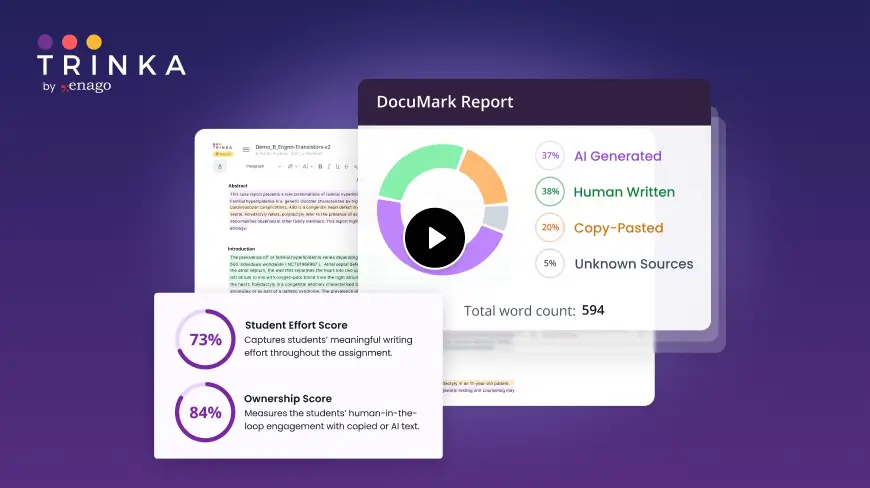
DocuMark: Responsible AI Use for Academic Integrity
Knowing your institution's AI policy is step one. DocuMark helps enforce it fairly by empowering universities to manage AI-generated content, prevent cheating, and support student writing through responsible AI use.
Common Questions About Middlebury College's AI Policies
Middlebury College has defined AI policies in 12 of 12 categories, with an overall coverage score of 100%.
Citation of AI-supported work is required according to the citation style being used and any instructor instructions. If an instructor has not explained how to cite AI-supported work, students are told to ask the instructor for their preferred citation method.
Unauthorized or undisclosed AI use is enforced through existing Honor Code and academic integrity processes. Failure to comply with course AI policies may be construed as an Honor Code violation resulting in disciplinary action. The Academic Honesty Policy expressly forbids plagiarism, cheating, duplicate use of work, and falsifying data, and any member of the College community who is aware of academic dishonesty is morally obligated to report it. The provided sources do not define a university position on AI detection tools.
Middlebury's ITS team reviews AI tools and maintains a list of approved tools available to students, faculty, and staff. Faculty may use non-ITS-sanctioned AI tools but must understand the associated risks to data privacy, security, and institutional compliance. Staff must never input personal or confidential data into any AI tool. The institution's data classification policy governs what data may be stored or shared: public research data may reside on publicly accessible platforms, sensitive data, including unpublished manuscripts and proprietary research, must be on secure Middlebury-approved systems with restricted sharing, and regulated data requires documentation, lifecycle planning, and registration with Information Security.