Teaching & Learning
- Use of generative AI in coursework is permitted only within the limits set by the assessment brief
- Students must follow the assignment instructions and module guidance, and using AI beyond what is explicitly allowed is treated as poor academic practice or academic misconduct depending on the circumstances
Use of GenAI by students should be linked to learning outcomes, as appropriate.
Students need to understand the circumstances in which GenAI use is acceptable in an assignment brief (for summative and formative assessments) and when it is unacceptable.
Assessment instructions should set out and communicate whether the use of GenAI is acceptable, and if so, to what extent.
Academic Misconduct can include but is not limited to the following:
The use of any of the following technologies unless expressly permitted by the University, faculty or module tutor/leader:
• Generative Artificial Intelligence (AI) tools (e.g. ChatGPT, DALL-E, Midjourney)
• Automated Paraphrasing software (e.g. Quillbot)
• Undisclosed editing software (e.g. Grammarly)
• Automated text generation software
• Language translation software (e.g. Google Translate)
• Contract cheating / ghost writing services
The use of any of these technologies may result in Poor Academic Practice or Academic Misconduct according to the assignment instructions and nature of usage. This list is not exhaustive.
If AI use is not allowed by your assessment brief/module tutor, then it should not be used, and such use may be considered a form of cheating.
- AI use in assessments is controlled at the assessment level
- The university requires assessment instructions to state whether AI is allowed and to what extent, and if AI is not permitted by the brief or module tutor, using it in that assessment may be treated as cheating or misconduct
Students need to understand the circumstances in which GenAI use is acceptable in an assignment brief (for summative and formative assessments) and when it is unacceptable.
Assessment instructions should set out and communicate whether the use of GenAI is acceptable, and if so, to what extent.
If AI use is not allowed by your assessment brief/module tutor, then it should not be used, and such use may be considered a form of cheating.
The use of any of the following technologies unless expressly permitted by the University, faculty or module tutor/leader:
• Generative Artificial Intelligence (AI) tools (e.g. ChatGPT, DALL-E, Midjourney)
• Automated Paraphrasing software (e.g. Quillbot)
• Undisclosed editing software (e.g. Grammarly)
• Automated text generation software
• Language translation software (e.g. Google Translate)
• Contract cheating / ghost writing services
- It encourages students to understand AI's benefits and limitations, but still requires adherence to assessment-specific rules
- The university permits AI as a learning support tool when used appropriately for teaching and learning development rather than as a substitute for producing assessed work
GenAI can support student learning in the form of improved accessibility, enhanced creativity, active learning and the development of digital literacy. It can also facilitate the co-development of digital, AI and data literacies, preparing students to critically engage with the use of AI in their future careers.
Students should be made aware of the pedagogical uses of AI in the context of teaching and learning, as well as the specific risks that use of GenAI can pose if not used appropriately.
Use of GenAI by students should be linked to learning outcomes, as appropriate.
The use of technology should not represent a way to avoid learning or a shortcut to bypass quality learning, teaching and assessment processes.
- The university does not set a separate institution-wide rule specifically for AI code generation in programming assignments
- Programming-related AI use falls under the same assessment-specific permission model as other AI use, so students may use it only where the university, faculty, or module tutor/leader expressly permits it
Assessment instructions should set out and communicate whether the use of GenAI is acceptable, and if so, to what extent.
The use of any of the following technologies unless expressly permitted by the University, faculty or module tutor/leader:
• Generative Artificial Intelligence (AI) tools (e.g. ChatGPT, DALL-E, Midjourney)
• Automated Paraphrasing software (e.g. Quillbot)
• Undisclosed editing software (e.g. Grammarly)
• Automated text generation software
• Language translation software (e.g. Google Translate)
• Contract cheating / ghost writing services
Research
- The university requires researchers and research students to use AI in research writing responsibly and with transparency
- Generative AI cannot be listed as an author, and any use of AI in generating written research outputs must be acknowledged and explained in the manuscript or thesis, with human accountability retained by the named authors
Researchers and postgraduate researchers (PGRs) at Middlesex University must ensure that they are aware of, and comply with, the terms and conditions of the organisations providing AI tools, and must act transparently and responsibly in their use of AI in research.
The use of Generative AI and AI-assisted technologies in scientific writing and editing can support the authors to improve language and readability. However, AI and AI-assisted technologies should not be listed as an author or co-author, or be cited as an author.
Authors should disclose in their manuscripts the use of AI and AI-assisted technologies in the writing process by following the relevant author guidelines or including a statement at the end of their manuscript. A statement will appear in the published work. Please note that authors are ultimately responsible and accountable for the contents of the work.
All use of AI in supporting the generation of a thesis, entirely or in part, must be acknowledged and a statement included in the thesis clearly explaining the extent to which AI has been used. The final responsibility for the integrity of the thesis rests with the PGR and, where appropriate, with supervisory teams.
- Researchers may use AI in research data and analysis only with careful human oversight and subject-specific review
- The university warns that AI can fabricate data, references, and other outputs, requires verification of any AI-generated or AI-assisted material, and requires researchers to ensure that use of AI with personal data complies with data protection law and university requirements
AI tools may be used to support and improve the efficiency and quality of the research process. Researchers should note however that many such tools can produce fabricated and false outputs, 'hallucinations', and can misrepresent existing work through poor quality referencing or by generating misleading responses. It is therefore essential to verify and review all AI generated or AI assisted outputs. Researchers should ensure that all information generated by AI is factually accurate, correctly cited and validated against original, authoritative sources before being used in any context.
There are a range of legal and ethical issues that need to be considered when using AI tools for research, including but not limited to copyright, intellectual property, confidentiality, and data privacy. Researchers should ensure that the use of personal data in training, deploying or using AI tools complies with relevant data protection legislation such as the UK General Data Protection Regulation (UK GDPR) and the Data Protection Act 2018.
Researchers should be mindful of the confidential nature of research data and should not upload any data to AI tools unless they are satisfied that this does not breach any legal, contractual, ethical, or institutional requirements.
If you use AI for data analysis or coding, data or code should be checked carefully for any bias or inaccuracies introduced by the AI.
If you use AI to generate images, data or code, you need to check carefully for any bias or inaccuracies and ensure this is carefully documented in your methods.
- The university requires AI use in research to comply with research integrity, legal, contractual, ethical, and institutional standards
- Researchers are responsible for transparency, must preserve confidentiality and data protection, and remain accountable for the integrity of research outputs even when AI is used
Researchers and postgraduate researchers (PGRs) at Middlesex University must ensure that they are aware of, and comply with, the terms and conditions of the organisations providing AI tools, and must act transparently and responsibly in their use of AI in research.
There are a range of legal and ethical issues that need to be considered when using AI tools for research, including but not limited to copyright, intellectual property, confidentiality, and data privacy. Researchers should ensure that the use of personal data in training, deploying or using AI tools complies with relevant data protection legislation such as the UK General Data Protection Regulation (UK GDPR) and the Data Protection Act 2018.
Researchers should be mindful of the confidential nature of research data and should not upload any data to AI tools unless they are satisfied that this does not breach any legal, contractual, ethical, or institutional requirements.
Please note that authors are ultimately responsible and accountable for the contents of the work.
The final responsibility for the integrity of the thesis rests with the PGR and, where appropriate, with supervisory teams.
Academic Integrity
- For research writing and theses, the university requires explicit acknowledgement of AI use and a statement describing the extent of use
- Disclosure of AI use is required when AI use is permitted in assessments, and the form of disclosure must follow the assessment brief and any faculty or module guidance
Students need to understand the circumstances in which GenAI use is acceptable in an assignment brief (for summative and formative assessments) and when it is unacceptable.
If use of AI is allowed in your work, then you need to acknowledge that use, as directed by the assessment brief, and comply with any faculty or module guidance on acknowledging or referencing the use of AI.
Undisclosed use of technologies as highlighted in paragraph 6.2.2 can be Poor Academic Practice or Academic Misconduct.
Authors should disclose in their manuscripts the use of AI and AI-assisted technologies in the writing process by following the relevant author guidelines or including a statement at the end of their manuscript. A statement will appear in the published work.
All use of AI in supporting the generation of a thesis, entirely or in part, must be acknowledged and a statement included in the thesis clearly explaining the extent to which AI has been used.
- Undisclosed or unauthorised AI use can be handled as poor academic practice or academic misconduct under the university's misconduct procedures
- The policy documents provided do not set out a specific institutional position on AI detection tools, but they do state that AI-related breaches are subject to formal misconduct enforcement
Undisclosed use of technologies as highlighted in paragraph 6.2.2 can be Poor Academic Practice or Academic Misconduct.
The use of any of these technologies may result in Poor Academic Practice or Academic Misconduct according to the assignment instructions and nature of usage. This list is not exhaustive.
If AI use is not allowed by your assessment brief/module tutor, then it should not be used, and such use may be considered a form of cheating.
Institutional & Administrative
- Staff must review AI outputs for accuracy and must not rely on AI alone for substantial feedback or assessment decisions
- The university permits staff to use generative AI to support teaching and related work, but requires responsible use, protection of confidentiality and intellectual property, and human oversight
Middlesex University seeks to support all members of the community in exploring the possibilities GenAI offers to transform our work, studies and lives.
The role of academic staff in supporting students to develop relevant knowledge of and skills in the use of GenAI, as appropriate, is essential.
Academic staff should not upload student work into GenAI tools for the purpose of generating feedback, due to potential legal and ethical risks around intellectual property and confidentiality.
When AI tools are used to support feedback generation, academic staff retain responsibility for reviewing and ensuring the accuracy, fairness, and appropriateness of the final feedback provided to students.
As university practice evolves, GenAI should be used to support processes, where appropriate, and not to fully automate academic judgement or decision-making.
A GenAI review should not be used as the sole means of providing substantial feedback on student work or for making academic assessment decisions.
- The provided sources do not identify a university-wide list of approved AI platforms, but they do impose data protection and confidentiality constraints on use
- The university requires users to protect confidential, personal, and research data when using AI tools and warns against uploading material where this could breach legal, ethical, contractual, or institutional requirements
Appropriate, ethical, and secure use of GenAI is important and staff and students should be aware of data privacy, intellectual property, and bias.
Students should avoid entering personal, confidential, or sensitive information into GenAI tools.
Academic staff should not upload student work into GenAI tools for the purpose of generating feedback, due to potential legal and ethical risks around intellectual property and confidentiality.
Researchers should ensure that the use of personal data in training, deploying or using AI tools complies with relevant data protection legislation such as the UK General Data Protection Regulation (UK GDPR) and the Data Protection Act 2018.
Researchers should be mindful of the confidential nature of research data and should not upload any data to AI tools unless they are satisfied that this does not breach any legal, contractual, ethical, or institutional requirements.
You must not use open AI systems (e.g. ChatGPT) to process data that is:
• defined as special category data under data protection law
• criminal conviction and offence data
• classified as Highly Restricted under the Data Governance Policy
• otherwise confidential or restricted
- The policy says the university will monitor legal, educational, and technical developments and refine its guidance over time rather than fixing a static approach
- Middlesex has an institutional AI policy for learning and teaching that frames AI adoption around enhancement of education, inclusivity, ethics, transparency, and ongoing review
This policy establishes the University position on the use of GenAI in learning and teaching, to ensure its ethical, transparent and effective use.
The policy reflects Middlesex University strategic commitments to inclusive, practice-based, and digitally rich education.
Middlesex University seeks to support all members of the community in exploring the possibilities GenAI offers to transform our work, studies and lives.
The University recognises that developments in AI and GenAI are rapid, and it will continue to monitor legal, educational and technical developments, refining its approach as needed. All members of the University community are encouraged to engage critically and responsibly with GenAI as part of an evolving educational and professional landscape.
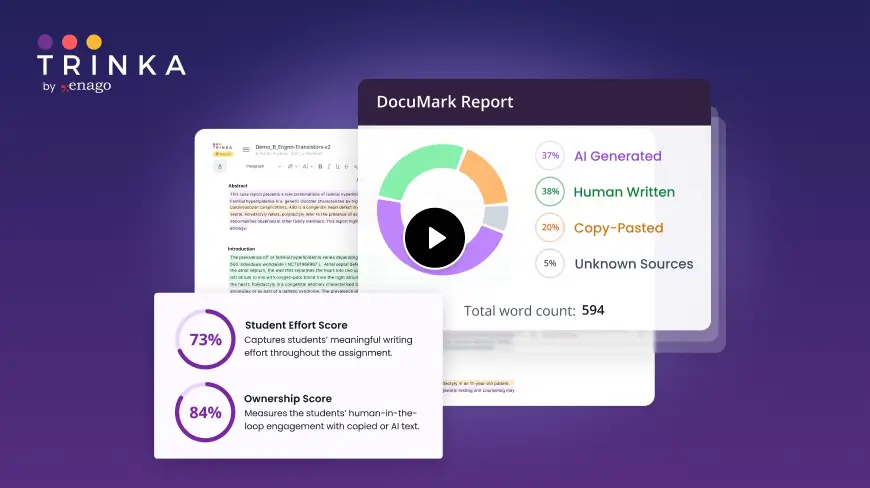
DocuMark: Responsible AI Use for Academic Integrity
Knowing your institution's AI policy is step one. DocuMark helps enforce it fairly by empowering universities to manage AI-generated content, prevent cheating, and support student writing through responsible AI use.
Common Questions About Middlesex University's AI Policies
Middlesex University has defined AI policies in 12 of 12 categories, with an overall coverage score of 100%.
Disclosure of AI use is required when AI use is permitted in assessments, and the form of disclosure must follow the assessment brief and any faculty or module guidance. For research writing and theses, the university requires explicit acknowledgement of AI use and a statement describing the extent of use.
Undisclosed or unauthorised AI use can be handled as poor academic practice or academic misconduct under the university's misconduct procedures. The policy documents provided do not set out a specific institutional position on AI detection tools, but they do state that AI-related breaches are subject to formal misconduct enforcement.
The university requires users to protect confidential, personal, and research data when using AI tools and warns against uploading material where this could breach legal, ethical, contractual, or institutional requirements. The provided sources do not identify a university-wide list of approved AI platforms, but they do impose data protection and confidentiality constraints on use.