Teaching & Learning
- AI use for coursework and submitted assignments is set at instructor discretion within institutional guidelines
- Faculty must place one of the syllabus AI statements in their courses, and students must follow the policy for each course
- AI may be used for brainstorming, outlining, grammar, and similar support, but submissions written by generative AI are prohibited, and violations are treated as academic misconduct
All faculty, teaching in the residential program or Morehouse Online shall list one of the syllabi statements
In this course, all students will submit their work without the use or input of generative artificial intelligence (Gen AI) tools and technologies such as ChatGPT, Dall-e, etc. Please note that each instructor and course at Morehouse College will have different AI policies and standards. It is the student’s responsibility to adhere to the expectations for each course. Violations of the AI statements will be considered academic misconduct, as stated in the College’s core academic policy located here.4
This course encourages the use of Gen AI tools and technologies such as ChatGPT, Dall-E, Claude, etc., to enhance your learning experience and support your academic work. Your use of AI should be responsible, ethical, cited, and align with the student learning objectives of the course. Each student is responsible for assessing the validity, bias, and applicability of Gen AI usage and should acknowledge the use of Gen AI in your submitted assignments. Please note that each instructor and course at Morehouse College will have different AI policies and standards; it is the student’s responsibility to adhere to the expectations for each course. Violations of the AI statements will be considered academic misconduct as stated in the College’s core academic policy located here.
Writing Assistance is supported to brainstorm, generate ideas, organize thoughts, develop a template or outline, or check grammar spelling. Writing submission that are written by Gen AI is prohibited.
- Faculty are encouraged to design assessments that emphasize process, authentic work, and learning evidence to preserve academic integrity
- Morehouse does not impose a single blanket rule on AI use in exams and assessments; course-level faculty policies govern student academic use
- The institutional guidelines permit AI proctoring and AI grading, assessment, and feedback under the "Use with Oversight" category, which requires human review and verification
Morehouse College affirms that decisions regarding the use of AI in teaching and learning reside with faculty, within the parameters of these guidelines and institutional policy.
Faculty are encouraged to make AI expectations explicit through clear syllabus language and assessments that emphasize process, critique, authentic work, and learning evidence.
Use with Oversight
Permits Gen AI tools include AI writing assistance (new material), AI research data analysis, AI detectors, along with AI proctoring, and AI grading, assessment, and feedback.
- AI is permitted for personal learning and study support, but the disclosure requirement varies by use case
- AI tutoring chatbots, summarization, translation, and notetaking are allowed under open use in the teaching-use table, while study assistance to create study notes and research/information-gathering support must be disclosed and properly cited in the student-use examples
Open Use (No Disclosure Required)
Permits Gen AI tools include AI notetaking, AI summarization, AI translation, AI chatbot for FAQs, AI graphic design, AI search engine, AI writing assistance (brainstorming, idea creation, or editing), AI tutoring chatbot, syllabus design, enhancement of teaching materials, classroom interactions, video and audio additions as supplemental resources, AI simulations are supported under Open Usage.
AI Notetaking is supported under open use to transcribe or summarize class lectures and meetings.
Study Assistance as a tutor partner to create study notes to test your understanding of course content should be disclosed and properly cited.
Research and Information Gathering to explain and break down complex concepts for better understanding or generative collective summaries. Gen AI output should be credible and relevant and referenced to original sources to verify facts and deeper understanding.
- Students should consult their instructor's course policy
- No explicit standalone policy for AI use in code generation or programming assignments has been identified in the available Morehouse AI policy documents
- However, general academic AI guidelines apply: AI use in coursework is governed by instructor syllabus statements, and any AI-assisted coding would fall under the same disclosure, citation, and academic integrity requirements as other AI-assisted work
All faculty, teaching in the residential program or Morehouse Online shall list one of the syllabi statements. Please note that each instructor and course at Morehouse College will have different AI policies and standards. It is the student's responsibility to adhere to the expectations for each course. Violations of the AI statements will be considered academic misconduct, as stated in the College's core academic policy.
No discipline-specific or code-generation-specific guidance was identified in the reviewed policy documents.
Research
- Research use of AI must comply with discipline-specific publication and presentation standards
- The academic guidelines do not provide a detailed standalone rule for manuscript drafting, but they require responsible use, citation where applicable, and adherence to external disciplinary requirements
Research and Student Training
Gen AI use in research must comply with discipline specific publications and presentations.
Students, faculty, and staff must voluntarily disclose the use of AI tools in academic work, research, or official communications when appropriate.
Students should follow their instructor’s directive for acknowledging or citing AI use. If uncertain, students should consult with the instructor before submitting the assignments.
APA, MLA, and Chicago styles provide guidelines for citing Gen AI work that should be used (Table 1).
- AI may be used for research data analysis, but it requires oversight, verification, disclosure, and citation
- Institutional data protections also apply: sensitive, confidential, institutional, confidential, and restricted data cannot be entered into public or unapproved AI tools, and only authorized classifications may be used with AI systems
Use with Oversight
Permits Gen AI tools include AI writing assistance (new material), AI research data analysis, AI detectors, along with AI proctoring, and AI grading, assessment, and feedback.
Data Analysis and Visualizations to interpret and summarize data sets are permitted. Verification and explanation of the data and visualizations should be disclosed and cited.
Sensitive, confidential, or institutional data must not be entered into public or unapproved AI tools.
AI systems may only be used with data classified as Public or Internal under Morehouse’s Data Classification Policy, unless explicit authorization is obtained from the Data Owner and CIO. Confidential and Restricted data must not be used with public or unapproved AI systems.
- No specific rules for grant proposals or IRB applications are defined in the available sources
- Morehouse requires transparency and disclosure for AI use in research and prohibits deploying AI-generated content as human-authored work without disclosure
- Users are accountable for all AI-produced outputs they submit or act on, and must review and verify AI outputs before use, as AI tools can generate factually wrong statements, fabricate citations, and reflect training data biases
Students, faculty, and staff must voluntarily disclose the use of AI tools in academic work, research, or official communications when appropriate.
Prohibited conduct includes deploying AI-generated content as human-authored work without disclosure.
You are responsible for every output you submit or act on, regardless of whether AI produced it. AI tools make errors. They can generate confident-sounding statements that are factually wrong, fabricate citations, misrepresent data, and reflect historical biases in their training data. Reviewing and verifying AI output before using it is not optional; it is part of the work.
Academic Integrity
- The guidelines direct users to standard citation styles such as APA, MLA, and Chicago, and several permitted academic uses specifically require disclosure and proper citation
- Disclosure and attribution of AI use are required when appropriate, and students must follow their instructor’s directions for acknowledging or citing AI use in submitted work
Students, faculty, and staff must voluntarily disclose the use of AI tools in academic work, research, or official communications when appropriate. The deployment of AI systems should be transparent, with clear communication about their purpose, functioning, and impact.
Students should follow their instructor’s directive for acknowledging or citing AI use. If uncertain, students should consult with the instructor before submitting the assignments.
APA, MLA, and Chicago styles provide guidelines for citing Gen AI work that should be used (Table 1).
Each student is responsible for assessing the validity, bias, and applicability of Gen AI usage and should acknowledge the use of Gen AI in your submitted assignments.
Study Assistance as a tutor partner to create study notes to test your understanding of course content should be disclosed and properly cited.
- Undisclosed or prohibited AI use is treated as academic misconduct under Morehouse's AI policy
- AI plagiarism detection tools are acceptable but may not be used to unfairly penalize students
- Violations trigger a tiered enforcement process: a written warning is issued for a first plagiarism or unethical concern, and a second offense is submitted to the Academic Integrity and Tracking of Responsible AI and Misconduct Survey (AI TRACK) database monitored by the Vice Provost for Academic Innovation and Learning, with communication to Student Conduct
The use of Gen AI to detect plagiarism is acceptable but may not unfairly penalize students.
Violations of the AI statements will be considered academic misconduct, as stated in the College's core academic policy located here.
If there are any plagiarism or unethical concerns, students and faculty will receive a written warning first (from instructor or supervisor). Upon a second offense, a case should be submitted to the Academic Integrity and Tracking of Responsible AI and Misconduct Survey (AI TRACK) database monitored by the Vice Provost for Academic Innovation and Learning. Second offenses will be communicated to Student Conduct.
Institutional & Administrative
- Academic grading, assessment, and instruction are governed separately by the Academic AI Guidelines rather than the Staff Guidelines
- Faculty have autonomy to determine how AI is used in their courses within institutional parameters, and are encouraged to make AI expectations explicit in syllabi and assessments that emphasize process, authentic work, and student learning outcomes
- Staff may use AI for college business only with approved tools, must review and verify all AI outputs before acting on them, and are prohibited from using AI to rank, score, filter, or evaluate people in ways that could introduce or reinforce bias; uses involving student outcomes, hiring, or financial aid require prior consultation with a supervisor and ITS
Morehouse College affirms that decisions regarding the use of AI in teaching and learning reside with faculty, within the parameters of these guidelines and institutional policy.
Faculty are encouraged to determine how AI tools are incorporated into their courses in ways that:
• Support student learning outcomes
• Maintain academic integrity
• Reflect disciplinary standards and expectations
Faculty are encouraged to make AI expectations explicit through clear syllabus language and assessments that emphasize process, critique, authentic work, and learning evidence.
You are responsible for every output you submit or act on, regardless of whether AI produced it. AI tools make errors. They can generate confident-sounding statements that are factually wrong, fabricate citations, misrepresent data, and reflect historical biases in their training data. Reviewing and verifying AI output before using it is not optional; it is part of the work.
Do not use AI to rank, score, filter, or evaluate people in ways that could introduce or reinforce bias. If you are using AI in a context that involves student outcomes, hiring, or financial aid, consult your supervisor and ITS before proceeding. These expectations apply to administrative and operational decision-making. Academic uses of AI in grading, assessment, and instruction are governed separately by the Academic AI Guidelines.
- Morehouse restricts AI use based on a formal data classification tier structure
- Data classified as Public or Internal may be used with AI systems, subject to any additional authorization requirements
- Staff must use only tools on the ITS-maintained approved list for college business, and all faculty, staff, and students are responsible for consulting the approved-tools list before adopting any AI technology connected to college systems or institutional data
AI systems may only be used with data classified as Public or Internal under Morehouse's Data Classification Policy, unless explicit authorization is obtained from the Data Owner and CIO. Confidential and Restricted data must not be used with public or unapproved AI systems.
An Approved AI Tools List will be maintained by the Office of Information Technology and published on the College intranet. Faculty, staff, and students are responsible for consulting this list before adopting or using any AI technology in connection with College systems or institutional data.
Sensitive, confidential, or institutional data must not be entered into public or unapproved AI tools.
Tier 1: Restricted — Highest sensitivity. Information subject to legal or regulatory protection. Includes: student educational records (FERPA), Social Security numbers, financial account data, Protected Health Information (HIPAA), NPI (GLBA), biometric identifiers, attorney-client communications, and security vulnerability information. NEVER enter into any AI tool under any circumstances.
You may not use any AI tool not on the current approved list to conduct College business or process institutional data.
All Staff: Follow these guidelines and the AI Security and Risk Policy. Complete any required AI training. Report incidents promptly. Use only approved tools.
- Morehouse describes an institution-wide, human-centered AI strategy focused on teaching, learning, and research, with integrity, transparency, and continuous improvement as core themes
- Governance is shared across formal groups: Academic Affairs created an Academic Policy Working Group for AI guidance, and an AI Governance Committee co-chaired by the CIO and Provost oversees policy development, reviews the security policy, and advises the President
Morehouse College is building an AI-ready culture that elevates teaching, learning, and research across the liberal arts—grounded in responsible, human-centered AI that enhances (not replaces) academic rigor, critical thinking, and creativity.
Morehouse’s AI policies and guidelines prioritize integrity, transparency, and mission-aligned learning. During the 2024–2025 academic year, Academic Affairs established an Academic Policy Working Group to develop generative AI guidance for both student learning and faculty instruction, with representation across the institution (including HR and IT).
Morehouse’s approach centers ethical reasoning, inclusivity, and continuous improvement—using pilots, workshops, and shared governance to refine what responsible AI looks like across disciplines.
AI Governance Committee Co-chaired by the CIO and Provost. Oversees AI policy development, reviews the AI Security and Risk Policy, and advises the President
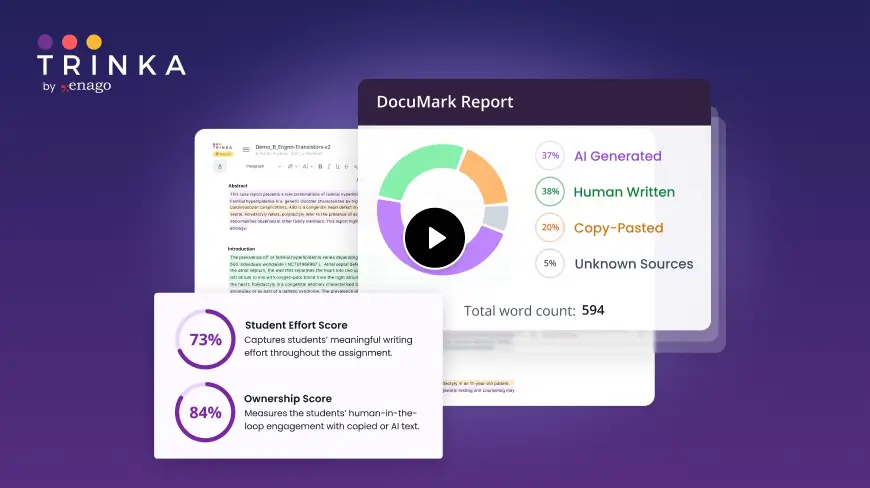
DocuMark: Responsible AI Use for Academic Integrity
Knowing your institution's AI policy is step one. DocuMark helps enforce it fairly by empowering universities to manage AI-generated content, prevent cheating, and support student writing through responsible AI use.
Common Questions About Morehouse College's AI Policies
Morehouse College has defined AI policies in 12 of 12 categories, with an overall coverage score of 100%.
Disclosure and attribution of AI use are required when appropriate, and students must follow their instructor’s directions for acknowledging or citing AI use in submitted work. The guidelines direct users to standard citation styles such as APA, MLA, and Chicago, and several permitted academic uses specifically require disclosure and proper citation.
Undisclosed or prohibited AI use is treated as academic misconduct under Morehouse's AI policy. AI plagiarism detection tools are acceptable but may not be used to unfairly penalize students. Violations trigger a tiered enforcement process: a written warning is issued for a first plagiarism or unethical concern, and a second offense is submitted to the Academic Integrity and Tracking of Responsible AI and Misconduct Survey (AI TRACK) database monitored by the Vice Provost for Academic Innovation and Learning, with communication to Student Conduct.
Morehouse restricts AI use based on a formal data classification tier structure. Data classified as Public or Internal may be used with AI systems, subject to any additional authorization requirements. Confidential and Restricted data must not be used with public or unapproved AI systems under any circumstances; Tier 1 Restricted data (including FERPA student records, SSNs, PHI, biometric identifiers, and financial account data) must never be entered into any AI tool. Staff must use only tools on the ITS-maintained approved list for college business, and all faculty, staff, and students are responsible for consulting the approved-tools list before adopting any AI technology connected to college systems or institutional data.