Teaching & Learning
- Students are prohibited from using AI to produce work they present as their own unless they have explicit faculty permission
- The college also states that instructors set acceptable procedures for course work, so AI use in assignments is governed by instructor approval and course-level expectations
To this end, Mount Holyoke College prohibits the use of artificial intelligence tools or other uncredited persons or entities to produce content that a student misleadingly represents as their own original work, such as generating an essay, creating text, images, providing analysis, creating code or producing assignment responses without the explicit permission of the faculty member.
Violations of academic honesty related to the use of AI tools:
● Improper use of AI or digital tools for completing assignments without prior approval by the instructor (some examples may include translators, grammar correction tools).
* Faculty Guidelines: Instructors should set clear expectations regarding AI use in their courses. The appropriateness of AI for drafting, researching, or editing academic work will be determined on a course-by-course basis. Students must seek clarification on AI use from their instructors.
- AI use in examinations and other assessments is prohibited without instructor approval
- The student accountability policy specifically includes examinations among the contexts where generating or contributing content with software without approval is a violation, and students are also expected to follow published exam procedures
Each student is responsible for observing established procedures in the preparation of assignments, and the writing of papers and examinations, and for submitting only original work.as one's own, only that work that they themselves have originated.
It is a joint responsibility to observe those procedures publicized by campus announcements, such as the procedures to be followed in the preparation and writing of final examinations.
● Improper use of software for generating or contributing to any content in assignments, examinations, and/or papers without instructor approval.
- For academic use generally, students are directed to follow faculty guidance and disclose use in academic work
- The college promotes AI literacy and critical engagement, but it does not set a specific university-wide rule on students using AI for private study or tutoring
Learning Together: LITS, in collaboration with faculty, staff, and students, will provide workshops and other opportunities to encourage sharing and to increase AI literacy among students, faculty and staff. These sessions will cover ethical issues, practical applications, and critical analysis of AI technologies.
**Important note for students: When using Gemini and other tools in academic work, students should follow the guidelines set by faculty in their individual courses, and be transparent about the origin and process used for their submitted work. See the LibGuide on Artificial Intelligence for details.
- AI-generated code for academic work is prohibited unless the faculty member explicitly permits it
- Mount Holyoke treats code generation as part of the same academic honesty framework that governs other assignment content, and instructors determine what is acceptable in their courses
To this end, Mount Holyoke College prohibits the use of artificial intelligence tools or other uncredited persons or entities to produce content that a student misleadingly represents as their own original work, such as generating an essay, creating text, images, providing analysis, creating code or producing assignment responses without the explicit permission of the faculty member.
* Faculty Guidelines: Instructors should set clear expectations regarding AI use in their courses. The appropriateness of AI for drafting, researching, or editing academic work will be determined on a course-by-course basis. Students must seek clarification on AI use from their instructors.
Research
- Use of generative AI in academic work must be disclosed, including in papers and projects
- The college also states that whether AI is appropriate for drafting, researching, or editing academic work is decided on a course-by-course basis, so there is no single blanket permission for research writing by students
* Transparency: Any use of generative AI in academic work should be disclosed. This includes acknowledging AI-generated content in papers, projects, or other creative outputs.
* Faculty Guidelines: Instructors should set clear expectations regarding AI use in their courses. The appropriateness of AI for drafting, researching, or editing academic work will be determined on a course-by-course basis. Students must seek clarification on AI use from their instructors.
* Review AI Outputs: AI tools can generate content that is inaccurate, biased, or misleading. Users are responsible for verifying the accuracy of AI-generated information and ensuring it complies with professional integrity standards.
- Human-subjects research materials containing personally identifiable information must be kept confidential, and sensitive institutional data is classified and protected
- The college requires users to verify AI outputs and handle data in line with confidentiality and data-classification rules, but it does not define a specific university-wide policy on using AI for research data analysis or synthetic data generation
* Review AI Outputs: AI tools can generate content that is inaccurate, biased, or misleading. Users are responsible for verifying the accuracy of AI-generated information and ensuring it complies with professional integrity standards.
All personally identifiable information obtained from participants is confidential. When the possibility exists that others may obtain this information, participants are informed of this before they consent to participate. All information and data are handled, stored, and discarded in a manner that insures the confidentiality of each participant.
The Data Stewards will classify information assets of the College into one of the following data classifications based on the sensitivity of the data, the degree to which it should be shared, and the impact that any loss, corruption, destruction or unauthorized disclosure might have for the College and its community members.
* RESTRICTED - Information assets protected by state or federal law, contractual agreements and proprietary information whose loss, corruption or unauthorized disclosure can cause severe personal, financial or reputational harm to the College, College employees or the people we serve.
- Its AI guidelines also require disclosure of generative AI in academic work and verification of AI outputs for professional integrity
- Mount Holyoke does not provide an AI-specific rule for grant proposals or IRB applications in the provided sources, but it does require confidentiality, informed consent, and IRB review for human-subjects research
Prior to conducting research, researchers enter into an agreement with participants that clarifies the nature of the research. Participants are informed of all features of the research that might influence their willingness to participate.
All personally identifiable information obtained from participants is confidential. When the possibility exists that others may obtain this information, participants are informed of this before they consent to participate. All information and data are handled, stored, and discarded in a manner that insures the confidentiality of each participant.
A PI must submit an IRB proposal document, which includes information concerning the purpose of the study, a description of the participants that will be recruited, a detailed description of the procedure of the study, a description of any risks that exceed minimal risk to the participants, and a copy of the informed consent form.
* Transparency: Any use of generative AI in academic work should be disclosed. This includes acknowledging AI-generated content in papers, projects, or other creative outputs.
* Review AI Outputs: AI tools can generate content that is inaccurate, biased, or misleading. Users are responsible for verifying the accuracy of AI-generated information and ensuring it complies with professional integrity standards.
Academic Integrity
- The guidance specifically says AI-generated content in papers, projects, and creative outputs should be acknowledged
- Disclosure of generative AI use in academic work is required by the AI guidelines, and students are told to be transparent about the origin and process used for submitted work
* Transparency: Any use of generative AI in academic work should be disclosed. This includes acknowledging AI-generated content in papers, projects, or other creative outputs.
**Important note for students: When using Gemini and other tools in academic work, students should follow the guidelines set by faculty in their individual courses, and be transparent about the origin and process used for their submitted work. See the LibGuide on Artificial Intelligence for details.
- Undisclosed or unauthorized AI use in assignments, examinations, and papers is treated as dishonorable academic conduct or scholarly misconduct
- The provided sources define improper AI use as an academic honesty violation and route such cases through the college's academic integrity system, but they do not define a policy on AI detection software
Violations of academic honesty related to the use of AI tools:
* Improper use of AI or digital tools for completing assignments without prior approval by the instructor (some examples may include translators, grammar correction tools).
* Improper use of software for generating or contributing to any content in assignments, examinations, and/or papers without instructor approval.
* Chair of Academic Honor Board, reviewing dishonorable academic conduct, such as plagiarism and cheating (See Academic Honor Board).
Plagiarism or other forms of scholarly misconduct can have no purpose or place in the academic life of the College.
Violations of authorial integrity, including plagiarism, invasion of privacy, unauthorized access, and trade secret and copyright violations, may be grounds for sanctions against members of the academic community.
Institutional & Administrative
- The guidelines also direct workplace AI integrity questions to Human Resources, but they do not provide a detailed rule set on grading, recommendation letters, or administrative drafting
- Faculty are expected to set clear course-level expectations for student AI use, and faculty and staff must consult LITS before purchasing or deploying new AI platforms for college-related work
* Faculty Guidelines: Instructors should set clear expectations regarding AI use in their courses. The appropriateness of AI for drafting, researching, or editing academic work will be determined on a course-by-course basis. Students must seek clarification on AI use from their instructors.
* Consultation for New Tools: As with any new technologies or tools, before purchasing or deploying new AI platforms for College-related work, faculty and staff must consult with LITS to review contracts and ensure compliance with security, accessibility and privacy policies. Users must not assume that because a particular AI function is currently free-to-use that it will always remain so.
* For questions regarding academic integrity and AI, contact dean-studies@mtholyoke.edu. For professional integrity in the use of AI in the workplace, contact human-resources@mtholyoke.edu.
- The college also identifies Gemini in Mount Holyoke Google accounts as a privacy-protective option compared with free personal accounts or free ChatGPT access
- Mount Holyoke requires AI use to comply with institutional data and IT policies, prohibits unauthorized disclosure of sensitive information, and requires LITS review before faculty or staff deploy new AI platforms for college work
* Acceptable Use Policy: The use of AI tools is subject to Mount Holyoke College’s Code of Ethical Conduct, Student Honor Code, Acceptable Use of IT Policy, Data Classification Policy, Nondiscrimination and Anti-Harassment Policy, Sex Discrimination and Sex-based Harassment Policy and other relevant institutional policies.
* Consultation for New Tools: As with any new technologies or tools, before purchasing or deploying new AI platforms for College-related work, faculty and staff must consult with LITS to review contracts and ensure compliance with security, accessibility and privacy policies. Users must not assume that because a particular AI function is currently free-to-use that it will always remain so.
Unacceptable use of MHC Information Technology and Institutional Data resources includes but is not limited to:
* unauthorized use or disclosure of personal, private, sensitive, and/or confidential information;
* unauthorized use or disclosure of Information Technology and Institutional Data;
* installing, downloading, or running software that has not been approved following appropriate security, legal, and/or LITS review in accordance with MHC policies;
* RESTRICTED - Information assets protected by state or federal law, contractual agreements and proprietary information whose loss, corruption or unauthorized disclosure can cause severe personal, financial or reputational harm to the College, College employees or the people we serve.
Gemini’s functions include creating text and image content based on prompts, questions, and information entered by the user. Using Gemini from your Mount Holyoke account protects and keeps your content and interactions entered there private, unlike alternatives like a free personal Google account, or free ChatGPT access.
- The college also provides institutional mechanisms for feedback and tool assessment, indicating an ongoing governance process rather than a fixed one-time policy
- Mount Holyoke has college-wide ethical AI guidelines framed around responsible, secure, and critical engagement with AI, and it states that these guidelines will be continuously reviewed and updated
The following guidelines aim to ensure the ethical, secure, and responsible use of AI, fostering a culture of critical engagement with technology in line with the College’s mission and strategic vision as we navigate these changes as a community.
* Ongoing Review and Adaptation: As AI technology evolves, the College will continuously review and update its guidelines, ensuring responsible adaptation to new developments. If you have any feedback you’d like to share about these guidelines or AI use at MHC generally, please use this feedback form.
For questions or to request that a certain tool’s AI features be reviewed by LITS please submit the AI Tools assessment request form.
For more on how MHC approaches AI, review our LibGuide on Artificial Intelligence, and our Artificial intelligence (AI) feedback and tools assessment page.
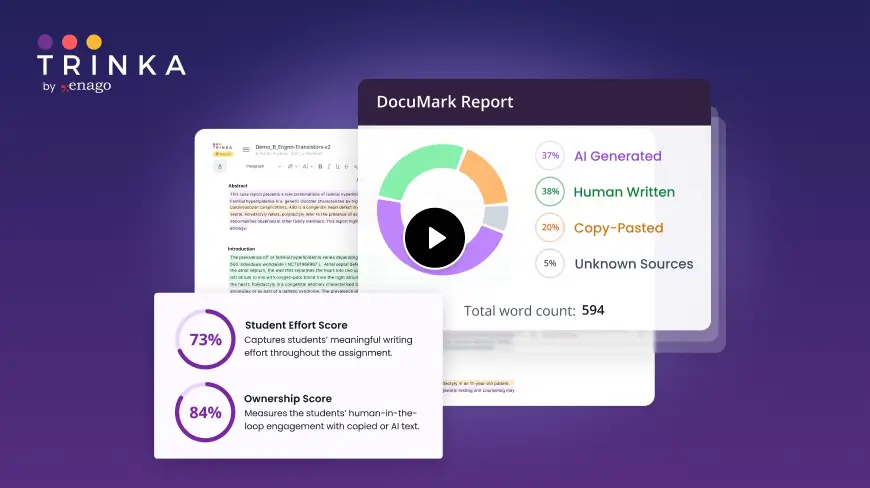
DocuMark: Responsible AI Use for Academic Integrity
Knowing your institution's AI policy is step one. DocuMark helps enforce it fairly by empowering universities to manage AI-generated content, prevent cheating, and support student writing through responsible AI use.
Common Questions About Mount Holyoke College's AI Policies
Mount Holyoke College has defined AI policies in 12 of 12 categories, with an overall coverage score of 100%.
Disclosure of generative AI use in academic work is required by the AI guidelines, and students are told to be transparent about the origin and process used for submitted work. The guidance specifically says AI-generated content in papers, projects, and creative outputs should be acknowledged.
The provided sources define improper AI use as an academic honesty violation and route such cases through the college's academic integrity system, but they do not define a policy on AI detection software. Undisclosed or unauthorized AI use in assignments, examinations, and papers is treated as dishonorable academic conduct or scholarly misconduct.
Mount Holyoke requires AI use to comply with institutional data and IT policies, prohibits unauthorized disclosure of sensitive information, and requires LITS review before faculty or staff deploy new AI platforms for college work. The college also identifies Gemini in Mount Holyoke Google accounts as a privacy-protective option compared with free personal accounts or free ChatGPT access.