Teaching & Learning
- The syllabus language is instructor-level and must explain whether AI is allowed or prohibited in that course
- Murray State does not set a university-wide AI rule for coursework in the provided sources, but it requires every course syllabus to state expectations for students' use of artificial intelligence
Artificial Intelligence Statement Expectations for student use of artificial intelligence, including examples where these tools are allowed/prohibited
- Murray State does not provide a university-wide AI rule specific to exams in the provided sources
- Instead, course syllabi must state expectations for student AI use, including where such tools are prohibited, so exam-related rules are handled at the course level when instructors specify them
Artificial Intelligence Statement Expectations for student use of artificial intelligence, including examples where these tools are allowed/prohibited
Research
- The provided sources do not mention AI specifically in research ethics filings, grant proposals, or IRB submissions
- However, the university requires researchers to follow sponsor requirements and identifies fabrication, falsification, and plagiarism as research misconduct, which would govern any research conduct involving AI if those behaviors occurred
It is the policy of Murray State University that all project directors and principal investigators submitting proposals for externally sponsored grants and contracts follow the regulations and requirements of the granting agency and of the University.
The Public Health Service policies define misconduct as follows: “fabrication, falsification or plagiarism in proposing, performing, or reviewing research, or in reporting research results.”
Academic Integrity
- Murray State requires instructors to include syllabus expectations about student AI use, but the provided sources do not establish a university-wide disclosure or citation method for AI
- They also define plagiarism broadly as using another's ideas, words, or work without credit, which may apply where AI use is treated as a source or unauthorized assistance by an instructor
Artificial Intelligence Statement Expectations for student use of artificial intelligence, including examples where these tools are allowed/prohibited
Plagiarism is the use of another person’s ideas, words, or work as one’s own without proper credit being given to the other person.
- The provided sources do not mention AI detection tools
- They do establish enforcement procedures for academic dishonesty: instructors determine whether a preponderance of the evidence shows a student violated academic honesty rules, and sanctions can range from assignment penalties to course failure or suspension
The faculty member determines whether by a preponderance of evidence the student participated in any act of academic dishonesty.
Sanctions for violating this policy may include one or more of the following: 1. oral or written reprimand 2. a reduced grade or score for the assignment involved 3. no credit or reduced credit for the assignment involved 4. a reduced grade for the course involved 5. failure in the course 6. recommendation of expulsion from the University
Institutional & Administrative
- Faculty responsibility is explicit only for communicating course-level AI expectations
- Murray State requires faculty to address student AI use in their syllabi, but the provided sources do not set a broader AI policy for faculty or staff uses such as grading, lesson planning, feedback, or administrative writing
Artificial Intelligence Statement Expectations for student use of artificial intelligence, including examples where these tools are allowed/prohibited
- The provided sources do not name approved AI platforms, but they do impose broad technology privacy and acceptable-use rules that would govern any AI tool use with university data
- Users may not use university IT resources in ways that violate law, compromise security, or expose confidential information, and the university states there is no guarantee of privacy when using its systems
Murray State University provides computing, network and information resources for use by the University community in support of the educational, research, and service mission of the University. Use of these resources is conditioned upon acceptance of the responsibility to utilize them in an efficient, ethical and legal manner.
Examples of unacceptable use include, but are not limited to the following:
1. use of information technology resources in violation of federal, state, or local law or University policy;
2. use of information technology resources for any purpose inconsistent with the University’s non-profit status;
3. use of information technology resources in a manner that interferes with the normal operation of the University’s computing systems or network, or infringes on the rights of others;
4. use of information technology resources in a manner that would compromise the security or integrity of the University’s computing systems or network;
5. unauthorized access to or disclosure of confidential University records or information;
6. unauthorized access to or disclosure of confidential information of others;
7. unauthorized modification or destruction of University information technology resources;
8. sharing passwords or other means of access to computing systems or network resources with unauthorized users;
9. use of another individual’s identity, password, or other means of access to computing systems or network resources;
10. use of information technology resources for unauthorized commercial purposes or personal gain.
The University cannot guarantee the privacy, confidentiality, integrity, or security of electronic records or messages created, sent, received or stored using University-owned or administered information technology resources.
- The clearest operational governance item in the provided sources is the syllabus requirement that courses include an AI statement for student use
- The university has acknowledged AI at the institutional level through presidential communications, but the provided sources do not set out a formal university AI governance framework, committee charter, or strategy roadmap
Murray State University announces keynote and panel discussions for Artificial Intelligence and Impact event
Artificial Intelligence Statement Expectations for student use of artificial intelligence, including examples where these tools are allowed/prohibited
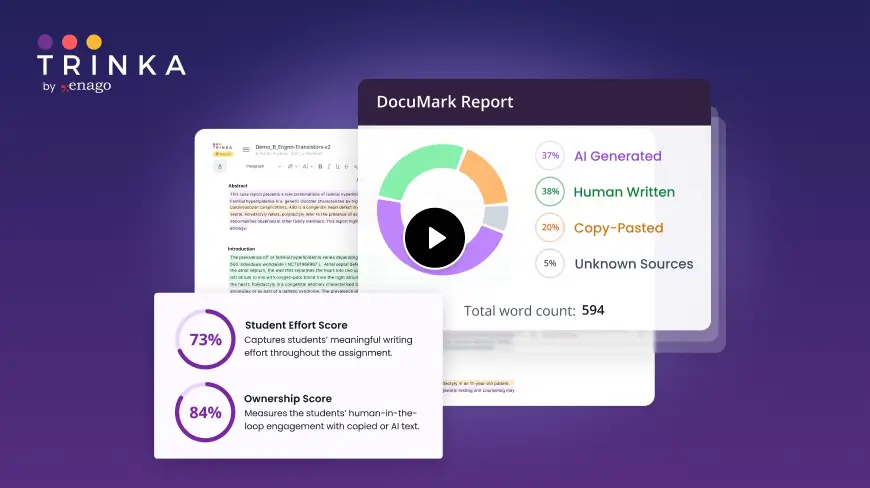
DocuMark: Responsible AI Use for Academic Integrity
Knowing your institution's AI policy is step one. DocuMark helps enforce it fairly by empowering universities to manage AI-generated content, prevent cheating, and support student writing through responsible AI use.
Common Questions About Murray State University's AI Policies
Murray State University has defined AI policies in 8 of 12 categories, with an overall coverage score of 67%.
Murray State requires instructors to include syllabus expectations about student AI use, but the provided sources do not establish a university-wide disclosure or citation method for AI. They also define plagiarism broadly as using another's ideas, words, or work without credit, which may apply where AI use is treated as a source or unauthorized assistance by an instructor.
The provided sources do not mention AI detection tools. They do establish enforcement procedures for academic dishonesty: instructors determine whether a preponderance of the evidence shows a student violated academic honesty rules, and sanctions can range from assignment penalties to course failure or suspension.
The provided sources do not name approved AI platforms, but they do impose broad technology privacy and acceptable-use rules that would govern any AI tool use with university data. Users may not use university IT resources in ways that violate law, compromise security, or expose confidential information, and the university states there is no guarantee of privacy when using its systems.