Teaching & Learning
- Work submitted must still be the student's own, and presenting AI-generated content as one's own is treated as cheating and academic misconduct
- For coursework and assignments, AI use is not uniformly permitted or prohibited across the university; students must follow the guidance for the specific module or assessment
If you use an AI content generation tool as part of your academic work, you need to be very careful that you do not commit Academic Misconduct by submitting work that is not your own. You should always first check with your module leader or tutor about what – if any – use of Gen AI is allowed in your work.
Your assessments are required to be solely your own work, or in the case of group work, solely the work of your group. They are a means for you to demonstrate what you have learned. Submitting work which is not your own is plagiarism and falsification i.e. cheating.
If you do plan to use an Gen AI content generation tool to develop your assessment, you should contact your module leader to find out what, if any, evidence of this use should be submitted with your assignment use is allowed.
Staff will use the assessment brief to indicate what use of Generative AI is appropriate in any given assessment.
Edinburgh Napier University’s Academic Integrity Regulations AI3.2 state that students’ inappropriate use of Generative AI, such as the direct use of generated content presented in an assessment submission as their own work, constitutes a form of cheating and a breach of the Academic Integrity Regulations.
- For exams and formal assessments, AI use is controlled through assessment-specific guidance and students are told to ask their module leader if unsure
- Inappropriate AI use to gain an undue advantage in an assessment is treated as academic misconduct, and online assessments require a declaration covering any GenAI use
Please read our student guidance around artificial intelligence to understand what it means for you as a student to use these tools, particularly around the context of assessments and exams. If you are unsure whether you are permitted to use any AI tools in your submission, contact your module leader.
Most online assessments now require you to submit a declaration which allows you to acknowledge and detail any use of GenAI tools. You should seek the guidance of your module leader for all assessment submissions, including online exams and coursework.
Being found to have inappropriately used artificial intelligence (AI) content generation or writing assistance tools e.g. a paraphrasing tool or website – e.g. ChatGPT Quilbot- to gain an undue advantage in an assessment. The extent to which any advantage has been gained will be determined at the Academic Integrity Officer’s discretion.
- This use is advisory rather than unrestricted: students are warned to verify accuracy, avoid overreliance, and use AI to support learning rather than replace it
- The university permits AI tools to be used as study support, such as for understanding topics, generating ideas, debating, structuring work, improving communication, and literature searching
there are many apps and tools which can often provide quick answers, feedback and ideas.
Use the content to help your learning, not do your learning for you. Develop the skills to evaluate AI created content; this will help you evaluate and improve your own work.
Ideas for how you might want to use these tools
1. As a basic search engine for understanding: Gen AI platforms will answer questions on topics you may be studying but struggle to understand. Caution: Gen AI can sound very convincing but be very inaccurate, so always check another source to verify accuracy.
2. As an ideas generator: Gen AI platforms can quickly come up with range of ideas for what you might want to focus on in your submission. Use this when you are finding it hard to get started.
4. As a debating partner: ask the tool to take a role or position on a debate.
5. To suggest a submission structure: ask the tool to provide you with a structure for your essay, report, presentation etc.
7. To make suggestions to improve your communication of your ideas: this might be your grammar, spelling, phrasing etc. Many tools can help with this, but always refine the answers further and don't just copy and paste.
Generative Artificial Intelligence (GenAI) tools are currently being added to Library databases and reference management software. While these tools can help with discovery, it is important to understand how to use them responsibly and critically in an academic environment.
Do not rely on AI content as a key source and make sure you check the factual accuracy of content.
- Use for programming assignments therefore falls under the same assessment-specific rules requiring students to check with module leaders and submit their own work
- The university acknowledges that GenAI tools can generate computer coding, but it does not provide a distinct university-wide coding policy in the supplied sources
Generative artificial intelligence (Gen AI) tools can generate content across many subjects and skills e.g., writing, art / design, computer coding.
You should always first check with your module leader or tutor about what – if any – use of Gen AI is allowed in your work.
Staff will use the assessment brief to indicate what use of Generative AI is appropriate in any given assessment.
Research
- The university requires disclosure and referencing of AI-generated material, and advises students to discuss AI use early with their supervisor
- For postgraduate research writing, AI may be used with caution, but students must preserve originality and independence, and the final work must reflect their own analysis and creativity
Generative AI tools, such as ChatGPT, present opportunities and challenges in postgraduate research.
Originality and Independence: AI-generated content cannot be claimed as independent or original work. Depending on how you use such content, it may conflict with the academic principles that underpin postgraduate research.
If you incorporate generative AI tools in your research:
* Cite AI Outputs: Reference all AI-generated material appropriately.
* Disclose Usage: Clearly indicate where and how you have used AI in your thesis, such as in an appendix or narrative introduction.
* Ensure Original Work: Use AI as a starting point or inspiration, but ensure the final product reflects your own analysis and creativity.
Discuss Gen AI usage early with your supervisor for tailored advice.
- The university does not define a detailed policy on using AI for research data analysis or interpretation in the supplied sources
- The only explicit rule provided is that research data, personal information, and proprietary information must not be uploaded into generative AI tools
Data Privacy: Do not upload your research data, personal or proprietary information into any generative AI tool. This would constitute a serious breach of policy.
- The university states that research must be conducted to high standards of integrity and ethics, and that staff and students must know the university policies governing research
- It also has a University Research Integrity Committee that oversees governance and investigates allegations of research misconduct, but the supplied sources do not set AI-specific rules for grant proposals, IRB applications, or ethics declarations beyond the general postgraduate guidance
Research should be conducted to the highest levels of integrity, including appropriate research design and frameworks, to ensure that findings are robust and defensible. Researchers should also adhere to the highest level of research ethics, in line with requirements set out by national and international regulatory bodies including the Concordat to Support Research Integrity (2019).
All staff and students should be familiar with the Universities Policies and procedures that govern the research process.
The University Research Integrity Committee oversees governance policies, procedures and practices across the University.
The Committee also has responsibility for investigating allegations of research misconduct in line with its Research Misconduct Policy.
Approval for ethics applications is devolved to school level.
Academic Integrity
- The university requires disclosure of AI use in assessments and postgraduate research
- Students must acknowledge AI use on assessment declaration forms, and some programme guidance requires a short description plus an appendix detailing the tool, model, prompts, and stage of use; postgraduate researchers must reference AI outputs and clearly disclose where and how AI was used
An Assessment Declaration Cover Sheet (or Moodle Form) will be used in every assessment for students to declare that their submission is their own work and that any contributions from other sources have been acknowledged, including any use of Generative AI.
Most online assessments now require you to submit a declaration which allows you to acknowledge and detail any use of GenAI tools.
If you use Gen AI, please adhere to the following:
1. Regularly save your work under different file names, so if required, you can demonstrate the development of your work over a period of time.
2. Answer YES on the Assessment Declaration Cover Sheet.
3. Give information on the sheet in less than 100 words to describe how (and at which points) you have used such tools to support your completion of this assessment.
4. Include an appendix in your submission titled 'Use of Gen AI tools for this submission'. This section is not included in your word count and should be after the reference list.
5. Provide:
a. What tool you used and which model e.g. ChatGPT 5.
b. Details on what input you gave the tool e.g. examples of your prompts.
c. At what stage of the creation of your submission you did this e.g. was it at the beginning to brainstorm ideas, at the end to check your writing?
If you incorporate generative AI tools in your research:
* Cite AI Outputs: Reference all AI-generated material appropriately.
* Disclose Usage: Clearly indicate where and how you have used AI in your thesis, such as in an appendix or narrative introduction.
- The university treats inappropriate AI use as a breach of academic integrity and subjects it to formal disciplinary procedures and penalties
- The supplied sources mention TurnitinUK as a text-matching tool for plagiarism deterrence, but they do not set out a specific AI-detection policy or endorse AI detectors as decisive evidence
Breaches of the Academic Integrity Regulations will be taken to include acts of plagiarism (including self-plagiarism), cheating, collusion, falsification or fabrication of data, personation or bribery, artificial intelligence (AI) content generation or writing assistance tools, all as defined in Appendix I.
Being found to have inappropriately used artificial intelligence (AI) content generation or writing assistance tools e.g. a paraphrasing tool or website – e.g. ChatGPT Quilbot- to gain an undue advantage in an assessment. The extent to which any advantage has been gained will be determined at the Academic Integrity Officer’s discretion.
The penalties imposed for academic misconduct reflect the seriousness of this conduct. Being found to have committed academic misconduct has potentially severe consequences for your studies and future employment.
Each School shall designate an appropriate member(s) of staff, other than a Dean of School, to have responsibility for investigating allegations of breaches of the Academic Integrity Regulations. This person is referred to below as an Academic Integrity Officer (AIO).
TurnitinUK is a text matching software tool which helps deter plagiarism and supports academic writing skills.
Institutional & Administrative
- The university encourages colleagues to incorporate Generative AI into teaching, learning activities, and assessments where appropriate
- Programme and module leaders are expected to discuss AI use with students and specify permitted use through the AI Toolkit, traffic-light system, and assessment briefs; the supplied sources do not provide separate rules on grading, recommendation letters, or administrative communications
The University encourages colleagues to incorporate Generative AI into their teaching and learning activities and assessments where appropriate, as per Principle 5 (2.5) and the University’s Position Statement on Generative AI (3.1 & 3.2).
Programme and module leaders will engage in dialogue with their students on their use of generative AI, using the AI Toolkit and its traffic-light system to indicate what use of generative AI is appropriate in their modules and assessments. Staff will use the assessment brief to indicate what use of Generative AI is appropriate in any given assessment.
- The university warns that external AI tools are not supported by the university and that users should be cautious about data privacy
- For postgraduate research, uploading research data, personal information, or proprietary information into generative AI tools is explicitly prohibited; the supplied sources do not identify an approved institutional AI platform list
They are external tools, they're not supported by the University, so you want to make sure that you're comfortable with how your data is being used, not just anything that you input, but also your personal information.
Before using any free tool you should read the terms and conditions carefully. It is rare for a tool or app to be completely free and make money in other ways e.g. advertising, taking your personal data and using or selling it.
Data Privacy: Do not upload your research data, personal or proprietary information into any generative AI tool. This would constitute a serious breach of policy.
- The supplied sources show that the university has institutional governance for AI in teaching and research, but not a single overarching university-wide AI strategy document in the materials provided
- Governance evidence includes an AI Toolkit and traffic-light system for assessment decisions, plus a University Research Integrity Committee overseeing governance policies, procedures, and practices across the university
Programme and module leaders will engage in dialogue with their students on their use of generative AI, using the AI Toolkit and its traffic-light system to indicate what use of generative AI is appropriate in their modules and assessments.
The University Research Integrity Committee oversees governance policies, procedures and practices across the University.
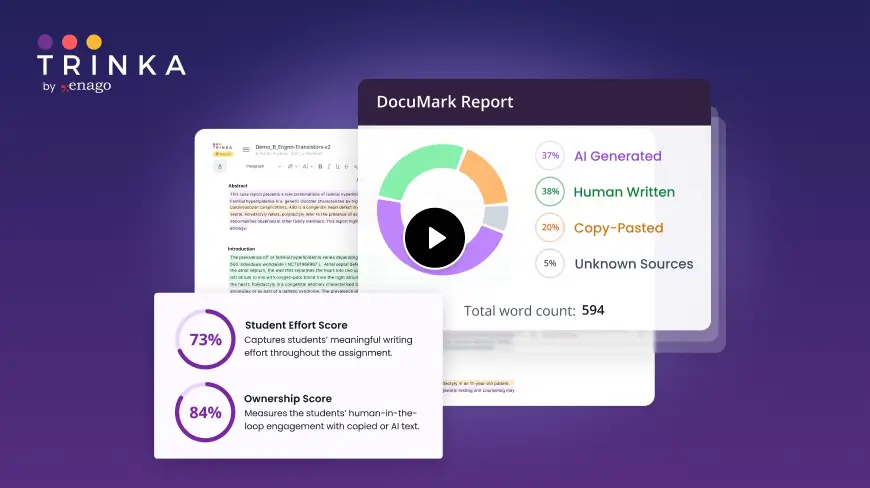
DocuMark: Responsible AI Use for Academic Integrity
Knowing your institution's AI policy is step one. DocuMark helps enforce it fairly by empowering universities to manage AI-generated content, prevent cheating, and support student writing through responsible AI use.
Common Questions About Napier University's AI Policies
Napier University has defined AI policies in 12 of 12 categories, with an overall coverage score of 100%.
The university requires disclosure of AI use in assessments and postgraduate research. Students must acknowledge AI use on assessment declaration forms, and some programme guidance requires a short description plus an appendix detailing the tool, model, prompts, and stage of use; postgraduate researchers must reference AI outputs and clearly disclose where and how AI was used.
The university treats inappropriate AI use as a breach of academic integrity and subjects it to formal disciplinary procedures and penalties. The supplied sources mention TurnitinUK as a text-matching tool for plagiarism deterrence, but they do not set out a specific AI-detection policy or endorse AI detectors as decisive evidence.
The university warns that external AI tools are not supported by the university and that users should be cautious about data privacy. For postgraduate research, uploading research data, personal information, or proprietary information into generative AI tools is explicitly prohibited; the supplied sources do not identify an approved institutional AI platform list.