Teaching & Learning
- Course-level rules for outside resources used on homework, laboratory exercises, and group work are set by the instructor rather than by a single university-wide AI rule
- Students are expected to understand what is permitted for each assignment, and faculty are expected to state any special honesty rules clearly, including whether online resources are allowed and whether citation is required
Get clarification from the course instructor or teaching assistant; expectations can vary by instructor as well as by assignment for a given instructor.
3.1 The need to foster academic honesty and research integrity imposes a nexus of responsibilities on the Institute, its students, and faculty.
Students: Each student’s responsibility is to understand for every academic assignment what is expected from them and what would be violations of academic honesty.
Faculty: It is the responsibility of the instructor of a course to clearly articulate any special case of academic honesty violations that is relevant to that course
Provide clarification on what constitutes cheating on your homework, laboratory exercises, and group work. For example, do you permit students to consult on-line resources, such as Chegg? Since this varies by faculty member, inform students about your policy (e.g., if permitted, do they need to provide a citation?).
- Using unauthorized material during tests is prohibited
- For take-home and online exams, faculty are expected to set the permitted parameters and may use proctoring, lockdown browsers, plagiarism-detection services, or alternative assessment designs to enforce academic honesty
2.1.1 Cheating: the use of unauthorized material during a test, or the act of copying from another student;
Set parameters for take-home exams; they are sometimes viewed by students as group projects in which students closely collaborate on answering the questions. Plan accordingly.
Encourage academic integrity for online course assignments and exams by considering, e.g., academic honesty statement signed by the student, randomization of test items, time limits for exams, the use of open-ended questions and “open book” exams, the use of a lock-down browser or online proctoring services, online plagiarism detection services such as Turnitin or iThenticate, verbal quizzing in a breakout room.
Consider alternatives to online proctoring of exams (e.g., take exams in-person on campus or at a nearby testing center).
- Use of study-assistance tools is not defined in a university-wide AI policy
- The only explicit guidance is that instructors should tell students whether they may consult online resources, so permitted use varies by instructor and assignment
If you are unclear about what constitutes cheating or plagiarism in a course:
Get clarification from the course instructor or teaching assistant; expectations can vary by instructor as well as by assignment for a given instructor.
Provide clarification on what constitutes cheating on your homework, laboratory exercises, and group work. For example, do you permit students to consult on-line resources, such as Chegg? Since this varies by faculty member, inform students about your policy (e.g., if permitted, do they need to provide a citation?).
- Faculty are expected to discuss plagiarism in code assignments and to state course-specific rules on what outside help or resources are allowed
- The university does not state an AI-specific programming rule, but it does explicitly treat computer code assignments as subject to plagiarism expectations
2.1.2 Plagiarism: the unauthorized use or use without proper citation of either someone’s published work, unpublished material in someone else’s computer files or material derived from the Internet;
Discuss plagiarism of text and computer code assignments.
Provide clarification on what constitutes cheating on your homework, laboratory exercises, and group work. For example, do you permit students to consult on-line resources, such as Chegg? Since this varies by faculty member, inform students about your policy (e.g., if permitted, do they need to provide a citation?).
Research
- No AI-specific manuscript-writing rule is defined
- For research generally, plagiarism in proposing, performing, reviewing, or reporting research results is prohibited, and inaccurate authorship is treated as an academic research integrity violation
Research Misconduct is defined as: fabrication, falsification, or plagiarism in proposing, performing, or reviewing research, or in reporting research results.
2.2.1 Inaccurate listing of authorship: the act of listing as an author or co-author those who have not made substantial contributions to the research or listing an author or co-author without their consent or the act of not naming as an author or co-author someone who is a major contributor;
- No AI-specific policy on AI-assisted data analysis or synthetic data is defined
- The university does explicitly prohibit falsification or fabrication of research data and requires IRB review before any human-subjects research begins
2.1.4 Falsification: any form of illegal alteration of academic documents for any purpose including improper alteration of experimental data obtained in the laboratory;
2.2.4 Fabrication of data: improper alteration of experimental data obtained in the laboratory or any scientific or research experiment;
Federal regulations require that any and all research involving human subjects be reviewed and approved by an Institutional Review Board (IRB) for the Protection of Human Subjects in Research PRIOR to initiation of such research.
All research at New Mexico Tech that involves human subjects must be submitted to the IRB for review before such research can be performed.
- Research misconduct is prohibited, including plagiarism in research proposals and reported results
- Faculty, staff, and students have a duty to report suspected research misconduct, and human-subjects work must receive IRB review and approval before the research starts
Misconduct in research is prohibited at New Mexico Tech, and allegation(s) of research misconduct will be assessed and investigated using the associated procedures for this policy. Research Misconduct is defined as: fabrication, falsification, or plagiarism in proposing, performing, or reviewing research, or in reporting research results.
New Mexico Tech faculty, staff and students have a duty to report and respond to suspected misconduct in research, in order to protect the research enterprise and the reputation of the institution.
2.2.3 Violation of ethical standards related to human and animal testing: e.g., experimentation on human subjects without informed consent (All human/animal experiments must be reviewed and preapproved by NMT’s Institutional Review Board);
Federal regulations require that any and all research involving human subjects be reviewed and approved by an Institutional Review Board (IRB) for the Protection of Human Subjects in Research PRIOR to initiation of such research.
Academic Integrity
- More generally, plagiarism includes using published work, computer files, or Internet-derived material without proper citation
- When an instructor permits use of outside online resources, citation may be required, but the university does not set a single institution-wide AI disclosure rule
2.1.2 Plagiarism: the unauthorized use or use without proper citation of either someone’s published work, unpublished material in someone else’s computer files or material derived from the Internet;
Provide clarification on what constitutes cheating on your homework, laboratory exercises, and group work. For example, do you permit students to consult on-line resources, such as Chegg? Since this varies by faculty member, inform students about your policy (e.g., if permitted, do they need to provide a citation?).
- The university endorses multiple enforcement mechanisms for suspected honesty violations, including plagiarism-detection tools and software-similarity checking
- Violations are not tolerated, faculty are encouraged to report major cases, and penalties can include course-grade consequences, disciplinary action, record notations, and for research misconduct, sanctions up to termination or dismissal
Violations of academic honesty and research integrity is therefore unacceptable and will not be tolerated at New Mexico Tech.
NMT Plagiarism check for theses and dissertations (for NMT faculty ONLY, scroll to iThenticate)
MOSS System for Detecting Software Similarity
Let students know how easy it is for faculty to detect plagiarizing and when solutions are copied.
Encourage academic integrity for online course assignments and exams by considering, e.g., academic honesty statement signed by the student, randomization of test items, time limits for exams, the use of open-ended questions and “open book” exams, the use of a lock-down browser or online proctoring services, online plagiarism detection services such as Turnitin or iThenticate, verbal quizzing in a breakout room.
Report all major academic honesty violations
Inform students of the consequences of honesty policy violations. Some are still in “high-school mode” while others have different cultural expectations. Students found in violation of our academic honesty policy can receive penalty actions that affect their course grade; receive academic disciplinary actions; have notes placed in their academic or permanent records that may adversely affect future employment, internship and graduate school opportunities; and they become ineligible, and may not regain, their “Tech Scholar” designation.
Violations of this policy will be subject to disciplinary action, consistent with disciplinary policies of this institution, up to and including termination or dismissal.
Institutional & Administrative
- The sources do not define an AI-specific policy for faculty or staff use in grading, feedback, recommendation letters, or administrative communications
- The explicit guidance for faculty is to communicate course honesty rules in syllabi, clarify what resources students may use, and report major violations; research personnel are also required to complete RCR training
Place pertinent information (e.g., Academic Honesty policy and procedures) in your syllabus.
Provide clarification on what constitutes cheating on your homework, laboratory exercises, and group work. For example, do you permit students to consult on-line resources, such as Chegg? Since this varies by faculty member, inform students about your policy (e.g., if permitted, do they need to provide a citation?).
Report all major academic honesty violations
RCR training is mandatory for all individuals responsible for the design, conduct, or reporting of research at New Mexico Tech (NMT), including principal investigators (PIs), co-principal investigators, faculty, staff, and students.
- The university has established institution-level AI initiatives centered on a new AI institute and statewide consortium participation
- The stated strategy is to make the AI institute the central hub for AI integration across curriculum, research, and operations, while supporting research and education with AI infrastructure, workforce development, and partnerships
This new initiative is designed to serve as the university’s central hub for AI integration, spearheading the advancement of artificial intelligence (AI) across the curriculum, faculty and staff research, and campus-wide operational activities.
The mission of the Raul Deju Institute for AI (aka AI Institute) is to support research and education with AI infrastructure, cultivate talent pipelines, and ignite new partnerships to solve real-word problems.
Leading research universities, national laboratories, and community colleges in New Mexico have joined forces to establish the New Mexico Artificial Intelligence Consortium). The consortium, formalized through an MOU (Memorandum of Understanding) signed by all parties, signifies a collaborative effort to advance the development and application of artificial intelligence and machine learning across the state.
DocuMark: Responsible AI Use for Academic Integrity
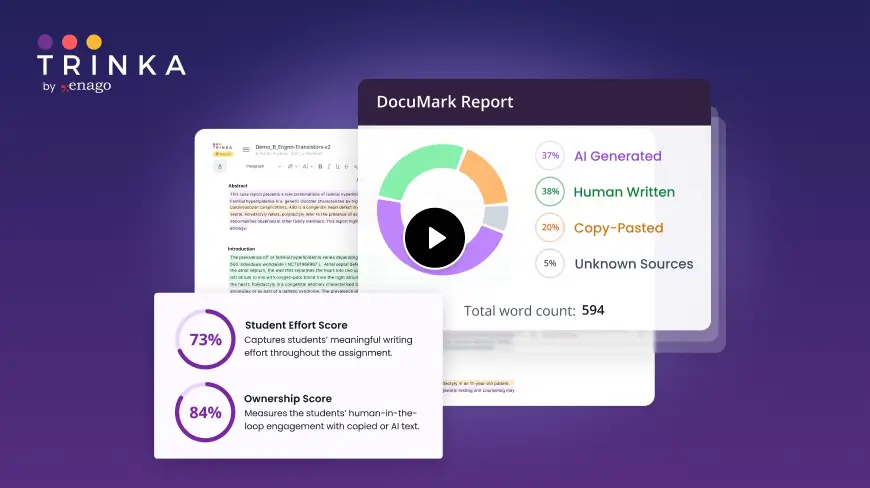
Knowing your institution's AI policy is step one. DocuMark helps enforce it fairly by empowering universities to manage AI-generated content, prevent cheating, and support student writing through responsible AI use.
Common Questions About New Mexico Institute of Mining and Technology's AI Policies
New Mexico Institute of Mining and Technology has defined AI policies in 11 of 12 categories, with an overall coverage score of 92%.
When an instructor permits use of outside online resources, citation may be required, but the university does not set a single institution-wide AI disclosure rule. More generally, plagiarism includes using published work, computer files, or Internet-derived material without proper citation.
The university endorses multiple enforcement mechanisms for suspected honesty violations, including plagiarism-detection tools and software-similarity checking. Violations are not tolerated, faculty are encouraged to report major cases, and penalties can include course-grade consequences, disciplinary action, record notations, and for research misconduct, sanctions up to termination or dismissal.
No explicit data protection or approved AI platform policy is currently defined in the available policy sources.