Teaching & Learning
- University-wide requirements for student AI use in coursework are not defined in the accessible source text provided
- It also provides an example policy statement that requires attribution of AI-generated content used in assignments and warns that failure to disclose AI assistance may lead to plagiarism charges
- NYU Steinhardt provides syllabus-support guidance indicating that instructors should define when generative AI can be used (or not used) for assignments and should communicate those decisions clearly to students
To help streamline the process of adding AI policies to your syllabus, here are templates and examples that can be adapted for your course. These templates ensure students are fully informed about when AI can be used and how to properly acknowledge AI-generated content. Remember that you can establish different AI policies for each assignment, depending on how you want the tools to be used (or not used). Just make sure to clearly communicate this decision to your students.
Example Policy Statement: "Any AI-generated content used in assignments must be properly attributed. Failure to disclose AI assistance may result in plagiarism charges."
- Formal university-wide permissions or limits for student study use are not defined in the accessible source text provided
- It also includes discussion prompts about classroom norms for AI usage, indicating that expectations may be set at the course level
- NYU Steinhardt includes teaching guidance that encourages student reflection on how AI may assist their work and emphasizes critical thinking beyond relying on AI-generated responses
Assign students a reflection on how AI may assist them in their work and the importance of critical thinking beyond relying on AI-generated responses.
“How do you think AI should be used in our classroom? How can we establish agreed-upon norms for AI usage?”
Research
- It also separates non-research (administrative/classroom) uses into a different support channel
- Specific rules on how AI may be used for research data collection/analysis are not defined in the accessible source text provided
- NYU Research Technology Services describes Pythia as a generative AI platform intended for research workflows and indicates it provides access to externally hosted LLMs and HPC resources for fine tuning LLMs
Welcome to Pythia, the generative AI platform for research workflows. As part of the Pythia platform, the following capabilities are offered:
Access to externally hosted LLMs
HPC resources for fine tuning LLMs
If you're looking to harness Generative AI for administrative or classroom use, please reach out to genai-support@nyu.edu
Academic Integrity
- University-wide disclosure rules applicable across all NYU schools are not defined in the accessible source text provided
- It also advises instructors to include guidelines on ethical AI usage and proper attribution when AI-generated content is used in assignments
- NYU Steinhardt’s syllabus-support guidance includes an example policy statement requiring proper attribution of AI-generated content used in assignments and warns that failure to disclose AI assistance may result in plagiarism charges
Include guidelines on ethical AI usage, including proper attribution when AI-generated content is used in assignments.
Example Policy Statement: "Any AI-generated content used in assignments must be properly attributed. Failure to disclose AI assistance may result in plagiarism charges."
- NYU Steinhardt’s example syllabus policy language explicitly links non-disclosure of AI assistance to potential plagiarism charges
- The accessible source text provided does not define AI detection tooling (e.g., Turnitin/GPT detectors) or describe specific enforcement procedures related to AI beyond that example statement
Example Policy Statement: "Any AI-generated content used in assignments must be properly attributed. Failure to disclose AI assistance may result in plagiarism charges."
Institutional & Administrative
- NYU Research Technology Services directs administrative/classroom genAI use inquiries to a separate support contact
- The accessible source text provided does not define specific rules for faculty/staff uses such as grading, feedback, or recommendation letters
- NYU Steinhardt provides general guidance that instructors can use AI to personalize learning experiences, streamline administrative tasks, and enhance student engagement
AI is transforming education by providing new ways to support teaching and learning. Instructors can use AI to personalize learning experiences, streamline administrative tasks, and enhance student engagement. This page serves as a starting point for understanding how AI can be integrated into your teaching practice.
If you're looking to harness Generative AI for administrative or classroom use, please reach out to genai-support@nyu.edu
- The accessible source text provided does not define NYU-wide approved AI platforms or explicit data classification tiers for AI use
- NYU Stern’s Learning Science Lab warns that information submitted in prompts to third-party genAI chatbots is accessible to the tool owner and may be used for model training and appear in future responses, framing this as a student-data protection concern
With so much information about genAI currently being shared, you may be wondering what data is safe to submit to third party genAI tools. As we see the creation of more robust genAI models, the companies behind these tools continue to collect user data to improve their performance. Every time a prompt is submitted to a chatbot, the information in that prompt is accessible to the owner of the chatbot, and may be used in model training (and thus appear in future responses).
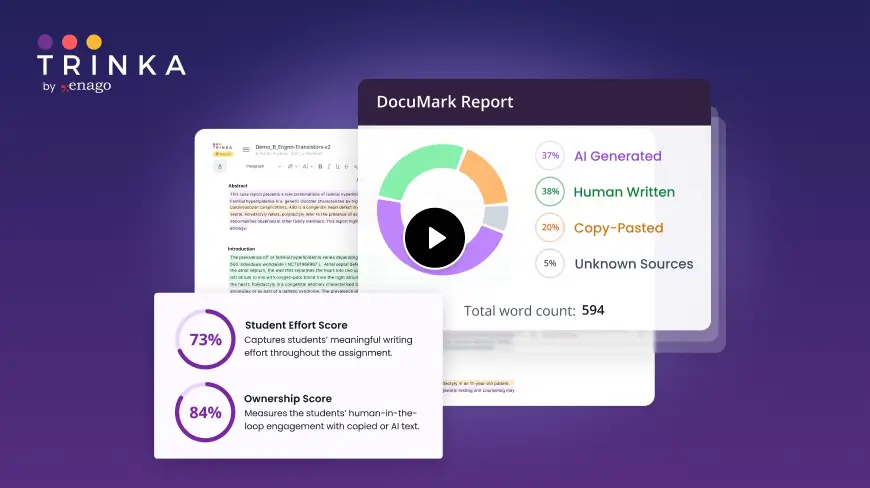
DocuMark: Responsible AI Use for Academic Integrity
Knowing your institution's AI policy is step one. DocuMark helps enforce it fairly by empowering universities to manage AI-generated content, prevent cheating, and support student writing through responsible AI use.
Common Questions About New York University (NYU)'s AI Policies
New York University (NYU) has defined AI policies in 7 of 12 categories, with an overall coverage score of 58%.
NYU Steinhardt’s syllabus-support guidance includes an example policy statement requiring proper attribution of AI-generated content used in assignments and warns that failure to disclose AI assistance may result in plagiarism charges. It also advises instructors to include guidelines on ethical AI usage and proper attribution when AI-generated content is used in assignments. University-wide disclosure rules applicable across all NYU schools are not defined in the accessible source text provided.
NYU Steinhardt’s example syllabus policy language explicitly links non-disclosure of AI assistance to potential plagiarism charges. The accessible source text provided does not define AI detection tooling (e.g., Turnitin/GPT detectors) or describe specific enforcement procedures related to AI beyond that example statement.
NYU Stern’s Learning Science Lab warns that information submitted in prompts to third-party genAI chatbots is accessible to the tool owner and may be used for model training and appear in future responses, framing this as a student-data protection concern. The accessible source text provided does not define NYU-wide approved AI platforms or explicit data classification tiers for AI use.