Teaching & Learning
- The university frames unauthorized AI use as a potential academic integrity violation, while permitted use should be accompanied by disclosure requirements as specified by the instructor
- Northwestern indicates that student use of generative AI for coursework and assignments is generally set at the instructor/course level, with instructors choosing whether AI use is prohibited, conditionally permitted, or open/encouraged
As with other course features, instructors have the freedom to integrate generative artificial intelligence (GAI) to support their teaching goals.
Closed: The use of GAI is prohibited.
Conditional: The use of GAI is permitted when explicitly authorized by the instructor.
Open: The use of GAI is encouraged. Students must adhere to the instructor’s expectations.
Whatever approach instructors take to GAI, they should document their expectations on syllabi.
Closed: You are prohibited from using Generative Artificial Intelligence (GAI) to produce any materials or content related to this course. Any use of GAI will be viewed as a potential academic integrity violation.
Conditional: In this course, you are allowed to use Generative Artificial Intelligence (GAI) on assignments only for the purposes specified in assignment prompts.
Open: In this course, you are allowed to use Generative Artificial Intelligence (GAI) in any manner.
It is each student’s responsibility to be aware of all rules and policies applicable to their program. In particular, it is the student’s responsibility to understand the guidelines set by instructors around the use of generative artificial intelligence (GenAI). Such guidelines may vary considerably from course to course and even across assignments within a single course.
- Specific exam-by-exam permissions for generative AI are not defined at the university-wide level in the cited materials; expectations are positioned as instructor-set and may vary by course/assignment
- Northwestern’s academic integrity principles identify using unauthorized study aids or information on an examination as cheating, and also describe cheating as allowing another person or resource (including generative AI) to do one’s work and submitting it without proper attribution
Using unauthorized notes, study aids, or information on an examination
Allowing another person or resource (including, but not limited to, generative artificial intelligence) to do one's work and submitting that work under one's own name without proper attribution
It is each student’s responsibility to be aware of all rules and policies applicable to their program. In particular, it is the student’s responsibility to understand the guidelines set by instructors around the use of generative artificial intelligence (GenAI). Such guidelines may vary considerably from course to course and even across assignments within a single course.
- Students are also directed to follow Northwestern IT’s generative AI guidance to ensure they only share approved data with AI tools
- Northwestern states that students can use generative AI tools as a study partner (including use like a tutor) while following course and assignment rules, ensuring submitted work is their own, tracking how AI was used, and checking outputs for accuracy and bias
Students can use Generative AI (GAI) tools as a study partner. In fact, large language models (LLMs) can be used like a tutor to help you better understand course concepts.
Follow the guidelines of the course you are taking and the assignment as it is written. When in doubt, ask your instructor for guidance on appropriate use of GAI.
Ensure that the submitted work is your own, not copied and pasted from an LLM
Keep track of where and how you used GAI
Always check material from an LLM for accuracy and to make sure it is free of bias
Follow the Northwestern IT Guidance on the Use of Generative AI to ensure that you share only approved data with the tools
- Northwestern does not define a distinct, university-wide policy specific to AI use for code generation or programming assignments in the provided sources
- General course policy guidance indicates instructor-set rules (prohibited/conditional/open) for generative AI use and frames unauthorized use as a potential academic integrity violation
Closed: The use of GAI is prohibited.
Conditional: The use of GAI is permitted when explicitly authorized by the instructor.
Open: The use of GAI is encouraged. Students must adhere to the instructor’s expectations.
Whatever approach instructors take to GAI, they should document their expectations on syllabi.
Research
- The guidance also warns that data shared in generative AI queries is often accessible to others and that users should not enter institutional data into AI tools that are not validated by the university and lack explicit permission from the data provider
- Northwestern’s IT guidance states that only Level 1 (non-confidential/public) data is permissible to upload to generative AI tools, and that processing data above Level 1 requires the AI tool to be approved through Northwestern IT procurement and security review
In most cases, the data you share as part of your queries in generative AI tools will be accessible by others using the same tools.
Therefore, University faculty, staff, students, and affiliates should not enter institutional data into any generative AI tools that have not been validated by the University for appropriate use and have explicit permission of the data provider.
If your data is Level 1 (non-confidential and public data), uploading it to generative AI tools is permissible.
To process data above Level 1, any generative AI tool must have been approved through Northwestern IT’s procurement and security review processes.
Academic Integrity
- For courses where instructors allow generative AI, Northwestern provides template syllabus statements requiring a disclosure describing what AI was used for, which tools were used, and what prompts were used
- Northwestern states that submitting work produced by another person or resource (including generative AI) under one’s own name without proper attribution is cheating, and that unauthorized use of generative AI to create content submitted as one’s own is plagiarism
Allowing another person or resource (including, but not limited to, generative artificial intelligence) to do one's work and submitting that work under one's own name without proper attribution
Plagiarism includes, but is not limited to, the unauthorized use of generative artificial intelligence to create content that is submitted as one's own.
Any use of GAI should be accompanied by a disclosure at the end of an assignment explaining (1) what you used GAI for; (2) the specific tool(s) you used; and (3) what prompts you used to get the results.
- Northwestern’s provided sources do not define a university-wide stance on AI detection tools
- However, Northwestern states that academic integrity violations include cheating and plagiarism, including allowing generative AI to do one’s work without proper attribution and unauthorized use of generative AI to create content submitted as one’s own, and it indicates that any use of GAI in a “Closed” course will be viewed as a potential academic integrity violation
Allowing another person or resource (including, but not limited to, generative artificial intelligence) to do one's work and submitting that work under one's own name without proper attribution
Plagiarism includes, but is not limited to, the unauthorized use of generative artificial intelligence to create content that is submitted as one's own.
Closed: You are prohibited from using Generative Artificial Intelligence (GAI) to produce any materials or content related to this course. Any use of GAI will be viewed as a potential academic integrity violation.
Institutional & Administrative
- Northwestern states that instructors have the freedom to integrate generative AI to support teaching goals and should clearly communicate expectations/requirements to students and document them on syllabi
- Northwestern also provides institutional privacy/data guidance applicable to faculty, staff, students, and affiliates, stating they should not enter institutional data into non-validated generative AI tools and outlining data-level restrictions for uploading/processing data with generative AI tools
As with other course features, instructors have the freedom to integrate generative artificial intelligence (GAI) to support their teaching goals.
All instructors should communicate any expectations or requirements clearly with students to avoid confusion.
Whatever approach instructors take to GAI, they should document their expectations on syllabi.
Therefore, University faculty, staff, students, and affiliates should not enter institutional data into any generative AI tools that have not been validated by the University for appropriate use and have explicit permission of the data provider.
- It further states that Level 1 data is permissible to upload to generative AI tools, and that using generative AI tools with data above Level 1 requires approval through Northwestern IT’s procurement and security review processes
- Northwestern IT warns that data shared in generative AI queries is often accessible by others and advises university community members not to enter institutional data into generative AI tools that are not validated by the university and lack explicit permission from the data provider
In most cases, the data you share as part of your queries in generative AI tools will be accessible by others using the same tools.
Therefore, University faculty, staff, students, and affiliates should not enter institutional data into any generative AI tools that have not been validated by the University for appropriate use and have explicit permission of the data provider.
If your data is Level 1 (non-confidential and public data), uploading it to generative AI tools is permissible.
To process data above Level 1, any generative AI tool must have been approved through Northwestern IT’s procurement and security review processes.
- Northwestern states that its Generative AI Advisory Committee (established in 2023) serves as a strategic body to guide Northwestern’s response to generative AI in teaching and learning
- The committee is charged with advising the Provost on pedagogical issues and resource development related to generative AI (including academic integrity and instructional policy/practices) and includes responsibilities such as reviewing policies, advising on local and institutional policy related to teaching and learning with GAI, promoting student literacy and responsible use, and reducing barriers to instructor adoption by streamlining access to tools/resources/support
Since its establishment in 2023, the Generative AI Advisory Committee has served as a strategic body to guide Northwestern's response to the emergence of generative artificial intelligence (GAI) in teaching and learning.
The committee is charged with advising the Provost on pedagogical issues and resource development related to GAI, including academic integrity and instructional policy and practices, and providing guidance to instructors about pedagogical opportunities and challenges as AI and related technologies advance.
The responsibilities of the committee include:
Review policies developed by the Office of the Provost and related units
Advise the Provost on matters of local and institutional policy related to teaching and learning with GAI
Promote student literacy and responsible use of GAI for learning
Identify and reduce barriers to instructor adoption of GAI by streamlining access to tools, resources and support that empower pedagogical experimentation and innovation.
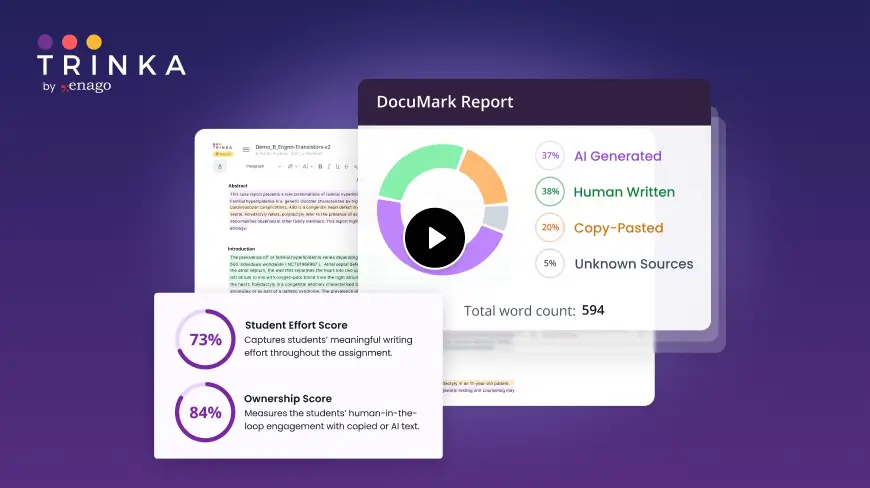
DocuMark: Responsible AI Use for Academic Integrity
Knowing your institution's AI policy is step one. DocuMark helps enforce it fairly by empowering universities to manage AI-generated content, prevent cheating, and support student writing through responsible AI use.
Common Questions About Northwestern University's AI Policies
Northwestern University has defined AI policies in 10 of 12 categories, with an overall coverage score of 83%.
Northwestern states that submitting work produced by another person or resource (including generative AI) under one’s own name without proper attribution is cheating, and that unauthorized use of generative AI to create content submitted as one’s own is plagiarism. For courses where instructors allow generative AI, Northwestern provides template syllabus statements requiring a disclosure describing what AI was used for, which tools were used, and what prompts were used.
Northwestern’s provided sources do not define a university-wide stance on AI detection tools. However, Northwestern states that academic integrity violations include cheating and plagiarism, including allowing generative AI to do one’s work without proper attribution and unauthorized use of generative AI to create content submitted as one’s own, and it indicates that any use of GAI in a “Closed” course will be viewed as a potential academic integrity violation.
Northwestern IT warns that data shared in generative AI queries is often accessible by others and advises university community members not to enter institutional data into generative AI tools that are not validated by the university and lack explicit permission from the data provider. It further states that Level 1 data is permissible to upload to generative AI tools, and that using generative AI tools with data above Level 1 requires approval through Northwestern IT’s procurement and security review processes.