Teaching & Learning
- At the School of Integrative Health, students are prohibited from using AI to complete coursework unless the instructor has expressly permitted it
- More generally, the university requires submitted work to be the student's own and treats misrepresentation of work and plagiarism as academic integrity violations
The use of AI software to complete assignments or take exams is considered cheating and is a violation of the Academic Policy unless there is expressed permission from the instructor.
In order to participate as a student at Notre Dame of Maryland University, a student is required to, and agrees to, maintain academic integrity. The University’s Honor Code requires academic honesty, and it is expected that all work submitted by a student is the student’s own.
Any form of academic dishonesty, including cheating, plagiarism, and misrepresentation of work, is a violation of academic integrity.
- At the School of Integrative Health, using AI to take exams is prohibited unless the instructor has expressly permitted it
- The university's academic integrity policy also prohibits using prohibited information during tests, quizzes, or examinations
The use of AI software to complete assignments or take exams is considered cheating and is a violation of the Academic Policy unless there is expressed permission from the instructor.
Cheating is taking credit for work which has been completed by another person, or assisting others in the misrepresentation of their academic work. Examples include, but are not limited to, the following:
giving or using prohibited written and/or oral information during tests, quizzes, or examinations;
- The university does not publish a standalone policy on AI for personal learning or study assistance
- Graduate coursework (EDU-638, EDU-640) addresses AI in educational contexts but this is curricular content rather than a student-facing study-assistance policy
- However, the SOIH AI policy notes that students should consult the 'Guidelines for AI Use at NDMU SOP' for academic honesty guidance when using AI, suggesting some guidance documents exist
Students are responsible for understanding and avoiding academic dishonesty as relates to the use of AI to complete coursework.
Refer to the Guidelines for AI Use at NDMU SOP for academic honesty when using AI.
EDU-638: Foundations in AI in Education
EDU-640: Ethical Leadership, Research, and Policy in AI-Driven Education
- However, the university does not state a programming-specific AI rule beyond those broader policies
- The university treats uncredited use of computer programs from any source as plagiarism, and at the School of Integrative Health AI use to complete coursework is prohibited unless the instructor gives express permission
Plagiarism is defined as the appropriation of ideas, facts, phrases, or additional materials (such as maps, charts, artwork, or computer programs) from any source without giving proper credit or offering appropriate documentation.
The use of AI software to complete assignments or take exams is considered cheating and is a violation of the Academic Policy unless there is expressed permission from the instructor.
Research
- The university does not provide a separate institution-wide rule specifically addressing AI use for drafting or editing research manuscripts
- At the School of Integrative Health, students are expected to avoid academic dishonesty related to AI not only in class assignments but also in research and written work
Each student shall adhere to ethical principles in all of their academic endeavors in class, in clinic, in internships, in research, and in the presentation of class assignments, tests, and all written work.
Students are responsible for understanding and avoiding academic dishonesty as relates to the use of AI to complete coursework.
- The university prohibits fabrication or falsification of research data, methods, results, and conclusions
- The IRB manual also sets requirements for the use of research data, including that pilot-study data not be used as research data and that public de-identified secondary data sets do not require IRB submission or approval, but it does not give AI-specific rules for data analysis
Fabrication and/or falsifying laboratory and clinical experiences, internship records, attendance records, research data, survey results, research methods, research results, research conclusions, or any other information and/or process used in the collection and presentation of academic, scientific, or professional materials.
Pilot studies do not require IRB submission or approval provided they meet all the following criteria:
• there are 10 or fewer subjects included,
• that data from those subjects are not used as research data, and
• that data from those subjects are not disseminated in any manner.
Projects using public, de-identified, secondary data sets do not require IRB submission or approval.
- The materials provided do not state any AI-specific rules for grant proposals, IRB applications, or ethics declarations
- The university requires faculty and students to submit IRB proposals for research they participate in, and the IRB manual governs proposal submission, review, privacy, and confidentiality
All NDMU faculty and students must submit an IRB proposal for any research they participate in, including
It’s all online! Submit your research proposal and supporting documents electronically via the online submission system at bit.ly/ndmuirbapplication. (This is a SurveyMonkey site).
The IRB must assess whether research activities violate privacy by examining how investigators access subjects or their information and considering the subjects' privacy expectations.
Investigators need proper authorization to access subjects or their information.
Confidentiality: Members must keep all materials confidential.
Academic Integrity
- Students must acknowledge sources and follow the instructor's required documentation method
- The plagiarism guidance specifically directs students to refer to the SOP's AI guidelines for academic honesty when using AI, but the provided materials do not set out a university-wide AI citation or disclosure statement requirement beyond source acknowledgment rules
The exact language of another person (whether a single distinctive word, phrase, sentence, or paragraph) must be identified as a direct quotation and must be provided with a specific acknowledgment of the source of the quoted matter.
Paraphrases and summaries of the language and ideas of another person must be clearly restated in the author’s own words, not those of the original source, and must be provided with a specific acknowledgment of the source of the paraphrased or summarized matter.
Sources must be acknowledged using the systematic documentation method required by the instructor for specific assignments and courses.
Refer to the Guidelines for AI Use at NDMU SOP for academic honesty when using AI.
- The provided materials do not mention AI detection tools
- Undisclosed or unauthorized AI-related academic dishonesty is enforced through the university's academic integrity process
- Faculty investigate suspected violations, impose sanctions, file incident reports, and repeated or egregious violations can lead to probation, suspension, or expulsion
Students suspecting someone of violating this policy should report it to their faculty member or the Academic Department Chair or Program Director. All charges of academic dishonesty will be investigated and resolved by the faculty and/or Academic Department Chair or Program Director through the procedures outlined in the university’s Academic Integrity Policy
A faculty member who, based on personal observations or information provided by others, suspects that a violation has occurred will speak to the suspected student about the situation and, if the violation involves work submitted by the student, shall keep an original copy of the work, if available.
If a faculty member has reasonable proof of a violation, the faculty member shall meet with the student and learn the facts. In consultation with the Department Chair, the faculty member will judge the offense and impose the appropriate sanction(s) from any of the following:
an oral reprimand
a written reprimand
an assignment to repeat the work, to be graded on its merits, for full or partial credit
a lower grade or 0 grade on the test, project, or assignment
a lower grade in the course
a failing grade in the course
the successful completion of the academic integrity course/workshop
For instances of repeated academic integrity violations or an egregious academic integrity violation, the student may be considered for additional sanction beyond those imposed by the faculty member. In such instances, the Office of Community Standards may refer the case to the Honor Board to consider additional sanctions, such as 1) placement on disciplinary probation, 2) suspension from the University, or 3) expulsion from the University.
Institutional & Administrative
- The university does not publish an operational policy governing faculty or staff use of AI for grading, feedback, lesson planning, or administrative tasks
- Graduate curriculum content (EDU-638, EDU-640) discusses AI in education, suggesting institutional awareness, but this is course content rather than a faculty-use policy
EDU-638: Foundations in AI in Education
EDU-640: Ethical Leadership, Research, and Policy in AI-Driven Education
(Note: These are graduate course descriptions, not operational faculty/staff AI use policies.)
- The sources do not define approved AI platforms or an institution-wide data-classification policy for entering university information into AI tools
- The IRB materials require confidentiality, privacy protections, authorization for access to subjects or their information, and secure storage of IRB records
The IRB must assess whether research activities violate privacy by examining how investigators access subjects or their information and considering the subjects' privacy expectations.
Investigators need proper authorization to access subjects or their information.
Confidentiality: Members must keep all materials confidential.
Access & Security of IRB Records
• Physical records are stored in locked cabinets/rooms.
• Digital records are secured on password-protected hardware.
• Access is limited to the IRB Chair, members, institutional officials, and regulatory agencies.
- The only explicit policy in the materials is school-specific rather than institution-wide
- The provided sources show limited AI governance in the form of a School of Integrative Health course policy and graduate coursework on AI in education, but they do not state a university-wide AI strategy, governance committee, or institutional roadmap
Subject: Artificial Intelligence (AI) in Courses Policy
The purpose of this policy is to affirm the School of Integrative Health’s commitment to academic integrity and to describe violations of academic integrity as related to students’ use of artificial intelligence (AI) to complete coursework. This policy supplements the university’s Academic Integrity Policy (https://catalog.ndm.edu/academic-and-behavioral-standards-and-policies).
EDU-638: Foundations in AI in Education
EDU-640: -Ethical Leadership, Research, and Policy in AI-Driven Education
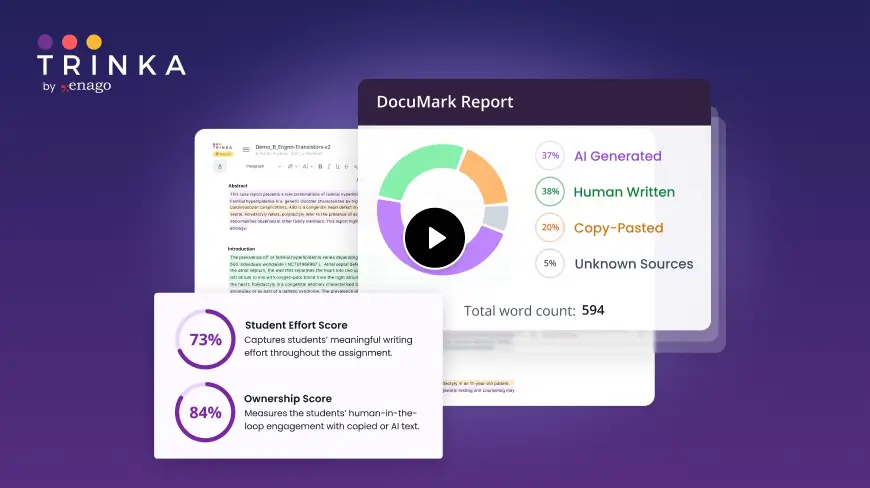
DocuMark: Responsible AI Use for Academic Integrity
Knowing your institution's AI policy is step one. DocuMark helps enforce it fairly by empowering universities to manage AI-generated content, prevent cheating, and support student writing through responsible AI use.
Common Questions About Notre Dame of Maryland University's AI Policies
Notre Dame of Maryland University has defined AI policies in 12 of 12 categories, with an overall coverage score of 100%.
Students must acknowledge sources and follow the instructor's required documentation method. The plagiarism guidance specifically directs students to refer to the SOP's AI guidelines for academic honesty when using AI, but the provided materials do not set out a university-wide AI citation or disclosure statement requirement beyond source acknowledgment rules.
Undisclosed or unauthorized AI-related academic dishonesty is enforced through the university's academic integrity process. Faculty investigate suspected violations, impose sanctions, file incident reports, and repeated or egregious violations can lead to probation, suspension, or expulsion. The provided materials do not mention AI detection tools.
The IRB materials require confidentiality, privacy protections, authorization for access to subjects or their information, and secure storage of IRB records. The sources do not define approved AI platforms or an institution-wide data-classification policy for entering university information into AI tools.