Teaching & Learning
- Course-level AI use rules are left to instructor discretion rather than set by a single university-wide student rule in the provided sources
- Faculty are directed to establish a clear syllabus policy, discuss appropriate AI use with students, and specify expectations for individual assignments, including whether and how students should disclose AI use
Effectively integrating Generative AI requires both proactive conversations with students and a clear syllabus policy. Engage students early and consistently to discuss appropriate AI use, building upon the framework provided by your syllabus. Explain the reasoning behind your policy and its implications.
Where relevant, include a discussion of Generative AI tools in the descriptions or instructions for individual assignments.
Be clear with students, both verbally and in written policies, as to when it is appropriate to use these tools for your courses and whether and how they should disclose that they used them.
- The materials frame AI tools as a starting point for learning rather than a substitute for outside sources, knowledge, or student judgment
- The provided sources encourage faculty to guide students in using generative AI as a learning aid and to teach students to evaluate outputs critically
Guide your students in using generative AI tools, such as writing queries, analyzing results, interrogating the bots’ responses, and using other sources.
Let students know that the tools are a good starting point, but they need outside sources, knowledge, and information to assess the results.
Giving students guided exposure to genAI in their coursework builds the GenAI literacy skills that will help them know how to use these tools ethically, appropriately, and effectively.
Research
- For research writing, AI use is allowed only in limited circumstances for editing or polishing, and researchers remain responsible for accuracy and compliance
- Separate instructional scenarios also show AI-assisted drafting paired with proper citation and an acknowledgment note, but the research office guidance is the stronger policy-facing statement for investigators
Limited appropriate use: AI may assist with tasks like editing or polishing in limited circumstances, but researchers remain fully responsible for content accuracy and compliance.
Professor Ada Script is writing a research paper to submit to a peer-reviewed academic journal. To streamline the writing process, they use a generative AI tool to help draft sections of the paper. The AI generates well-structured paragraphs based on prompts provided by Professor Script, who then edits and personalizes the content. Professor Script ensures that all sources provided by the AI are properly cited and includes a note in the acknowledgments stating that the AI tool assisted in drafting parts of the paper.
- It also warns that improper AI use can create misconduct risks such as AI-generated data or altered images without disclosure
- The research office guidance requires researchers to disclose and verify AI use affecting data and to clearly report AI-assisted image or data processing
Avoid misconduct risks: Improper AI use can lead to fabrication, falsification, or plagiarism (e.g., AI-generated data, altered images without disclosure, or inaccurate references).
Disclose how AI tools are used in applications, research methods, and outputs
Verify accuracy of all data, text, and citations
Clearly report any AI-assisted image or data processing
- The research office states that AI use in research must align with research integrity standards
- Grant or application materials must reflect the investigator's own ideas, substantially AI-generated submissions may not be considered, misuse can trigger compliance actions, and researchers are instructed to follow institutional, journal, and sponsor AI policies
NIH and the HHS Office of Research Integrity (ORI) remind researchers that while artificial intelligence (AI) can support biomedical innovation, its use must align with standards for research integrity.
Originality is required: Applications must reflect the investigator’s own ideas. Submissions substantially generated by AI may not be considered.
Follow institutional, journal, and sponsor policies on AI use
NIH emphasizes that responsible, transparent use of AI is acceptable and encouraged, but misuse may result in compliance actions.
Academic Integrity
- Disclosure expectations for student academic work are set at the course level in the provided sources, with faculty told to tell students whether and how to disclose AI use and to encourage proper citation
- For research-related uses, investigators are told to disclose how AI tools were used and to verify citations, and the responsible-use scenarios include citing AI-provided sources and noting AI assistance in acknowledgments
Encourage your students to use proper citations. Communicate your preferred method of citation to them. Ask them to be honest and open to share their prompts, share their results wherever relevant, and how they use them.
Be clear with students, both verbally and in written policies, as to when it is appropriate to use these tools for your courses and whether and how they should disclose that they used them.
Disclose how AI tools are used in applications, research methods, and outputs
Verify accuracy of all data, text, and citations
The student properly cites all sources provided by the AI and includes a note in the acknowledgments that the AI assisted in drafting the paper.
Professor Script ensures that all sources provided by the AI are properly cited and includes a note in the acknowledgments stating that the AI tool assisted in drafting parts of the paper.
- The provided sources caution faculty against relying on AI detection tools because of false positives and false negatives, especially for some student groups
- The research office also notes that misuse of AI in research may result in compliance actions, but no student-facing penalty procedure specific to undisclosed AI use is defined in the provided sources
GenAI detection tools raise the hopes of faculty by claiming to be able to spot the use of AI in student work. Some claim accuracy rates as high as 99%. However, tests conducted by educators have shown that AI detection tools often result in false positives and false negatives. Even more troubling is the higher frequency of false positives among students writing in a second language, students with poor writing skills, and students on the autism spectrum.
NIH emphasizes that responsible, transparent use of AI is acceptable and encouraged, but misuse may result in compliance actions.
Institutional & Administrative
- The university provides faculty- and staff-facing AI support and access, including Microsoft Copilot, and frames generative AI as a tool to assist teaching, scholarship, and productivity
- The responsible-use scenarios address faculty uses such as grading, participation tracking, course design, and feedback, emphasizing review for fairness, relevance, and accuracy, along with transparency to students in some scenarios
This webpage serves to familiarize, support, and guide Nova Southeastern University faculty in AI matters that affect both their practice and the student experience.
All faculty and staff have access to Microsoft Copilot , your AI assistant for education.
Empower your teaching and scholarship with Generative AI as your dedicated "Faculty Assistant."
Professor Taylor Marks has been experimenting with a generative AI tool to assist with grading student essays.
Professor Trace Fields uses an AI-powered tool to track students' participation and engagement during lectures.
Professor B.F. Winner uses a generative AI tool to create an assignment for an introductory psychology course.
Professor Stazie Noble uses a generative AI tool to provide personalized feedback on student project drafts in their graduate-level educational technology course. Before using the tool, Professor Noble reviews its capabilities and biases, adjusts the settings to match course goals, and tests it on sample work to ensure fairness and relevance. Professor Noble introduces the AI tool to their students, explains its purpose and limitations, and offers an opt-out option for those who prefer only human feedback.
- The provided sources identify an approved university AI platform for employees by stating that faculty and staff have access to Microsoft Copilot
- They also indicate that AI governance and related information-security policies exist and present a scenario warning about storing student data in a third-party cloud system without informing students, but the detailed data-classification or prohibited-platform rules are not visible in the provided source text
All faculty and staff have access to Microsoft Copilot , your AI assistant for education.
* AI Governance Policy (PDF)
Professor Fields uses alias names to replace real student names and stores the data in a third-party cloud system. The students are not informed about how their data are being collected or stored.
- Nova Southeastern University has an institutional AI governance structure in the provided sources
- AI requests must go through the Project Steering Committee process, and the university points users to an AI Governance Policy that is described as outlining its commitment to responsible and effective AI
All AI requests should be channeled through the Project Steering Committee process. This unified approach ensures consistency and strategic alignment across all initiatives.
For a deeper understanding of how we manage AI projects within our organizational framework, please refer to our AI Governance Policy . This policy outlines our commitment to responsible and effective AI.
* AI Governance Policy (PDF)
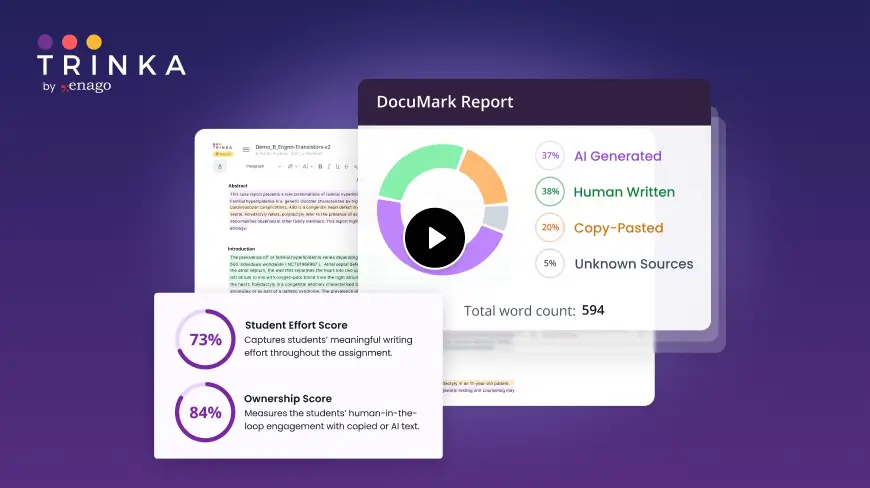
DocuMark: Responsible AI Use for Academic Integrity
Knowing your institution's AI policy is step one. DocuMark helps enforce it fairly by empowering universities to manage AI-generated content, prevent cheating, and support student writing through responsible AI use.
Common Questions About Nova Southeastern University's AI Policies
Nova Southeastern University has defined AI policies in 10 of 12 categories, with an overall coverage score of 83%.
Disclosure expectations for student academic work are set at the course level in the provided sources, with faculty told to tell students whether and how to disclose AI use and to encourage proper citation. For research-related uses, investigators are told to disclose how AI tools were used and to verify citations, and the responsible-use scenarios include citing AI-provided sources and noting AI assistance in acknowledgments.
The provided sources caution faculty against relying on AI detection tools because of false positives and false negatives, especially for some student groups. The research office also notes that misuse of AI in research may result in compliance actions, but no student-facing penalty procedure specific to undisclosed AI use is defined in the provided sources.
The provided sources identify an approved university AI platform for employees by stating that faculty and staff have access to Microsoft Copilot. They also indicate that AI governance and related information-security policies exist and present a scenario warning about storing student data in a third-party cloud system without informing students, but the detailed data-classification or prohibited-platform rules are not visible in the provided source text.