Teaching & Learning
- Unauthorized AI use for assignments is prohibited under the Honor Code
- AI may be used for assignments only when a faculty member or the Office of Disability & Access specifically authorizes it, and faculty are directed to explain how the Honor Code applies to specific assignments
vii) Utilizing artificial intelligence software or other related programs to create
or assist with assignments on the behalf of a student unless otherwise specified
by the faculty member and/or the Office of Disability & Access.
The Honor Pledge is a statement students are required to write and sign at the end of each academic exercise submitted for credit (papers, exams, quizzes, etc.). The pledge is: "I have adhered to the Honor Code in this assignment." The default assumption for this statement is that the student is required to do his or her own work without help from others not explicitly authorized by the instructor.
An "ounce of prevention!" As you prepare your syllabi for the coming semester, explain how the Honor Code applies to specific kinds of assignments in each of your courses.
● If you do not have a position on use of AI, be aware that Our Honor Code Charter currently considers unauthorized use of AI to be cheating:
○ Utilizing artificial intelligence software or other related programs to create or
assist with assignments on the behalf of a student unless otherwise specified by
the faculty member and/or the Office of Disability & Access is considered a
breach of the Honor Code.
- Students must affirm compliance with the Honor Code on exams and quizzes, so AI use during assessments would only be allowed if explicitly authorized
- AI use is not separately defined for exams, but Oberlin prohibits unauthorized assistance and unauthorized electronic-device use during closed assessments
(vi) Using written notes or information, or electronic devices, in an unauthorized
manner to store, share, or retrieve information during a closed assessment.
The Honor Pledge is a statement students are required to write and sign at the end of each academic exercise submitted for credit (papers, exams, quizzes, etc.). The pledge is: "I have adhered to the Honor Code in this assignment." The default assumption for this statement is that the student is required to do his or her own work without help from others not explicitly authorized by the instructor.
- Oberlin provides study and learning assistance resources related to AI through its library and the Lemle Teaching Center resources page; however, no institution-wide policy specifically governing student use of AI tools for personal learning or study assistance beyond the Honor Code framework has been confirmed in the extracted sources
Potential relevant sources not reviewed: https://libguides.oberlin.edu/AI-ChatGPT and https://www.oberlin.edu/lemle-teaching-center/resources. These pages may contain guidance on AI for learning and study assistance and should be reviewed before confirming 'not defined.'
Research
- No confirmed institution-wide policy specifically addressing AI use in research writing or manuscript preparation was found in the reviewed sources; however, unreviewed media documents and the oberlin.edu/ai page may contain relevant guidance and should be reviewed to confirm this classification
Unreviewed sources that may be relevant: https://www.oberlin.edu/media/19580/download and https://www.oberlin.edu/media/19575/download. The oberlin.edu/ai page notes concerns with 'faculty research and pedagogy' but does not provide specific manuscript preparation rules in the extracted content.
- However, the university does not state a specific AI policy for research data analysis tools
- The Honor Code prohibits fabricating or manipulating data in ways that lack accepted scientific or academic rigor, including manufacturing data to support research
4. Fabrication: the manufacturing or manipulation of information of data that lacks standard
scientific or academic rigor expected in the appropriate field of study or discipline. Some
examples of fabrication include:
(a) Falsifying citations, for example by citing information from a nonexistent reference.
(b) Manipulating or manufacturing data to support research.
- Oberlin states that AI raises concerns in faculty research and that the institution will work together to establish policy and procedures, but it does not define specific rules for AI use in grant proposals, IRB materials, or other research ethics documents
* Grapple with the concerns that AI raises in faculty research and pedagogy; student learning, ethical and privacy matters, environmental considerations, etc.
* Work together to establish policy and procedures.
Academic Integrity
- Students are required to sign the Honor Pledge on submitted work
- The university-level sources provided do not set a uniform Oberlin-wide AI citation format, but faculty guidance says instructors should address whether AI is permitted and how students should cite it in their courses
The Honor Pledge is a statement students are required to write and sign at the end of each academic exercise submitted for credit (papers, exams, quizzes, etc.). The pledge is: "I have adhered to the Honor Code in this assignment."
● Policies for the use of Artificial Intelligence in classes are changing quickly. Make sure to
address this in class, if it is something that pertains to your course.
● Consider the following questions in developing your policy statement.
○ If AI use is permitted, how should students cite their use of AI?
A lack of knowledge of the standards of academic citation is not an excuse for
inadequate or improper citation. Students should consult with a professor, librarian, or writing tutor
if they are unsure about their citations or the proper format.
- Unauthorized AI use is treated as an Honor Code violation and can lead to sanctions through the honor system
- The materials provided do not define a university stance on AI detection tools, and grading outcomes remain at faculty discretion rather than being automatic
● If you do not have a position on use of AI, be aware that Our Honor Code Charter
currently considers unauthorized use of AI to be cheating:
○ Utilizing artificial intelligence software or other related programs to create or
assist with assignments on the behalf of a student unless otherwise specified by
the faculty member and/or the Office of Disability & Access is considered a
breach of the Honor Code.
Typically, if a student is found responsible for an Honor Code Violation, they will receive sanctions. Those sanctions include a status sanction (meant to indicate a student's standing within the honor system), restorative sanctions (meant to address any harm caused by the incident), and educational sanctions (meant to prevent future occurrences of the incident). Status sanctions (from least severe to most) are A) an honor warning, B) an honor probation, C) a suspension, D) a dismissal.
Restorative sanctions include, but are not limited to, letters of apology or intentional conversations regarding the incident. Educational sanctions include, but are not limited to, an online academic integrity workshop, a post-hearing meeting with the honor system liaison, or reflective papers. These outcomes are mandatory for students to complete.
No. Faculty members evaluate assignments independently of the Honor Committee's decision. A student may be found in violation of the Honor Code, but still earn a passing grade on the assignment and in the class in question.
c. While the honor committee may recommend the faculty member issue a failing grade, the
grading of an assignment or course is at the discretion of the individual faculty member.
Institutional & Administrative
- Faculty are encouraged to set course-level AI policies and explain them in class and in syllabi
- Institutionally, Oberlin is also exploring AI applications in classrooms and administrative areas, and faculty and staff are slated to receive access to premium ChatGPT and Gemini during the Year of AI Exploration
An "ounce of prevention!" As you prepare your syllabi for the coming semester, explain how the Honor Code applies to specific kinds of assignments in each of your courses.
● Policies for the use of Artificial Intelligence in classes are changing quickly. Make sure to
address this in class, if it is something that pertains to your course.
### Access to AI Tools
Faculty and staff gain access to premium versions of ChatGPT and Gemini in September 2025; students will gain access in spring semester 2026.
### AI Pilot Explorations
Explore applications of AI in the classroom, student affairs, administrative areas, and more.
- Separately, the college prohibits reimbursement and P-card purchasing of AI subscriptions, with reimbursement denials and possible P-card consequences for noncompliance
- The provided sources do not define a formal data-classification or approved-platform policy, but they do state that Oberlin will provide institutional access to premium ChatGPT and Gemini
Faculty and staff gain access to premium versions of ChatGPT and Gemini in September 2025; students will gain access in spring semester 2026.
In alignment with the Center for Information Technology’s September 4, 2025, announcement of the “Year of AI Exploration at Oberlin,” effective immediately, all subscriptions to AI tools (e.g., ChatGPT) will no longer be reimbursable.
Please note:
* Beginning October 1, 2025, all requests for reimbursement of AI subscriptions will be denied.
* Individuals who continue to purchase AI subscriptions using P-cards will be required to reimburse the college.
* Continued noncompliance may result in suspension or termination of P-card privileges.
- The President's published statement is a key primary source for this governance framework
- Oberlin College has launched an institution-wide 'Year of AI Exploration' for 2025-26, supported by the President's Office and campus leadership
- The initiative aims to explore AI benefits and risks across teaching, research, student affairs, and administration; provide access to AI tools for faculty, staff, and students; and develop formal AI policy and procedures through community-wide engagement
To achieve this, 2025-26 will be a 'Year of AI Exploration' at Oberlin, an initiative supported by the President's Office and leadership across our college and conservatory.
Year of AI Exploration Goals:
* Support institutional exploration of AI through speakers, workshops, and hands-on opportunities for faculty, staff, and students.
* Grapple with the concerns that AI raises in faculty research and pedagogy; student learning, ethical and privacy matters, environmental considerations, etc.
* Work together to establish policy and procedures.
* Gather faculty, staff, and student perspectives on AI.
* Explore curricular and co-curricular pathways impacted and possibly enhanced by AI.
* Explore the work of various administrative units through the lens of AI innovation while being attentive to the underlying challenges and pitfalls.
Additional primary source not reviewed: https://www.oberlin.edu/president/statements-and-publications/year-ai-exploration-oberlin
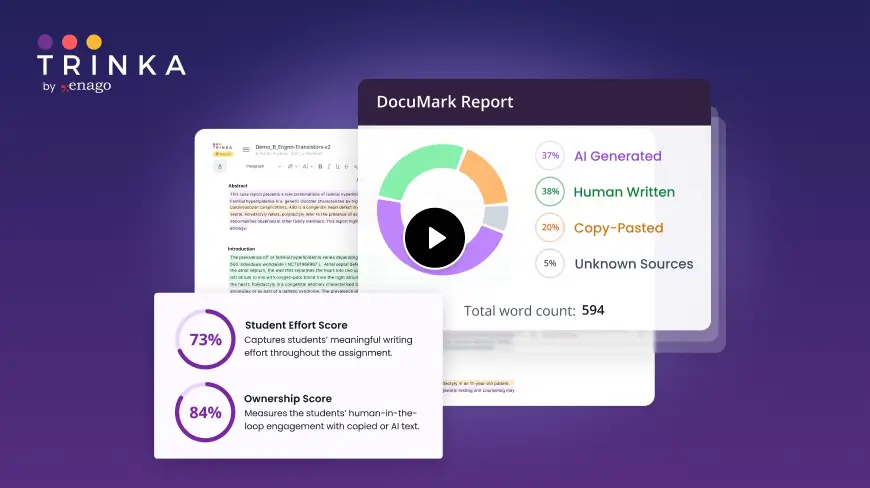
DocuMark: Responsible AI Use for Academic Integrity
Knowing your institution's AI policy is step one. DocuMark helps enforce it fairly by empowering universities to manage AI-generated content, prevent cheating, and support student writing through responsible AI use.
Common Questions About Oberlin College's AI Policies
Oberlin College has defined AI policies in 11 of 12 categories, with an overall coverage score of 92%.
Students are required to sign the Honor Pledge on submitted work. The university-level sources provided do not set a uniform Oberlin-wide AI citation format, but faculty guidance says instructors should address whether AI is permitted and how students should cite it in their courses.
Unauthorized AI use is treated as an Honor Code violation and can lead to sanctions through the honor system. The materials provided do not define a university stance on AI detection tools, and grading outcomes remain at faculty discretion rather than being automatic.
The provided sources do not define a formal data-classification or approved-platform policy, but they do state that Oberlin will provide institutional access to premium ChatGPT and Gemini. Separately, the college prohibits reimbursement and P-card purchasing of AI subscriptions, with reimbursement denials and possible P-card consequences for noncompliance.