Teaching & Learning
- Graduate guidance also places responsibility on students to follow course-specific instructor rules
- Ohio University does not set a single university-wide rule for student use of generative AI in coursework
- Faculty are directed to decide and communicate their own course expectations, and the university provides sample syllabus statements ranging from no AI use, to limited use, to broad permission with attribution
There are no official guidelines on the use of generative artificial intelligence (AI) in classroom activities and assignments at Ohio University. However, faculty may include syllabus language that addresses AI use in their classroom and provides details and expectations to students.
Faculty should make their expectations around the use of generative AI explicit, both in person and in writing, and should align classroom expectations to their learning outcomes and assignment goals.
No Use of AI Allowed: You are prohibited from using generative AI tools (like ChatGPT or DALL-E) in this course for any assignment, activity, or assessment.
Limited Use of AI Allowed with Attribution: You may use generative AI tools (like ChatGPT or DALL-E) only in the following ways in this course... with proper attribution.
Broad Use of AI Allowed with Attribution: You are allowed to use generative AI tools in this course to help with any stage of the writing process and other assignments, but you are expected to cite or otherwise attribute the tool whenever it is used.
Yes, if you are using a generative AI (genAI) tool for coursework, the use and extent must be in accordance with the instructor's policies for the class.
- Use of generative AI in exams and assessments is not governed by a single centralized student rule; it is left to instructor/course policy
- University sample syllabus language includes a complete ban option covering assessments, and graduate guidance says any use for coursework must follow the instructor's class policy
There are no official guidelines on the use of generative artificial intelligence (AI) in classroom activities and assignments at Ohio University. However, faculty may include syllabus language that addresses AI use in their classroom and provides details and expectations to students.
No Use of AI Allowed: You are prohibited from using generative AI tools (like ChatGPT or DALL-E) in this course for any assignment, activity, or assessment.
Yes, if you are using a generative AI (genAI) tool for coursework, the use and extent must be in accordance with the instructor's policies for the class.
- Ohio University presents generative AI as a tool that can support student learning, such as clarifying ideas, reviewing writing, brainstorming, tutoring, and creating study materials
- This use is framed as conditional rather than unrestricted, because students still must follow instructor rules for coursework and should use AI critically due to accuracy and bias concerns
AI can be a useful tool to support the learning process.
Student use cases for genAI tools may include finding explanations or definitions for topics being studied, generating examples, checking understanding of content, or creating review materials.
Students can use AI as a tutor by asking it to explain difficult concepts or provide examples.
You might ask ChatGPT to clarify a complex point from a paper or suggest related readings. It can support brainstorming and help identify ideas or keywords to explore. It can also check grammar, punctuation, and syntax if used carefully.
Always verify any content generated by AI, especially in scholarly or academic work. AI tools can make errors or "hallucinate" sources, facts, or citations.
- Ohio University does not provide a specific university-wide rule for AI-assisted coding in coursework
- Programming-related use falls under the same course-level approach as other assignments, where instructors set expectations and may allow, limit, or prohibit generative AI use
There are no official guidelines on the use of generative artificial intelligence (AI) in classroom activities and assignments at Ohio University. However, faculty may include syllabus language that addresses AI use in their classroom and provides details and expectations to students.
Faculty should make their expectations around the use of generative AI explicit, both in person and in writing, and should align classroom expectations to their learning outcomes and assignment goals.
Yes, if you are using a generative AI (genAI) tool for coursework, the use and extent must be in accordance with the instructor's policies for the class.
Research
- The university also warns that theses and dissertations may have discipline-specific restrictions and that students should consult advisors, committees, and journal or publisher rules
- Ohio University allows limited use of generative AI in research writing support, such as brainstorming, outlining, summarizing, language editing, formatting, and citation assistance, but it states that AI cannot be an author and that researchers remain responsible for the final work
Researchers and graduate students may use generative AI tools to support certain aspects of the writing process, such as brainstorming, outlining, summarizing non-confidential literature, or refining language.
AI tools should not be listed as authors on scholarly papers, as they cannot take responsibility for the content.
The researcher or student remains fully accountable for the accuracy, originality, and integrity of the final manuscript.
Yes, in limited ways. Generative AI may be useful for:
• Brainstorming and outlining
• Checking grammar and readability
• Formatting citations or improving sentence structure
However, you are still responsible for the accuracy, originality, and integrity of your work. Some disciplines, advisors, or publication venues may restrict or prohibit AI use.
Yes, but only with caution and depending on disciplinary and committee expectations. Since theses and dissertations are original scholarly work, students should discuss any AI use with their advisor or committee before including AI-generated content.
Some publishers and graduate programs may have specific restrictions.
- Ohio University permits researchers to use generative AI for some research support tasks, including coding assistance and data analysis support, but only with careful human oversight
- The university prohibits entering sensitive, confidential, export-controlled, or regulated data into public AI tools, and it requires researchers to validate outputs and consult compliance requirements for human subjects data and other protected information
Researchers may use generative AI for support in coding, brainstorming, literature review summaries, or language editing, depending on the norms of their field.
Researchers should not upload unpublished manuscripts, confidential data, export-controlled information, or identifiable participant data into public AI tools unless explicitly permitted by an approved Ohio University protocol or contract.
Researchers are responsible for reviewing all AI-generated output for accuracy, bias, and compliance.
Do not input high risk data into an AI system, unless expressly allowed through the data classification standard and university guidance.
Examples include Social Security numbers, driver license numbers, passport numbers, financial account numbers, health information, and biometric information.
For Exempt or Expedited review, researchers may use certain AI tools in their work if they do not input identifiable private information, sensitive data, or any information that could increase the risk to participants if disclosed.
If a proposed use of AI involves identifiable private information, sensitive data, automated decision-making, or use of AI as part of an intervention or interaction with participants, the study may require Full Board review.
- Ohio University sets explicit research-integrity expectations for AI use
- Researchers remain responsible for accuracy, originality, and compliance; AI cannot be credited as an author; confidential or regulated information cannot be uploaded to public tools unless specifically authorized; and human-subjects uses involving identifiable private information, sensitive data, automated decision-making, or AI-based interventions may trigger stricter IRB review
AI tools should not be listed as authors on scholarly papers, as they cannot take responsibility for the content.
The researcher or student remains fully accountable for the accuracy, originality, and integrity of the final manuscript.
Researchers should not upload unpublished manuscripts, confidential data, export-controlled information, or identifiable participant data into public AI tools unless explicitly permitted by an approved Ohio University protocol or contract.
Researchers are responsible for reviewing all AI-generated output for accuracy, bias, and compliance.
If a proposed use of AI involves identifiable private information, sensitive data, automated decision-making, or use of AI as part of an intervention or interaction with participants, the study may require Full Board review.
Researchers must describe the role of AI in the study design, data collection, analysis, and consent process, as applicable.
Academic Integrity
- In research, the university requires transparency with advisors, committees, publishers, or venues as applicable, and IRB materials must describe AI's role when relevant
- Ohio University provides explicit disclosure expectations where AI use is allowed in coursework: students are expected to cite or otherwise attribute the tool whenever it is used, and faculty are encouraged to specify citation requirements in their syllabus policies
Limited Use of AI Allowed with Attribution: You may use generative AI tools (like ChatGPT or DALL-E) only in the following ways in this course... with proper attribution.
Broad Use of AI Allowed with Attribution: You are allowed to use generative AI tools in this course to help with any stage of the writing process and other assignments, but you are expected to cite or otherwise attribute the tool whenever it is used.
If you permit students to use generative AI, you should indicate how they should cite or acknowledge its use.
Students should be transparent about AI use where required by an advisor, committee, publisher, or grant sponsor.
Researchers must describe the role of AI in the study design, data collection, analysis, and consent process, as applicable.
- Ohio University ties improper AI use to existing academic misconduct processes rather than setting a standalone AI enforcement code in the extracted sources
- The graduate guidance states that unauthorized AI use may be considered plagiarism or cheating under the Student Code of Conduct, and faculty materials advise making AI expectations explicit in syllabus statements
Potentially, yes. If your instructor prohibits AI use or limits it and you use it outside those boundaries, it could be considered a form of plagiarism or cheating under the Student Code of Conduct.
Faculty should make their expectations around the use of generative AI explicit, both in person and in writing, and should align classroom expectations to their learning outcomes and assignment goals.
Academic misconduct includes dishonesty or deception in fulfillment of academic assignments. This includes, but is not limited to, cheating, plagiarism, or knowingly furnishing false information to the University.
Institutional & Administrative
- Ohio University permits faculty and staff to use generative AI for teaching and work-related support, but it emphasizes human responsibility, careful review, and privacy protection
- Faculty are encouraged to use AI for preparation and instructional support while setting clear classroom policies, and staff must avoid entering restricted data into public systems and verify outputs before using them in official work
Faculty can use AI tools to support teaching in a variety of ways, such as brainstorming lesson ideas, generating sample discussion questions, drafting rubrics, creating low-stakes quiz questions, or revising instructional materials for clarity and accessibility.
Faculty should carefully review all outputs for accuracy, bias, and appropriateness.
Faculty should make their expectations around the use of generative AI explicit, both in person and in writing, and should align classroom expectations to their learning outcomes and assignment goals.
Use caution when using AI-generated text in official university communications, evaluations, or documentation. Human review is required.
Do not input institutional data, student records, employee information, or any regulated data into a public AI system unless approved.
All AI output must be reviewed by the user before it is shared, submitted, or used in decision-making.
- Ohio University has explicit institutional data-protection rules for AI use
- The policy distinguishes allowed use by data sensitivity rather than broadly approving all tools
- Users must not enter high-risk, regulated, student, employee, research, or other restricted university data into public AI tools unless an approved standard, protocol, contract, or university guidance allows it, and AI outputs must be human-reviewed before use
Do not input high risk data into an AI system, unless expressly allowed through the data classification standard and university guidance.
Do not input institutional data, student records, employee information, or any regulated data into a public AI system unless approved.
Examples include Social Security numbers, driver license numbers, passport numbers, financial account numbers, health information, and biometric information.
Researchers should not upload unpublished manuscripts, confidential data, export-controlled information, or identifiable participant data into public AI tools unless explicitly permitted by an approved Ohio University protocol or contract.
All AI output must be reviewed by the user before it is shared, submitted, or used in decision-making.
- The sources show a cross-campus effort to develop guidance, share resources, and support responsible adoption of AI in teaching, research, and administration
- Ohio University has institution-level AI governance activity through organized initiatives, work groups, and community-building resources rather than a single consolidated AI master policy in the extracted materials
Ohio University is exploring the implications of generative artificial intelligence across teaching, learning, research, and administration.
The AI Community of Interest is intended to connect faculty and staff who are exploring, using, or thinking critically about artificial intelligence in their work.
Advance Ohio Higher Education Work Groups
Public Syllabus Policies
Ohio University provides guidance and resources to help faculty, staff, and students use AI tools responsibly and effectively.
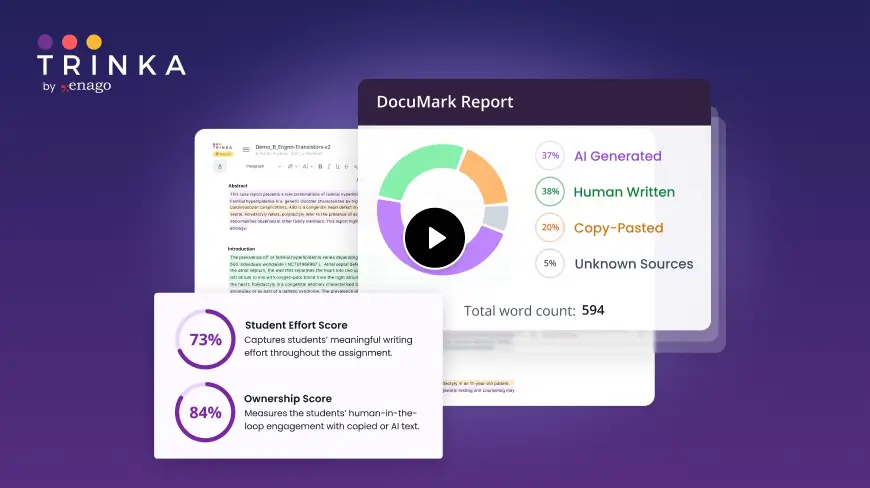
DocuMark: Responsible AI Use for Academic Integrity
Knowing your institution's AI policy is step one. DocuMark helps enforce it fairly by empowering universities to manage AI-generated content, prevent cheating, and support student writing through responsible AI use.
Common Questions About Ohio University's AI Policies
Ohio University has defined AI policies in 12 of 12 categories, with an overall coverage score of 100%.
Ohio University provides explicit disclosure expectations where AI use is allowed in coursework: students are expected to cite or otherwise attribute the tool whenever it is used, and faculty are encouraged to specify citation requirements in their syllabus policies. In research, the university requires transparency with advisors, committees, publishers, or venues as applicable, and IRB materials must describe AI's role when relevant.
Ohio University ties improper AI use to existing academic misconduct processes rather than setting a standalone AI enforcement code in the extracted sources. The graduate guidance states that unauthorized AI use may be considered plagiarism or cheating under the Student Code of Conduct, and faculty materials advise making AI expectations explicit in syllabus statements.
Ohio University has explicit institutional data-protection rules for AI use. Users must not enter high-risk, regulated, student, employee, research, or other restricted university data into public AI tools unless an approved standard, protocol, contract, or university guidance allows it, and AI outputs must be human-reviewed before use. The policy distinguishes allowed use by data sensitivity rather than broadly approving all tools.