Teaching & Learning
- Use of generative AI in coursework is governed by instructor discretion
- Students may use AI only when a professor explicitly permits it, and unauthorized use can be treated as plagiarism or another academic honesty violation
Students are expected to complete all coursework independently, except in cases where professors permit collaboration with other students or with generative AI tools or where professors explicitly permit the use of generative AI in assigned work.
Using generative AI without proper citation, attribution, and authorization from your instructor may constitute plagiarism.
Violations include: 1. Plagiarism by not properly acknowledging the sources of ideas or words or by submitting work done by someone or something else as one’s own.
- No standalone examination-specific AI policy has been identified; however, the general academic honesty policy and generative AI policy apply to assessed work, meaning AI use during exams or assessments is prohibited unless explicitly authorized by the instructor, consistent with the broader coursework rules
Students are expected to complete all coursework independently, except in cases where professors permit collaboration with other students or with generative AI tools or where professors explicitly permit the use of generative AI in assigned work.
Violations include: 1. Plagiarism by not properly acknowledging the sources of ideas or words or by submitting work done by someone or something else as one's own.
Unauthorized use of AI-generated or AI-assisted work can constitute a breach of this code.
- Ohio Wesleyan allows personal learning uses of AI such as brainstorming, summarizing, tutoring, and creating study aids
- These uses are presented as supportive tools, but students are cautioned to verify outputs and avoid overreliance because AI can be inaccurate or misleading
Students can use AI to brainstorm topics and ideas, summarize articles or notes, get explanations and overviews, generate outlines for papers or projects, create review guides, flashcards, and practice tests, ask for feedback on rough drafts, and compare and contrast texts, among many other things!
Use AI critically and thoughtfully. Verify information generated by AI tools before using it for assignments or research. AI systems can produce inaccurate, incomplete, or misleading information and often fail to account for context or nuance. Treat these tools as support for your learning—not as a replacement for your own understanding and effort.
Research
- OWU also states that AI systems cannot be listed as authors because authorship requires human responsibility and accountability
- The university requires anyone who uses AI to produce or assist with content to disclose that use and to identify the systems and prompts used
You should always disclose your use of AI when it has been used to produce or assist with content included in your output.
This disclosure should be included in a footnote or other appropriately relevant location and should indicate all of the following:
*the AI system(s) used
*the purpose(s) for which they were used
*the prompts, queries, and other input used to produce the output or the content at issue
*the source or sources of any uploaded content or data
According to OWU's generative AI guidelines, AI and generative AI systems cannot be listed as authors, co-authors, creators, or co-creators. Authorship carries responsibility for the work's accuracy, integrity, and originality—standards that AI systems cannot meet. Only humans can take accountability for the content they produce. Any use of AI in the creation process must be clearly disclosed in accordance with the university’s generative AI policy.
- No guidance specific to AI-assisted research data analysis workflows is provided
- OWU's data-classification policy restricts how all university data — including research data — may be used with AI systems
- Public data may be used freely, internal-use data only in approved or low-risk tools, confidential data (including unpublished research data) not in external AI systems without Information Services approval, and restricted data is strictly prohibited in any AI system without a formal agreement and security review
Data Classification and AI Usage
OWU classifies data into four categories:
1. Public Data: Information intended for public access and distribution.
Examples: public website content, course catalogs, published research, directory information.
AI Use: Permitted, with no restrictions unless otherwise limited by copyright or policy.
2. Internal-Use Data: Non-public information intended for internal university operations, but not harmful if disclosed.
Examples: internal meeting notes, unpublished teaching materials, internal memos.
AI Use: Permitted in institutionally approved or low-risk AI tools. Avoid entering into consumer/public AI tools unless the data is anonymized or de-identified.
3. Confidential Data: Sensitive information protected by law, regulation, contract, or policy.
Examples: FERPA-protected student records, employee records, donor data, unpublished research data, non-public financial information.
AI Use: Not permitted in external/public AI systems unless explicitly approved by Information Services.
4. Restricted Data: Highly sensitive information requiring strict controls.
Examples: social security numbers, financial account numbers, passwords, protected health information.
AI Use: Strictly prohibited in any AI system unless there is a formal agreement and security review in place.
- OWU treats undisclosed AI-generated or AI-assisted work as an academic integrity issue and requires disclosure of AI use
- The policy also bars AI systems from authorship because they cannot assume responsibility for the integrity of scholarly work
Unauthorized use of AI-generated or AI-assisted work can constitute a breach of this code.
You should always disclose your use of AI when it has been used to produce or assist with content included in your output.
According to OWU's generative AI guidelines, AI and generative AI systems cannot be listed as authors, co-authors, creators, or co-creators. Authorship carries responsibility for the work's accuracy, integrity, and originality—standards that AI systems cannot meet. Only humans can take accountability for the content they produce.
Academic Integrity
- Additional ethical guidance on AI attribution is available through the OWU library
- Disclosure of AI use is required whenever AI has been used to produce or assist with content in any submitted output
- Students are also directed to cite AI use according to their instructor's preferred style or the citation guidance required for the assignment
You should always disclose your use of AI when it has been used to produce or assist with content included in your output.
This disclosure should be included in a footnote or other appropriately relevant location and should indicate all of the following:
*the AI system(s) used
*the purpose(s) for which they were used
*the prompts, queries, and other input used to produce the output or the content at issue
*the source or sources of any uploaded content or data
Cite AI use in your work according to your instructor's preferred style or the citation guidance required for the assignment.
- The university warns that AI detection tools are unreliable and should not be used as sole evidence
- Enforcement for misuse of AI is handled through existing academic honesty procedures, and unauthorized AI-generated or AI-assisted work can be charged as a violation
OWU does not currently use or endorse any specific AI detection tool. Available tools are unreliable and often produce false positives. Faculty should not rely on AI detection software as the sole basis for accusing a student of academic dishonesty.
Unauthorized use of AI-generated or AI-assisted work can constitute a breach of this code.
If a faculty member has reason to believe that an integrity violation has occurred, she or he may either:
(1) within 10 days, consult with the student in question and come to a resolution, or
(2) report the matter to the department chair who will refer the matter to the Academic Integrity Board if no such consultation took place.
Any student found guilty of violating the academic honesty policy shall be subject to one or more of the following penalties:
a. a grade reduction on the project, examination, report, or paper,
b. a grade reduction in the course,
c. a grade of F in the course, and/or
d. suspension from the University.
Institutional & Administrative
- Faculty and staff may use AI to support teaching, administrative work, and other duties, but they remain responsible for all content and decisions
- The university prohibits entering sensitive data into unapproved AI systems and specifically forbids using AI to make final decisions in areas such as admissions, hiring, promotion, and student discipline without meaningful human oversight
Faculty and staff may use AI tools to support teaching, administrative tasks, communication, advising, and professional work, provided such use complies with this policy and all applicable laws and university policies.
Users are responsible for reviewing and validating all AI-generated output before using, sharing, or acting on it. Human judgment must be applied in all cases.
AI systems may not be used to make final decisions about admissions, hiring, promotion, student discipline, or other matters with legal or ethical implications without meaningful human review.
No Confidential or Restricted Data may be entered into public or consumer-grade AI systems unless expressly approved by OWU Information Services.
Faculty, staff, and students should not use generative AI to draft or revise recommendation letters unless they are obtaining informed permission from the student or person they are recommending. Even then, the faculty or staff member should carefully review and ensure the final content accurately reflects their own judgment.
- No specific list of institutionally approved AI platforms is publicly enumerated in the available policy pages
- OWU maintains a formal four-tier data-classification scheme that governs which data types may be entered into AI systems
- Public data is unrestricted; internal-use data is limited to institutionally approved or low-risk tools; confidential data (including FERPA-protected records and unpublished research) is prohibited from external AI systems without explicit Information Services approval; and restricted data is strictly prohibited in any AI system without a formal agreement and security review
Data Classification and AI Usage
OWU classifies data into four categories:
1. Public Data: Information intended for public access and distribution.
Examples: public website content, course catalogs, published research, directory information.
AI Use: Permitted, with no restrictions unless otherwise limited by copyright or policy.
2. Internal-Use Data: Non-public information intended for internal university operations, but not harmful if disclosed.
Examples: internal meeting notes, unpublished teaching materials, internal memos.
AI Use: Permitted in institutionally approved or low-risk AI tools. Avoid entering into consumer/public AI tools unless the data is anonymized or de-identified.
3. Confidential Data: Sensitive information protected by law, regulation, contract, or policy.
Examples: FERPA-protected student records, employee records, donor data, unpublished research data, non-public financial information.
AI Use: Not permitted in external/public AI systems unless explicitly approved by Information Services.
4. Restricted Data: Highly sensitive information requiring strict controls.
Examples: social security numbers, financial account numbers, passwords, protected health information.
AI Use: Strictly prohibited in any AI system unless there is a formal agreement and security review in place.
No Confidential or Restricted Data may be entered into public or consumer-grade AI systems unless expressly approved by OWU Information Services.
- The institution also provides faculty-development resources through the Smith Center for Faculty Excellence, library AI literacy and ethics guidance for students and researchers, and a definitions page clarifying key terms used in the policy
- Ohio Wesleyan University has a university-wide generative AI policy grounded in six principles: human accountability and oversight, transparency and disclosure, data privacy and security, academic integrity and intellectual honesty, fairness and bias mitigation, and legal and policy compliance
Ohio Wesleyan University (OWU) supports the thoughtful, ethical, and responsible use of artificial intelligence (AI) technologies to advance learning, teaching, research, and administrative effectiveness. At the same time, the university recognizes the risks associated with AI, including data privacy concerns, misinformation, bias, intellectual property issues, and threats to academic integrity.
This policy establishes university-wide expectations for the use of AI systems and generative AI tools by faculty, staff, students, and affiliates.
The use of AI at OWU must align with the following principles:
1. Human Accountability and Oversight
2. Transparency and Disclosure
3. Data Privacy and Security
4. Academic Integrity and Intellectual Honesty
5. Fairness and Bias Mitigation
6. Legal and Policy Compliance
The purpose of this page is to centralize resources and information around artificial intelligence and machine learning in pedagogy and scholarship. This page is intended for all OWU faculty and instructional staff—whether you're actively integrating AI into your teaching or just beginning to explore its possibilities.
The following resources are intended to support students and researchers at Ohio Wesleyan University in using generative AI tools thoughtfully and responsibly. They provide guidance on how tools like ChatGPT work, how they can support research and writing, the ethical issues they raise, and how to critically evaluate their output.
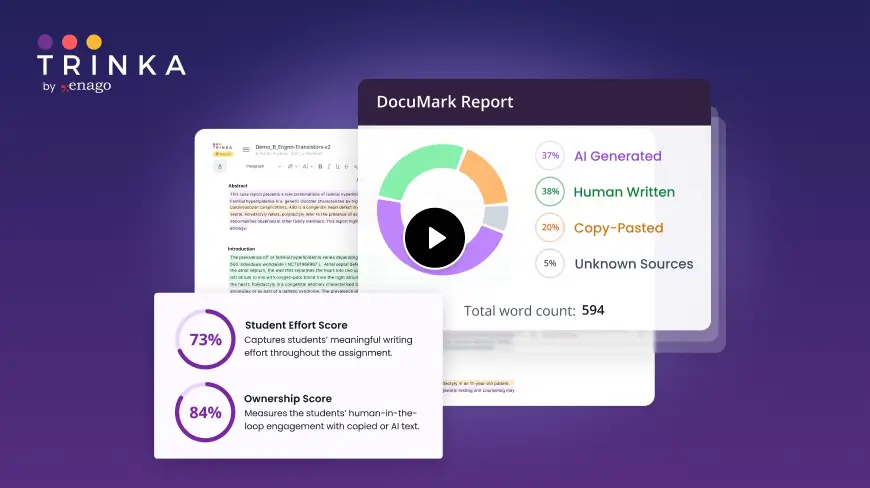
DocuMark: Responsible AI Use for Academic Integrity
Knowing your institution's AI policy is step one. DocuMark helps enforce it fairly by empowering universities to manage AI-generated content, prevent cheating, and support student writing through responsible AI use.
Common Questions About Ohio Wesleyan University's AI Policies
Ohio Wesleyan University has defined AI policies in 11 of 12 categories, with an overall coverage score of 92%.
Disclosure of AI use is required whenever AI has been used to produce or assist with content in any submitted output. The disclosure must identify the AI system(s) used, the purpose(s), the prompts or other inputs, and any uploaded content sources, and must be placed in a footnote or other appropriate location. Students are also directed to cite AI use according to their instructor's preferred style or the citation guidance required for the assignment. Additional ethical guidance on AI attribution is available through the OWU library.
The university warns that AI detection tools are unreliable and should not be used as sole evidence. Enforcement for misuse of AI is handled through existing academic honesty procedures, and unauthorized AI-generated or AI-assisted work can be charged as a violation.
OWU maintains a formal four-tier data-classification scheme that governs which data types may be entered into AI systems. Public data is unrestricted; internal-use data is limited to institutionally approved or low-risk tools; confidential data (including FERPA-protected records and unpublished research) is prohibited from external AI systems without explicit Information Services approval; and restricted data is strictly prohibited in any AI system without a formal agreement and security review. No specific list of institutionally approved AI platforms is publicly enumerated in the available policy pages.