Teaching & Learning
- Use of generative AI on coursework is at instructor discretion
- When an instructor prohibits AI, use of generative AI on course assignments is treated as plagiarism and may trigger academic integrity procedures
- Students are told to verify whether AI use is permissible in a given course, and faculty are told they may allow, limit, or prohibit AI for assignments
The following “Student Strategies for Using Artificial Intelligence”should only be used after verifying with the instructor that using AI-generated content on learning assignments is permissible.
Carefully read the syllabus and verify the permissible use of AI usage first.
Some instructors may not allow AI-generated content in assignments, or they may have specific rules about how it is used.
Faculty may wish to allow students to use generative AI tools, provide specific parameters for its use, or prohibit its use for course assignments and assessments.
Oklahoma State University:"Students are prohibited from using any generative AI tools such as ChatGPT, Bing AI, or Bard when completing course assignments. Use of these tools, or other similar generative AI tools, will not be tolerated and will be considered plagiarism and could result in the student failing the course. Any incident detected will be addressed through the university’s academic integrity procedures."
- Instructors are also encouraged to reduce cheating opportunities and monitor testing situations
- The university does not set a separate AI-specific exam rule, but exam conduct is governed by instructor permission and academic integrity rules
- Faculty may prohibit generative AI for assessments, and unapproved aids or technology during examinations are violations that can result in assignment or course penalties
Faculty may wish to allow students to use generative AI tools, provide specific parameters for its use, or prohibit its use for course assignments and assessments.
Cheating on Examinations: Gathering unauthorized information before or during an examination from others, using notes or other unapproved aids during an examination, failing to observe the rules governing the conduct of examinations (for example, continuing to work on an examination after time is called at the end of an examination), or having another student to take an examination for the student.
o Inappropriate use of technology (camera phones, text messaging, programmable calculator, etc.) during an examination.
Reduce opportunities for cheating through good classroom management - update tests frequently, space students out during exams, create multiple versions of the same test, monitor testing situations, use TurnItIn, etc.
- Examples given include concept explanation, proofreading, and study support
- Student guidance frames AI as something to supplement learning rather than replace critical thinking or originality
- The university permits AI as a learning support tool when used responsibly and with instructor permission where course work is involved
Artificial Intelligence (AI) tools, such as ChatGPT, Google Bard, or Microsoft Bing, can be valuable resources for university students, assisting with research, writing, and learning.
By employing the following strategies, students can ensure they are using generative tools to supplement their knowledge and skills rather than relying on them entirely. It is important to remember that AI tools are meant to assist and enhance learning, not replace critical thinking and originality in academic work.
Enhancing Learning: For example, a student studying quantum physics may use ChatGPT to seek further explanations on complex topics or ask for specific examples to solidify their understanding.
Improving Productivity: A student working on a research paper can leverage Grammarly to assist in proofreading and grammar checks, ensuring a higher quality of writing and saving time in the editing process.
- Faculty may prohibit generative AI for course assignments and assessments
- The university gives students examples of using AI for programming help, but coursework use still depends on instructor permission
- Academic integrity materials also treat copying another student's program or receiving unauthorized help on assignments as violations
In cases where a student encounters a difficult programming problem, Claude 2 can provide suggestions, offer code snippets, or explain different approaches to help the student overcome the challenge.
Faculty may wish to allow students to use generative AI tools, provide specific parameters for its use, or prohibit its use for course assignments and assessments.
Copying another student’s assignment, computer program or examination with or without permission from the author.
Copying another student’s computer program and changing only minor items such as logic, variable names, or labels.
o In a course requiring computer work, copying another student’s program rather than writing one’s own.
Research
- Research integrity rules do state that falsifying laboratory or research data is a violation, and graduate research involving human subjects requires IRB approval before research begins
- The university provides AI-related data privacy guidance for instructors and recommends Copilot for safer institutional use, but it does not define a university-wide policy specifically authorizing or restricting AI for research data analysis
Explore advanced Copilot features in this video, including visual search for data analysis and text-to-image generation.
Guide for Using ChatGPT to Analyze Data
We recommend using Copilot for AI chat to help keep our institutional data safe with built-in commercial data protection from Microsoft. To receive full data protection, you must sign into the Copilot using your institutional username and password.
Fabricating Information: Making up references for a bibliography, falsifying laboratory or research data (for example, tampering with experimental data to obtain “desired” results or creating results for experiments that were not done), or using a false excuse for an absence or an extension on a due date.
If the thesis, dissertation, formal report, or creative component involves human subjects, the research project is subject to federal regulations requiring review by the OSU Institutional Review Board (IRB). Approval to conduct the research must be obtained from the IRB before the research is started.
Academic Integrity
- When AI use is permitted, students are expected to disclose and cite it
- Faculty are also told to communicate permitted and prohibited AI use clearly in syllabi or Canvas
- Student guidance says they should inform instructors how AI was used, and general academic integrity rules require explicit citation and attribution of others' wording, ideas, data, and paraphrased material
Disclose the use of AI.
Inform instructors of AI tool use and explain how they were used.
Cite sources.
Just like any other source, AI-generated content should be cited.
Whenever the student uses wording, arguments, data, design, etc., belonging to someone else in a paper, report, oral presentation, or other assignment, the student must make this fact explicitly clear by correctly citing the appropriate references or sources. The student must fully indicate the extent to which any part or parts of the project are attributed to others.
The student must also provide citations for paraphrased materials.
It is important that faculty clearly communicate to students the acceptable use of generative AI in their course(s). Such communication should be includ ed via a statement in the syllabus and/or Canvas course site in addition to verbally communicating the faculty’s position in class.
- in the course, and level three sanctions apply to graduate students
- Sanctions can range from admonition or zero on the assignment to an F!
- Suspected AI misuse should be discussed with the student, may lead to supervised redo work, and if confirmed must be reported through university procedures
*Note that AI detectors have been found to be inaccurate for AI misuse. See the references below.
Speak with the student privately to discuss the concerns. Don't accuse but explain the specific areas that seem unusual and ask the student to explain their process and reasoning. Listen openly.
If the suspicion remains after discussing it with the student, request the student redo the assignment in a monitored setting, such as taking an oral exam on the material.
If AI misuse is confirmed, enforce the academic integrity policies accordingly. Report any infractions to the proper channels per University Policy.
Assign sanctions according to University policy o Admonition (first time, minor violation) is grade reduction o Level 1 (less than 10% of course grade) is a 0 or F on assignment o Level 2 is F! (pronounced F shriek) for the course o Level 3 for graduate students only
All violations, except those assigned an admonition, are entered into the student conduct database and become a part of a student’s educational record for up to ten years.
Institutional & Administrative
- Teaching resources explicitly cover lesson planning, content creation, course design, grading, and instructor productivity
- Faculty and staff are encouraged to use AI to support teaching and professional work, but with human judgment, review, and responsible practices
- Brand guidance for communications staff says AI is a tool rather than a substitute for expertise, requires careful review before publication, and bars some high-risk uses such as crisis statements and imitation of a person's likeness or voice without consent
Explore these resources to help you integrate artificial intelligence into your teaching.Access tools, resources, and practical strategies to support your use of AI in the classroom.
Welcome to our collection of AI tools designed to support and enhance your teaching. On this page, you'll find a variety of videos and resources that demonstrate how these tools can assist with lesson planning, content creation, and student engagement.
Grading & Instructor Productivity
AI should help you work, not think for you. Generative AI is a tool, not a replacement for human expertise and judgment.
You are responsible for ensuring any content you create using generative AI is accurate and meets quality standards. To avoid blind spots in the content creation process, clearly communicate how you are using AI to your team and project partners and always carefully review any AI-generated content before publication.
Generative AI should not be used to replicate or imitate a person’s likeness or voice without their written consent.
Generative AI should not be used for official statements related to crisis communications and/or the management of sensitive issues.
- Marketing and communications staff are also told not to enter private or proprietary data into tools that lack data privacy protections
- Instructors are told not to upload personally identifiable student information, to minimize stored data and conversation logs, and to seek guidance when unsure
- The university provides explicit privacy and data-handling guidance for AI use and recommends Microsoft Copilot as the institutionally safer option for faculty and staff because it includes commercial data protection
Before diving in, we encourage you to review our AI Usage Guidelines and Data Security document, which outlines how to responsibly and ethically incorporate AI into your professional practices.
- Avoid directly uploading students' personally identifiable information into AI systems. Anonymize or pseudonymize any student data used as much as possible.
- Configure AI tools settings to minimize data collection from students where options exist. Disable storage of user conversations and usage logs if they are not essential for educational purposes.
- If any uncertainty exists around privacy protections or appropriate use of specific AI technology in the classroom, seek guidance from your supervisor before proceeding.
OSU offers Microsoft Copilot with commercial data protection to faculty and staff.
We recommend using Copilot for AI chat to help keep our institutional data safe with built-in commercial data protection from Microsoft. To receive full data protection, you must sign into the Copilot using your institutional username and password.
Prioritize data privacy and security in all generative AI-related work. You should not enter private or proprietary data into generative AI tools that lack data privacy protections and should ensure data privacy settings before engaging with a specific generative AI tool.
- Its materials emphasize general AI use guidelines, support resources, and a growing ecosystem around Microsoft Copilot
- For marketing and communications, the university has broad AI guidelines that will be updated as technology and regulation change
- Oklahoma State presents an institutional AI adoption strategy centered on enabling teaching and learning, supporting faculty, and updating guidance as practices evolve
Empowering teachers with AI-driven tools to enhance their instructional practices, personalize learning experiences, and optimize student outcomes.
Microsoft Copilot is now available at Oklahoma State University!
Generative AI tools, when used appropriately, can be useful to both faculty and students.
This page will continue to be updated as we learn more about how best to support you and other faculty on campus.
These guidelines outline the basic best practices for use of generative AI in Oklahoma State University marketing and communications, deliverables and activities. These guidelines will continue to be updated and refined as new technology and its accompanying regulatory framework evolves.
These are broad parameters intended to align OSU MarCom staff’s use of artificial intelligence with the underlying principles of the Cowboy Code.
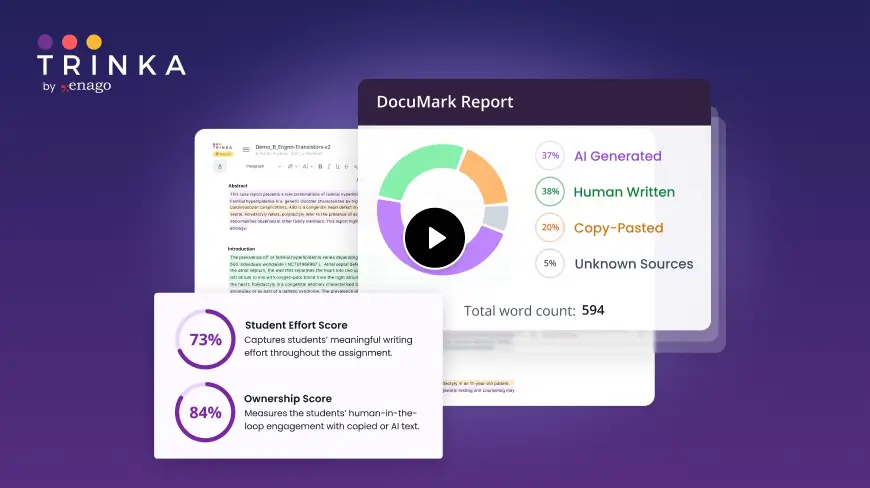
DocuMark: Responsible AI Use for Academic Integrity
Knowing your institution's AI policy is step one. DocuMark helps enforce it fairly by empowering universities to manage AI-generated content, prevent cheating, and support student writing through responsible AI use.
Common Questions About Oklahoma State University's AI Policies
Oklahoma State University has defined AI policies in 10 of 12 categories, with an overall coverage score of 83%.
When AI use is permitted, students are expected to disclose and cite it. Student guidance says they should inform instructors how AI was used, and general academic integrity rules require explicit citation and attribution of others' wording, ideas, data, and paraphrased material. Faculty are also told to communicate permitted and prohibited AI use clearly in syllabi or Canvas.
The university warns instructors that AI detectors are inaccurate and tells them to rely on conversation, review of evidence, and the formal academic integrity process instead of detector output alone. Suspected AI misuse should be discussed with the student, may lead to supervised redo work, and if confirmed must be reported through university procedures. Sanctions can range from admonition or zero on the assignment to an F! in the course, and level three sanctions apply to graduate students.
The university provides explicit privacy and data-handling guidance for AI use and recommends Microsoft Copilot as the institutionally safer option for faculty and staff because it includes commercial data protection. Instructors are told not to upload personally identifiable student information, to minimize stored data and conversation logs, and to seek guidance when unsure. Marketing and communications staff are also told not to enter private or proprietary data into tools that lack data privacy protections.