Teaching & Learning
- Olin states that essays should reflect the applicant's authentic voice
- For Olin admission essays, limited AI assistance is permitted for grammar, spelling, brainstorming, and initial research, but submitting pasted AI-generated text is prohibited
The essays are a key component of the Olin application. Both the Common App prompt and the Olin specific essays provide the Admission Committee with insight into your desire for an engineering education and, more specifically, your understanding of the Olin experience. Your authentic voice should be represented in your application essays, and the reliance on AI, especially models like ChatGPT, will result in writing that is not authentically yours in voice, tone, or nuance.
Copying and pasting directly from an AI generator is not permitted.
Tools for the review of the grammar and spelling in your Olin essays are examples of acceptable uses of AI. You may also use AI models for brainstorming or other initial research of either Olin or your essay topics. In short, consider how a parent, teacher, counselor, or other trusted adult might support you in writing your college application essays. They could meet with you to brainstorm ideas, help you clarify the details of your topic, or review a draft for grammar.
It is acceptable to use AI tools in a comparable way when preparing your application to Olin College.
- The only AI usage guidance found in verified sources pertains specifically to admission essay preparation
- Olin College does not define a university-wide policy for students using AI as tutoring, study help, or revision support in coursework
not defined
Research
- Olin College does not define a policy on the use of AI for research data collection, analysis, statistical processing, synthetic data, or interpretation of results
- The only AI tool referenced in verified sources is a Copilot AI Funding Search Agent for identifying external funding opportunities, which is an administrative tool unrelated to research data practices
not defined
- Olin College does not define AI-specific rules for grant proposals, IRB materials, or ethics declarations in verified sources
- General research integrity responsibilities are placed on the Principal Investigator, and all proposals must be reviewed by the Office of Grants and Sponsored Programs for compliance with sponsor and Olin guidelines
We ask for at least five days notice before a proposal submission deadline to allow us time to review your proposal and obtain institutional approvals. All proposals must be submitted through our office. As PI, you will be responsible for the management and integrity of the design, conduct, and technical reporting of the research project and for managing, monitoring, and ensuring the integrity of any collaborative relationships. Additionally, you will be responsible for the direction and oversight of compliance, financial, personnel, and other related aspects of the research project and for coordination with our office to ensure research is conducted in accordance with federal regulations and college and sponsoring agency policies and procedures.
Academic Integrity
- The student handbook sources provided also do not define AI-specific attribution requirements
- For admission essays, Olin defines acceptable and prohibited AI uses, but the verified sources do not require a disclosure or citation statement for AI use
Copying and pasting directly from an AI generator is not permitted.
Tools for the review of the grammar and spelling in your Olin essays are examples of acceptable uses of AI. You may also use AI models for brainstorming or other initial research of either Olin or your essay topics. In short, consider how a parent, teacher, counselor, or other trusted adult might support you in writing your college application essays. They could meet with you to brainstorm ideas, help you clarify the details of your topic, or review a draft for grammar.
It is acceptable to use AI tools in a comparable way when preparing your application to Olin College.
- The verified sources do not mention AI detection tools
- Olin does state that students are expected to follow the Honor Code and that academic integrity is governed through the Honor Code and Honor Board framework
It is expected that students will behave with integrity and according to the Honor Code.
All Olin students agree to follow the Honor Code (Student Handbook). There is a culture of honesty on campus that reaches into the classroom. As a student this means your are responsible for your behavior with regard to class deliverables.
Note that as of the August 2024 publication of the Student Handbook, some Honor Board sections of this Policy are slightly different than the version voted on by students in spring 2024. These variations do not make changes to Honor Board processes or policy, but were made to add additional clarity and aid in alignment in the introduction of the Community Expectations Policy as an umbrella policy. Changes will be voted on at the Fall 2024 town hall to harmonize the handbook and the honor code.
Institutional & Administrative
- Olin College does not define a faculty or staff AI policy in verified sources
- No guidance was found regarding AI use in grading, feedback, recommendation letters, or administrative communications
not defined
- Olin also offers Copilot AI Funding Search Agents for funding searches
- Olin classifies institutional data as Confidential, Restricted, or Public and ties handling requirements to those levels
- Confidential data may not be transmitted over non-Olin networks, Restricted data transmission over non-Olin networks is strongly discouraged and third-party email is not appropriate, and the Information Security Officer oversees third-party vendor compliance; however, the verified sources do not name a university-wide list of approved AI platforms
Data must be maintained in a secure, accurate, and reliable manner and be readily available for authorized use. Data security measures will be implemented commensurate with data value, sensitivity, and risk. To implement security at the appropriate level, establish guidelines for legal/regulatory compliance, and reduce or eliminate conflicting standards and controls over data, data should be classified into one of the following categories:
1. Confidential - Data which is legally regulated and data that would provide access to confidential or restricted data.
2. Restricted - Data which the Data Managers have decided NOT to publish or make public and data protected by contractual obligations.
3. Public - Data which there is no expectation for privacy or confidentiality.
Transmission of Confidential data through any non-Olin network or Olin guest network is prohibited (e.g. Internet). Transmission through any electronic messaging system (e-mail, instant messaging, text messaging) is also prohibited.
Transmission of Restricted data through any non-Olin network or Olin guest network is strongly discouraged. Third party email services are not appropriate for transmitting Restricted data.
Storage of Confidential data is prohibited on Non-qualified Machines and Computing Equipment unless approved by the Information Security Officer.
Works with Regulation Monitors and Data Managers to ensure all third-party vendors with access to Olin data are compliant.
Copilot AI Funding Search Agents
Try out our Copilot AI Funding Search Agents (Olin login required). Click the sample prompt below the message box and edit it to begin your search.
- The verified sources do not present a formal university-wide AI strategy, AI committee, or AI governance framework
- They do show limited operational use of AI tools and a site-use restriction against commercial AI-enabled scraping without permission
Copilot AI Funding Search Agents
Try out our Copilot AI Funding Search Agents (Olin login required). Click the sample prompt below the message box and edit it to begin your search.
Without the advance express written permission of Olin, you may not 'meta-search' the Sites, send, or cause to be sent, any automated queries of any sort to the Sites, or use the Sites in any commercial manner, including scraping or other similar usage in connection with any artificial intelligence tool or service. You agree not to sell, resell or offer for any commercial purposes, any portion of the Sites, including use or access.
DocuMark: Responsible AI Use for Academic Integrity
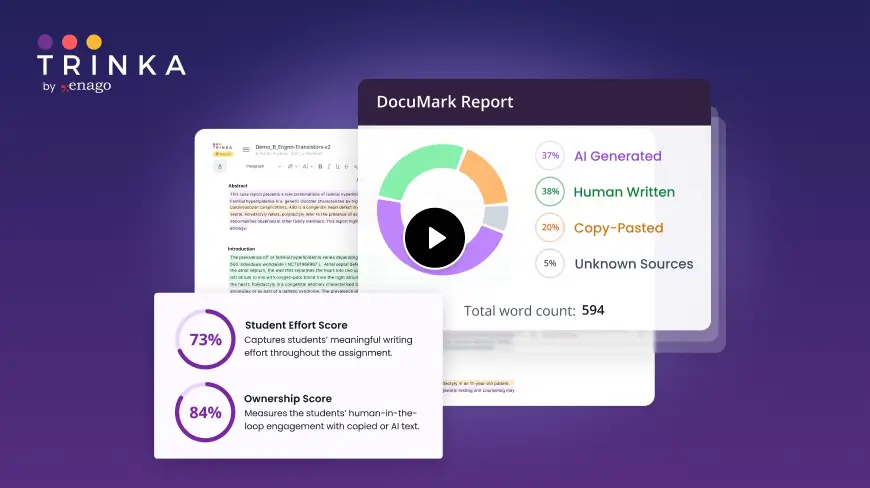
Knowing your institution's AI policy is step one. DocuMark helps enforce it fairly by empowering universities to manage AI-generated content, prevent cheating, and support student writing through responsible AI use.
Common Questions About Olin College of Engineering's AI Policies
Olin College of Engineering has defined AI policies in 9 of 12 categories, with an overall coverage score of 75%.
For admission essays, Olin defines acceptable and prohibited AI uses, but the verified sources do not require a disclosure or citation statement for AI use. The student handbook sources provided also do not define AI-specific attribution requirements.
The verified sources do not mention AI detection tools. Olin does state that students are expected to follow the Honor Code and that academic integrity is governed through the Honor Code and Honor Board framework.
Olin classifies institutional data as Confidential, Restricted, or Public and ties handling requirements to those levels. Confidential data may not be transmitted over non-Olin networks, Restricted data transmission over non-Olin networks is strongly discouraged and third-party email is not appropriate, and the Information Security Officer oversees third-party vendor compliance; however, the verified sources do not name a university-wide list of approved AI platforms. Olin also offers Copilot AI Funding Search Agents for funding searches.