Teaching & Learning
- University guidance states that generative AI tools should only be used for coursework in ways that follow the individual instructor’s guidelines, and students are responsible for reviewing each course policy
- Instructors may require students to use AI tools as part of learning activities, including tools that are not on OSU’s recommended/approved list, but only if the activity does not require students to enter their own creative works, sensitive data, or personally identifiable information; if such entry is required, instructors must use OSU recommended and approved GenAI tools
Generative Artificial Intelligence (GenAI) tools may be relevant to student learning but should only be used for coursework in ways that adhere to individual instructor guidelines. When GenAI use is permitted, care must be taken to use these tools responsibly. Instructors differ in their adoption of and approach to AI tools, and students are responsible for reviewing individual course policies and understanding appropriate use in each course.
Instructors may direct students to use AI applications and tools as part of their learning in the course. GenAI tools that are not on the OSU Recommended and Approved list may be required, as long as the assigned activities do not require a student to enter their own creative works, sensitive data, or personally identifiable information into the GenAI tool.
Instructors must use OSU Recommended and Approved GenAI tools if the student is required to enter their own creative works, sensitive data, or personally identifiable information into the GenAI tool.
- University guidance provides examples of study-related tasks for which students may be allowed to use GenAI (e.g., self-quizzing and other studying purposes), but indicates that whether GenAI is permitted depends on the individual instructor’s course policy and assignment instructions
Generative Artificial Intelligence (GenAI) tools may be relevant to student learning but should only be used for coursework in ways that adhere to individual instructor guidelines. When GenAI use is permitted, care must be taken to use these tools responsibly. Instructors differ in their adoption of and approach to AI tools, and students are responsible for reviewing individual course policies and understanding appropriate use in each course.
Always review individual assignments for specific instructions.
Examples of specific tasks for which students may be allowed to use GenAI: generate ideas, polish or edit drafted text, create an outline of an essay, modify or design presentation slides, review content, self-quizzing, or other studying purposes.
- University-level instructor guidance indicates that student use of GenAI for coursework must follow individual instructor guidelines
- A College of Engineering resource provides a course policy example stating students are allowed to use AI chatbots like ChatGPT as a resource to find solutions for errors and to understand/improve software they are developing, and allowed to use AI chatbots to verify algorithms
Generative Artificial Intelligence (GenAI) tools may be relevant to student learning but should only be used for coursework in ways that adhere to individual instructor guidelines. When GenAI use is permitted, care must be taken to use these tools responsibly. Instructors differ in their adoption of and approach to AI tools, and students are responsible for reviewing individual course policies and understanding appropriate use in each course.
The policy for this course is as follows:
1. You ARE allowed to use ChatGPT, Google Bard, Bing AI, or similar AI chatbots as you would a library resource. For example, you can use ChatGPT to find solutions for errors the same way you would use Stackoverflow or other Internet resources, or to understand and improve software you are developing.
2. You ARE allowed to use AI chatbots to verify algorithms.
Research
- This governs how research data may be handled in third-party services, but does not specifically define AI-related research data analysis practices
- OSU’s university data classification policy defines “Confidential Information” to include certain restricted research data and states that confidential information is generally restricted to university-owned and maintained systems; third-party services may not be used to store or access confidential information unless reviewed and approved
Research data identified by a funding agency or other research partner as requiring restricted access for safety, security, privacy, proprietary, or other reasons;
Third-party services may not be utilized to store or access confidential information unless the third party service has been reviewed and approved by the VPIS.
Academic Integrity
- Student Community Standards guidance states that AI-generated content should be cited similarly to other sources and advises students to check their syllabus for instructor expectations for AI citations
- College of Engineering citation guidance for code states that if students copy or adapt code (including snippets, modules, or functions), they must cite their source and specifies elements the citation should include (e.g., URL, retrieval date, tool title, type, author, version)
You should always check your syllabus to confirm your instructor’s expectations for AI citations. If you have questions, ask!
AI-generated content should be cited much like content used from journals, books, and websites, with the company used as the author.
When writing code, you want to use similar citation ideas as in academic writing instances. Whether you are copying or adapting code from a small snippet or using an entire module or function, you must cite your source.
Your citation should include:
* URL of your source
* Date you retrieved your source
* Title of the program or application you are using
* Type (e.g. source code, application, full program, etc.)
* Author name(s) if available
* Code version if available
- These enforcement provisions are not AI-specific and the provided sources do not define a position on AI detection tools
- OSU’s Acceptable Use of Computing Resources policy states that the university may monitor and record usage of university computing resources in certain circumstances, including when there is reason to believe activities violate policy or law, and states that violations may result in disciplinary actions up to and including termination or expulsion
The university reserves the right to monitor and record the usage of university computing resources by individuals for the following reasons:
b. There is reason to believe that activities are taking place in violation of this or other university policy, or local, state, federal, or international law;
Violations of this policy may result in:
c. Disciplinary actions up to and including termination or expulsion;
Institutional & Administrative
- OSU instructor guidance allows instructors to use OSU recommended and approved GenAI tools to provide an initial review of student work, draft feedback, or score materials against a rubric, but instructors remain responsible for assigning grades based on human evaluation
- Instructors are required to use only OSU recommended/approved AI tools when inputting student work and are required to review GenAI-created feedback before providing it to students; instructors are also strongly encouraged to disclose in the syllabus if they will use OSU recommended/approved GenAI tools for initial review, feedback drafting, or rubric scoring
Instructors may use OSU Recommended and Approved GenAI tools to provide an initial review of student work, draft feedback, or score materials against a rubric. However, instructors are ultimately responsible for assigning grades based on their human evaluation of student work.
Instructors are strongly encouraged to disclose to students in their syllabus statement if they will use OSU Recommended and Approved GenAI tools to provide initial review of student work, draft feedback, or score materials with a rubric. Per the above, only OSU Recommended and Approved GenAI tools may be used to provide such review, feedback or scoring.
Due to privacy and data security concerns, instructors may not input student work to any AI tools or applications that are not recommended and approved by OSU.
Instructors are required to review feedback for students created by GenAI to ensure the highest quality, accuracy, and appropriateness for the course and the student.
- OSU’s data management policy further states that confidential information is generally restricted to university-owned and maintained systems and that third-party services may not be used for confidential information unless reviewed and approved
- OSU’s AI guidelines define an “Approved Tool” as a university-provisioned, secured, and contracted tool (example: OSU-managed Microsoft Copilot) and state that while tools are under review they may only be used with unrestricted, publicly available data
- OSU guidance for instructors requires that instructors not input student work into GenAI tools that are not approved (or recommended/approved) by OSU; if students must enter their own creative works, sensitive data, or personally identifiable information, instructors must use OSU recommended and approved GenAI tools
Approved Tool: A software application that has been officially provisioned, secured, and contracted by the university, with centralized support and controls in place. Examples include OSU-managed, data-protected versions of tools such as Microsoft Copilot.
While tools are under review they may only be used with unrestricted, publicly available data
Instructors may not input student work into any GenAI tools or applications that are not approved by OSU.
Instructors must use OSU Recommended and Approved GenAI tools if the student is required to enter their own creative works, sensitive data, or personally identifiable information into the GenAI tool.
Information classified as Confidential is generally restricted to university-owned and maintained systems. Third-party services may not be utilized to store or access confidential information unless the third party service has been reviewed and approved by the VPIS.
- OSU’s Future AI site states a vision for AI at OSU and describes an AI@OSU Advisory Group and an AI@OSU Coordinating Team
- The AI site also states that OSU’s Provost established the AI@OSU Advisory Group and the AI@OSU Coordinating Team in December 2023 to lay groundwork for an AI Roadmap, and that the Provost’s AI Roadmap is “Coming soon.”
Oregon State University will be a visionary leader driving equitable, scalable and sustainable advancements in artificial intelligence education, research, knowledge translation and innovation, preparing the next generation workforce and partnering locally and globally in artificial intelligence technology development to empower societal change.
## AI@OSU Advisory Group
## AI@OSU Coordinating Team
Foundational Work: In December 2023, the Provost established the AI@OSU Advisory Group and the AI@OSU Coordinating Team to lay the groundwork for OSU’s AI Roadmap.
The Provost's AI Roadmap... Coming soon!
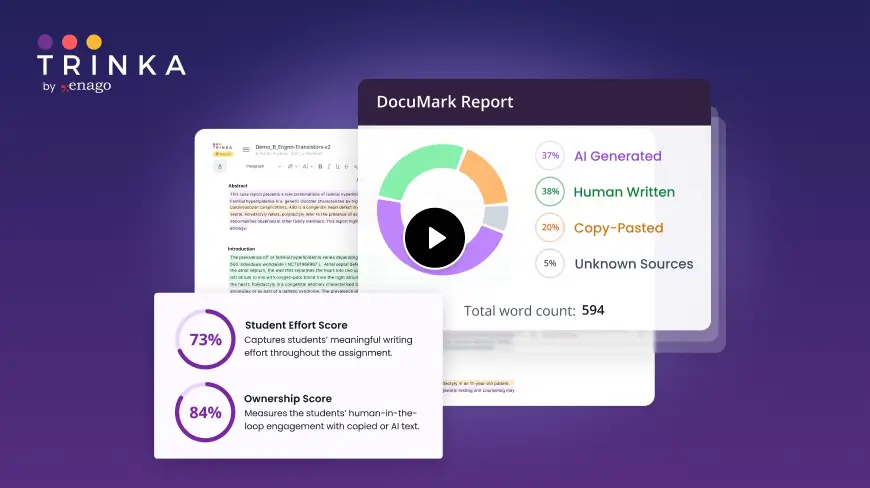
DocuMark: Responsible AI Use for Academic Integrity
Knowing your institution's AI policy is step one. DocuMark helps enforce it fairly by empowering universities to manage AI-generated content, prevent cheating, and support student writing through responsible AI use.
Common Questions About Oregon State University's AI Policies
Oregon State University has defined AI policies in 9 of 12 categories, with an overall coverage score of 75%.
Student Community Standards guidance states that AI-generated content should be cited similarly to other sources and advises students to check their syllabus for instructor expectations for AI citations. College of Engineering citation guidance for code states that if students copy or adapt code (including snippets, modules, or functions), they must cite their source and specifies elements the citation should include (e.g., URL, retrieval date, tool title, type, author, version).
OSU’s Acceptable Use of Computing Resources policy states that the university may monitor and record usage of university computing resources in certain circumstances, including when there is reason to believe activities violate policy or law, and states that violations may result in disciplinary actions up to and including termination or expulsion. These enforcement provisions are not AI-specific and the provided sources do not define a position on AI detection tools.
OSU’s AI guidelines define an “Approved Tool” as a university-provisioned, secured, and contracted tool (example: OSU-managed Microsoft Copilot) and state that while tools are under review they may only be used with unrestricted, publicly available data. OSU guidance for instructors requires that instructors not input student work into GenAI tools that are not approved (or recommended/approved) by OSU; if students must enter their own creative works, sensitive data, or personally identifiable information, instructors must use OSU recommended and approved GenAI tools. OSU’s data management policy further states that confidential information is generally restricted to university-owned and maintained systems and that third-party services may not be used for confidential information unless reviewed and approved.