Teaching & Learning
- Students are directed to check the syllabus or ask the instructor if they are unsure whether AI use is permitted
- Penn State states there is no university-wide policy on AI use in courses; AI policies are determined by individual instructors and can vary course-to-course
There is no university-wide policy about AI use at Penn State. Policies about AI use are up to individual instructors and may vary from course to course. If you’re unsure about whether AI use is permitted in your course, we recommend checking your syllabus or asking your instructor.
- The AI Hub also provides a framework (GenAI Use Icons) intended to help instructors communicate whether GenAI tools are allowed, limited, or not permitted for specific assignments
- Penn State indicates course-level AI rules are set by individual instructors rather than a university-wide policy; this applies to whether AI tools (including those that can generate code) may be used in a given course
There is no university-wide policy about AI use at Penn State. Policies about AI use are up to individual instructors and may vary from course to course. If you’re unsure about whether AI use is permitted in your course, we recommend checking your syllabus or asking your instructor.
The GenAI Use Icons is a framework to assist Penn State instructors in communicating their policies regarding GenAI utilization in coursework. It enables instructors to clearly articulate whether GenAI tools are or are not allowed for specific assignments.
Research
- The AI Hub also advises verifying AI output accuracy and ensuring it contains appropriate citations to real sources
- Penn State’s AI Hub guidelines state that researchers should determine whether they need to disclose AI use or follow other restrictions by checking with journal editors
Determine if you need to disclose your use of AI or if there are other restrictions on its use. Students should check with instructors, staff with their supervisors, and researchers with journal editors.
Be sure to verify that the AI output is accurate, reliable, and contains appropriate citations to real sources.
- This applies to research contexts as part of general guidance for AI use at the university
- Penn State’s AI Hub guidelines warn against using publicly available AI tools when information is intended to remain confidential, including proprietary work and personal information, due to the risk it could be used to train the model and be inadvertently conveyed to others
If you have any information that you want to remain confidential, including proprietary work, as well as your or other’s personal information, don’t use publicly available AI tools. The information could be used to train the large language model and could be inadvertently conveyed to others.
- Penn State’s AI Hub guidelines instruct users to follow applicable state and federal laws (including FERPA, HIPAA, and GLBA) when using generative AI
- For human subjects research protocols, Penn State’s Human Research Protection Program updated protocol templates to include questions about the use of AI in research and indicated these updated templates and other toolkit documents will be required in the new year
Be sure to follow applicable state and federal laws, including, but not limited to, the Family Educational Rights and Privacy Act (FERPA), the Health Insurance Portability and Accountability Act (HIPAA), and the Gramm-Leach-Bliley Act (GLBA).
Section 1.1 (study objectives) updated to include questions about use of Artificial Intelligence (AI) in research.
Use of updated protocol templates and other Toolkit documents will be required in the new year.
Academic Integrity
- The guidance also advises verifying AI output and ensuring appropriate citations to real sources
- Penn State’s AI Hub guidelines advise determining whether AI use must be disclosed and notes that students should check with instructors to understand disclosure requirements or other restrictions
Determine if you need to disclose your use of AI or if there are other restrictions on its use. Students should check with instructors, staff with their supervisors, and researchers with journal editors.
Be sure to verify that the AI output is accurate, reliable, and contains appropriate citations to real sources.
- However, the provided sources do not define AI detection tools or describe specific AI-detection-based enforcement methods
- Penn State’s sanctioning guidelines for academic integrity violations reference submitting an “AI form” for academic integrity cases, indicating an established reporting pathway
You may submit an AI form for a student who is not enrolled in the affected course.
Institutional & Administrative
- Penn State permits employees to use generative AI tools of their choice without review when only public, non-confidential data is involved, and notes that group/class use should follow accessibility guidance
- For instructors using AI software to assist with grading, Penn State requires prior approval from both the department head and dean (or appropriate campus leadership) before requesting/using AI-assisted grading software classified as courseware, and requires instructor review of student work to verify grade accuracy
Although the University does not endorse any particular generative AI tool, employees are permitted to use generative AI tools of their choice without any review as long as only public, non-confidential data is involved in such use.
If use is intended for a group and/or class, see the Accessibility Considerations guidance above for accessibility compliance.
Instructors need to secure approval prior to using courseware. Software being used to assist with grading is classified as courseware. Before submitting a request for an AI-assisted grading software, approval is needed (email is sufficient) from both the department head and dean, or appropriate academic leadership at commonwealth campuses.
Instructors must assign grades based on their professional judgment of student achievement. When using tools to assist with grading, instructors must review student work and verify grade accuracy.
- The guidelines also state employees may use AI tools without review if only public, non-confidential data is involved
- Penn State information classification types are defined under University Policy AD95, and the AI Hub notes its information levels refer to Penn State’s information classification types (Level 1-4)
- Penn State’s AI Hub guidelines prohibit using publicly available AI tools for confidential information (including proprietary work and personal information) due to potential use in model training and inadvertent disclosure
If you have any information that you want to remain confidential, including proprietary work, as well as your or other’s personal information, don’t use publicly available AI tools. The information could be used to train the large language model and could be inadvertently conveyed to others.
Although the University does not endorse any particular generative AI tool, employees are permitted to use generative AI tools of their choice without any review as long as only public, non-confidential data is involved in such use.
Information levels refer to Penn State’s information classification types (Level 1-4).
University Policy AD95 outlines the different information classification types and the security controls you are required to use for each of them.
- The process explicitly includes multiple perspectives (security, ethics, accessibility, privacy, research protections, and academic integrity)
- Penn State describes an AI Risk Assessment Process used to evaluate AI-enabled software and features according to Penn State’s AI guidelines, weighing benefits and risks to support AI adoption across the institution
Our assessment process evaluates AI-enabled software and features according to Penn State’s AI guidelines.
This evaluation considers multiple perspectives:
Security
Ethics
Accessibility
Privacy
Research protections
Academic integrity
By weighing both the benefits and risks, we ensure a balanced approach to AI adoption across our institution.
DocuMark: Responsible AI Use for Academic Integrity
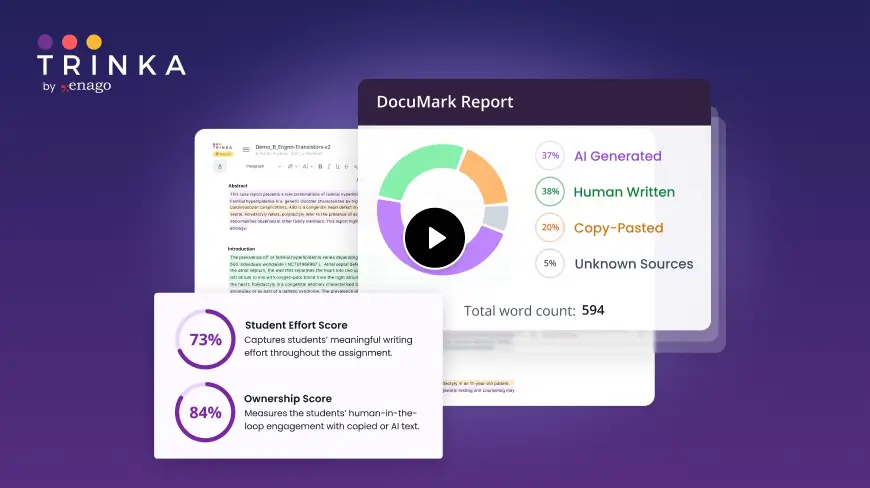
Knowing your institution's AI policy is step one. DocuMark helps enforce it fairly by empowering universities to manage AI-generated content, prevent cheating, and support student writing through responsible AI use.
Common Questions About Pennsylvania State University's AI Policies
Pennsylvania State University has defined AI policies in 10 of 12 categories, with an overall coverage score of 83%.
Penn State’s AI Hub guidelines advise determining whether AI use must be disclosed and notes that students should check with instructors to understand disclosure requirements or other restrictions. The guidance also advises verifying AI output and ensuring appropriate citations to real sources.
Penn State’s sanctioning guidelines for academic integrity violations reference submitting an “AI form” for academic integrity cases, indicating an established reporting pathway. However, the provided sources do not define AI detection tools or describe specific AI-detection-based enforcement methods.
Penn State’s AI Hub guidelines prohibit using publicly available AI tools for confidential information (including proprietary work and personal information) due to potential use in model training and inadvertent disclosure. The guidelines also state employees may use AI tools without review if only public, non-confidential data is involved. Penn State information classification types are defined under University Policy AD95, and the AI Hub notes its information levels refer to Penn State’s information classification types (Level 1-4).