Teaching & Learning
- Use of AI in coursework and assignments is at instructor discretion
- Unauthorized use of generative AI on assignments can be treated as academic misconduct
- The university policy states that faculty set expectations for whether and how AI may be used in their courses, and students are responsible for following those course-specific directions
Ultimately, faculty have the freedom and responsibility to determine how these tools are used in their courses and are expected to provide explicit guidance to students about which uses of AI are appropriate and under what circumstances.
Because faculty have different goals and assumptions for how generative AI should be used in their courses, student use of AI should be guided by the course syllabus and direct faculty instructions.
Unauthorized use of AI in relation to academic work and lying about the nature and extent of use are considered acts of academic dishonesty.
Faculty members should include clear statements about permissible use of generative AI in course assignments and syllabi.
- If AI use is not authorized for an assessment, using it may constitute academic dishonesty
- The university does not set a single AI rule specifically for exams and assessments; instead, expectations depend on faculty instructions and course materials
Ultimately, faculty have the freedom and responsibility to determine how these tools are used in their courses and are expected to provide explicit guidance to students about which uses of AI are appropriate and under what circumstances.
Because faculty have different goals and assumptions for how generative AI should be used in their courses, student use of AI should be guided by the course syllabus and direct faculty instructions.
Unauthorized use of AI in relation to academic work and lying about the nature and extent of use are considered acts of academic dishonesty.
- The university encourages AI use for learning support when students use it to supplement, not replace, their own work
- Guidance materials recommend using AI for brainstorming, reviewing, explaining concepts, and generating practice questions, while warning students to verify outputs and comply with instructor expectations
Generative AI can be a thought partner in the writing and learning process to help students brainstorm, prepare outlines, identify sources, synthesize ideas, review and revise their writing, and edit final drafts.
Whether students are enrolled in online or face-to-face courses, they should not rely on AI to replace their own thinking but rather use these tools to help them to improve or expand their own work.
Be sure your use of AI does not replace your own work and learning.
Support independent learning and studying. Explain a concept or summarize a chapter after you have engaged with the material yourself.
Generate a few low-stakes review questions to test your understanding of course concepts.
- Use in coursework remains subject to instructor direction, and students must follow course-specific requirements
- The university provides AI coding tools, including GitHub Copilot and IgniteAI, but does not establish a single university-wide rule for student use in programming assignments
Ultimately, faculty have the freedom and responsibility to determine how these tools are used in their courses and are expected to provide explicit guidance to students about which uses of AI are appropriate and under what circumstances.
Because faculty have different goals and assumptions for how generative AI should be used in their courses, student use of AI should be guided by the course syllabus and direct faculty instructions.
GitHub Copilot is an AI-powered code completion tool that helps you write code faster and smarter by suggesting whole lines or blocks of code as you type.
IgniteAI can help students brainstorm, organize thoughts, outline papers, write code, ask questions, and simplify information.
Research
- The university's AI policy applies to faculty, staff, and students and says users remain responsible for the accuracy, originality, and ethical use of AI-assisted work
- However, it does not provide a specific research-writing rule for manuscripts, theses, or dissertations beyond general integrity, attribution, and human-responsibility expectations
These guidelines are designed to support the responsible use of AI across teaching, learning, scholarship, service, and administration.
Faculty, staff, and students are responsible for the content and for all consequences stemming from their use of AI tools, including ensuring the accuracy and appropriateness of all resulting materials.
Generative AI may produce information or references that look and sound authentic but are inaccurate, misleading or completely fabricated. Therefore, information generated by AI should always be verified against reliable sources.
AI should not be used in place of original thought, intellectual effort or authentic engagement with course material.
- The only explicit related rule is to avoid entering sensitive or regulated information into publicly accessible AI platforms
- The university requires caution with data entered into AI tools and assigns users responsibility for verifying AI outputs, but it does not define a specific policy on using AI for research data collection, analysis, statistics, synthetic data, or interpretation of results
Information shared with publicly accessible AI tools may be stored, reviewed and used to improve those systems. Users must not enter any nonpublic, personal, confidential, proprietary or otherwise protected information into any publicly accessible generative AI system.
Users are accountable for understanding the terms of use, privacy and data handling policies of any AI tools they choose to use.
Faculty, staff, and students are responsible for the content and for all consequences stemming from their use of AI tools, including ensuring the accuracy and appropriateness of all resulting materials.
- It does not define specific rules for grant proposals, IRB applications, or research ethics disclosures tied to AI
- The university states broad responsible-use and integrity expectations for AI in scholarship, including accountability, accuracy checking, and compliance with laws, regulations, and university policies
These guidelines are designed to support the responsible use of AI across teaching, learning, scholarship, service, and administration.
Faculty, staff, and students are responsible for the content and for all consequences stemming from their use of AI tools, including ensuring the accuracy and appropriateness of all resulting materials.
Generative AI may produce information or references that look and sound authentic but are inaccurate, misleading or completely fabricated. Therefore, information generated by AI should always be verified against reliable sources.
All members of the Quinnipiac community are expected to use AI in ways that comply with all applicable laws, regulations, accreditation standards and university policies, including but not limited to those involving privacy, accessibility, academic integrity, data security, discrimination and harassment.
Academic Integrity
- The policy directs students to follow faculty instructions and citation standards, and says misrepresenting the extent of AI use is academic dishonesty
- Disclosure of AI use is required when instructors or programs ask for it, and students may need to cite or acknowledge AI depending on course expectations
Students should understand that faculty may set course expectations that include requiring or prohibiting certain AI use and may require students to cite or acknowledge use of AI.
It is every student's responsibility to understand and comply with course-specific expectations regarding AI use.
Unauthorized use of AI in relation to academic work and lying about the nature and extent of use are considered acts of academic dishonesty.
This may mean discussing the role of AI in the introduction, citing the AI tool in methods or acknowledgements, or following evolving style-guide recommendations.
- Undisclosed or unauthorized AI use can be enforced as academic dishonesty under the university's academic integrity process
- The university also cautions against relying on AI detectors alone, stating that such tools are not fully reliable and should not be the sole basis for accusations
Unauthorized use of AI in relation to academic work and lying about the nature and extent of use are considered acts of academic dishonesty.
Sanctions for academic dishonesty range from rewriting an assignment to expulsion from the university, depending on the severity of the offense.
The use of AI-content detection tools such as Turnitin's AI writing report is strongly discouraged.
There is currently no AI detector that can identify AI-created content with complete reliability.
AI detection reports should never be used as the sole or primary basis for an accusation of academic misconduct.
Institutional & Administrative
- Faculty and staff may use AI, but they are responsible for oversight, accuracy, confidentiality, and compliance with university policy
- Faculty are expected to give students explicit course guidance about AI, and the university specifically prohibits using AI to write recommendation letters or evaluate student submissions without meaningful human review
Ultimately, faculty have the freedom and responsibility to determine how these tools are used in their courses and are expected to provide explicit guidance to students about which uses of AI are appropriate and under what circumstances.
Faculty members should include clear statements about permissible use of generative AI in course assignments and syllabi.
Faculty and staff must ensure that any use of AI in work-related tasks is reviewed and validated by a human before being relied upon or shared, especially in situations involving evaluations, decision-making or communication on behalf of the university.
The use of AI to generate recommendation letters or evaluations of students is prohibited.
Faculty should not use AI to evaluate student work or submissions unless such use is transparent to students and meaningfully reviewed by the instructor.
- The university prohibits entry of nonpublic, personal, confidential, proprietary, or otherwise protected information into publicly accessible AI systems
- It also identifies institutionally supported tools, including Microsoft Copilot with enterprise data protection and university-provided AI tools such as IgniteAI, while requiring users to understand tool privacy and data-handling terms
Information shared with publicly accessible AI tools may be stored, reviewed and used to improve those systems. Users must not enter any nonpublic, personal, confidential, proprietary or otherwise protected information into any publicly accessible generative AI system.
Users are accountable for understanding the terms of use, privacy and data handling policies of any AI tools they choose to use.
Copilot with Enterprise Data Protection is Microsoft Copilot with added data protection features designed for business and education users.
When signed in with your Quinnipiac account, prompts and responses are protected—Microsoft does not retain chat data or use it to train underlying language models.
IgniteAI is Quinnipiac's AI assistant integrated into Canvas and available to all faculty, staff and students.
- Quinnipiac has a university-wide AI policy and guidelines intended to support responsible AI use across teaching, learning, scholarship, service, and administration
- The institution presents AI as a strategic priority through QILT resources, supported tools, and provost communications, but the extracted sources do not define a formal AI committee structure in the quoted policy language used here
Quinnipiac University is committed to promoting the responsible use of artificial intelligence (AI) in teaching, learning, scholarship and service.
These guidelines are designed to support the responsible use of AI across teaching, learning, scholarship, service, and administration.
This policy applies to all members of the Quinnipiac University community, including faculty, staff, students, administrators and others acting on behalf of the university.
The Quinnipiac Instructional Learning Technology team has compiled these resources to support teaching and learning with AI at Quinnipiac.
As a University, we are committed to embracing the opportunities of AI and exploring ways to use it to support teaching, learning and our work.
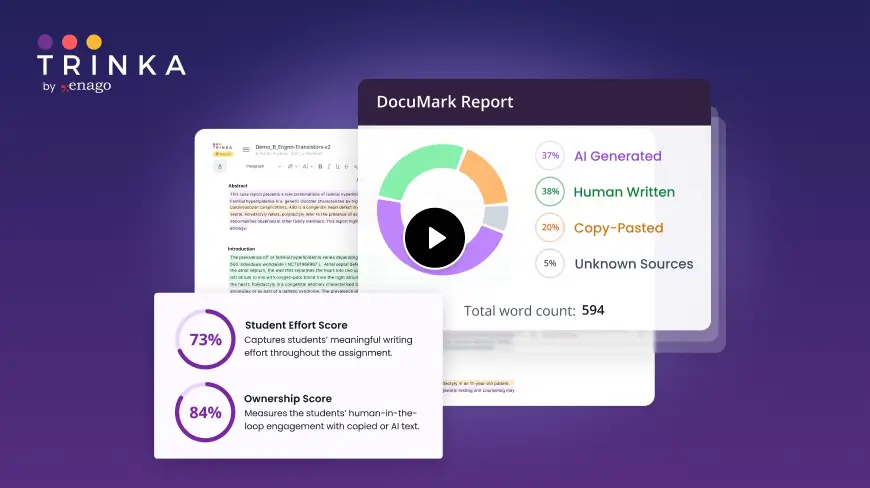
DocuMark: Responsible AI Use for Academic Integrity
Knowing your institution's AI policy is step one. DocuMark helps enforce it fairly by empowering universities to manage AI-generated content, prevent cheating, and support student writing through responsible AI use.
Common Questions About Quinnipiac University's AI Policies
Quinnipiac University has defined AI policies in 12 of 12 categories, with an overall coverage score of 100%.
Disclosure of AI use is required when instructors or programs ask for it, and students may need to cite or acknowledge AI depending on course expectations. The policy directs students to follow faculty instructions and citation standards, and says misrepresenting the extent of AI use is academic dishonesty.
Undisclosed or unauthorized AI use can be enforced as academic dishonesty under the university's academic integrity process. The university also cautions against relying on AI detectors alone, stating that such tools are not fully reliable and should not be the sole basis for accusations.
The university prohibits entry of nonpublic, personal, confidential, proprietary, or otherwise protected information into publicly accessible AI systems. It also identifies institutionally supported tools, including Microsoft Copilot with enterprise data protection and university-provided AI tools such as IgniteAI, while requiring users to understand tool privacy and data-handling terms.