Teaching & Learning
- For class assignments, RISD says students must follow instructor expectations because faculty may differ on whether AI is allowed
- Submitting AI-written text as one's own is prohibited under the code of conduct, and violating course-specific AI rules is also treated as misconduct
Before engaging with AI for a class assignment, check in with your instructor. Faculty have varying views on ChatGPT’s legitimacy and value, and its use at any stage may conflict with their learning goals for the assignment. If your instructor has not made their expectations around using AI explicit, ask first.
– Handing in text composed by ChatGPT is forbidden by the RISD code of conduct. While the language of this policy is not yet thoroughly defined, we know that having AI do the thinking and drafting for you is unethical and undermines the purpose of any assignment.
Noncompliance with Course Expectations The violation of specific course expectations set forth in a syllabus or otherwise provided to the student by the instructor whether verbal or written.
- RISD does not set a single AI rule specifically for exams and assessments in the provided sources
- Instead, use of AI during tests or other assessed work depends on what materials and collaboration the faculty authorizes, and violating instructor-set expectations is misconduct
Cheating The use of unauthorized information, study aids or other materials, communication with, or copying from another student on papers, projects, tests, or other academic work. It is the responsibility of students to consult with their faculty concerning what materials and types of collaboration are permissible.
Noncompliance with Course Expectations The violation of specific course expectations set forth in a syllabus or otherwise provided to the student by the instructor whether verbal or written.
- For assignment-related use, students are told to check with their instructor first
- RISD provides AI as an experimental learning resource and also describes limited uses of ChatGPT that can support student learning
Scholarbot is a chatbot set up by the T&LL that can help you get familiar and experiment with chat-based AI models.
Here are three ways to use ChatGPT that avoid potential plagiarism and better support your learning process. Use them selectively, not holistically.
Before engaging with AI for a class assignment, check in with your instructor.
Research
- RISD does not provide a university research-manuscript policy in the supplied sources
- The only explicit research-writing guidance provided warns students not to use ChatGPT as a research source and not to input thesis material or data
## DON’T use ChatGPT for research
– It is not itself a source. Even if you were to cite ChatGPT, it is not a reliable or respected source for any academic writing.
## DON’T feed ChatGPT your materials
– Avoid giving the AI your thesis material or data, which could be especially concerning in light of patents and ownership.
- RISD does not define a research data or analysis policy for AI in the provided sources
- One source advises students not to enter thesis material or data into ChatGPT because of concerns related to how content may be used
## DON’T feed ChatGPT your materials
– While it’s not going to share this content directly with other users, OpenAI is not transparent about what it uses to train its AI. It’s possible that your content could be used in ways you don’t anticipate.
– Avoid giving the AI your thesis material or data, which could be especially concerning in light of patents and ownership.
Academic Integrity
- RISD requires proper citation when AI-generated content is used and says attribution practices may vary by discipline
- The teaching guidance also recommends that instructors require documentation of the AI tool and process, and includes an example policy where undisclosed AI-generated writing is not allowed
Plagiarism The passing off of someone else’s ideas, writing, or work as one’s own is plagiarism, including content generated by artificial intelligence. Appropriate methods and forms of attribution vary by discipline. Some courses will include instruction in appropriate conventions for citation and attribution within the field.
Students are expected to seek out relevant guidelines on their own (the RISD Writing Center offers resources and guidance), to ask faculty when in doubt about standards, and to recognize that they are ultimately responsible for proper citation.
If you interested in allowing or encouraging your students to partly or fully use AI in their work, ask for some documentation of the tool (e.g.
ChatGPTvo, September 2024) and/or the process (prompts, iterations).
“Any undisclosed use of AI-generated writing or content in this course is not allowed in and will be considered a form of academic misconduct.
Using these tools requires careful consideration about when their use is appropriate, when it is not, and how it should be acknowledged and properly attributed.
- RISD's teaching guidance tells instructors to be skeptical of AI detection software because it may be unreliable and inequitable
- For enforcement, suspected academic misconduct is handled through faculty consultation with the student and internal reporting procedures, and undisclosed AI use may be treated as academic misconduct where course policy says so
Be skeptical about AI detection software. AI detection tools tend to penalize certain groups of students, including English as Second language students, they can often be bypassed, and they are not always effective or reliable.
If academic misconduct is suspected, the faculty member must first speak with the student prior to any action taken to help determine whether the suspicion is warranted. If so, the faculty should then confer with their department head and dean for advisement or clarification of the following three options. The accusing faculty and the department head and/or dean should consult the director of student conduct to seek further guidance and/or see if the student has a previous academic misconduct history.
“Any undisclosed use of AI-generated writing or content in this course is not allowed in and will be considered a form of academic misconduct.
Institutional & Administrative
- RISD encourages faculty to set explicit AI expectations in their syllabi and to be transparent about their own use of AI
- The guidance is advisory rather than a binding institutional rule, and it suggests faculty consider documentation, access, privacy, and security when permitting student AI use
Identify some key priorities or things that are critical to you, your teaching philosophy, and the learning objectives of your course. You can be as concise or detailed as you want to be, elaborate on instructions for students, or signal a certain openness or flexibility that will allow for space in the classroom for conversations.
Policies on the use of AI may differ at departmental / institutional, course, and course-content specific level. For example, you may have a broad strokes policy on the syllabus but elaborate on an assignment description. You may also have “full AI” and “zero AI” policies in different class assignments or activities.
Be transparent about your own use of and engagement with AI. Transparency on the use of AI requires building trust and having honest conversations between teachers and students. Provide information about your engagement with AI or communicate your willingness to dedicate space and time to have these conversations in the classroom.
If you interested in allowing or encouraging your students to partly or fully use AI in their work, ask for some documentation of the tool (e.g.
ChatGPTvo, September 2024) and/or the process (prompts, iterations).
If you are interested in allowing or encouraging your students to partly or fully use AI in their work, consider issues of access, cost, privacy, and security for your students.
- The available guidance only advises caution about privacy, security, data use, and entering thesis material or data into ChatGPT
- RISD does not identify an approved institutional AI platform list or a formal AI data-classification policy in the provided sources
If you are interested in allowing or encouraging your students to partly or fully use AI in their work, consider issues of access, cost, privacy, and security for your students.
– While it’s not going to share this content directly with other users, OpenAI is not transparent about what it uses to train its AI. It’s possible that your content could be used in ways you don’t anticipate.
– Avoid giving the AI your thesis material or data, which could be especially concerning in light of patents and ownership.
- The materials emphasize pedagogical engagement with AI rather than binding governance rules
- RISD shows institution-level support for AI pedagogy through resources, events, and faculty development, but the provided sources do not state a formal university-wide AI governance framework, committee, or strategy document
The "Critical Thinking & Making with AI" Faculty Summer Institute, offered by the Teaching & Learning Lab, introduces participants to emerging generative AI technologies and showcases pedagogy-driven strategies of engaging with AI in ways that serve the needs of art and design students in their scholarship as well as their creative practice.
The Institute combines hands-on exploration of AI tools with small group collaboration and reflection sessions, and covers a range of topics from introductory, "crash course" sessions to designing classroom/studio activities, centered around questions of critical thinking and making.
Rhode Island School of Design’s Debates in AI was a groundbreaking symposium held April 11-12, 2024, that invited artists worldwide to address the multifaceted dimensions of artificial intelligence (AI) and its profound impact on creative disciplines.
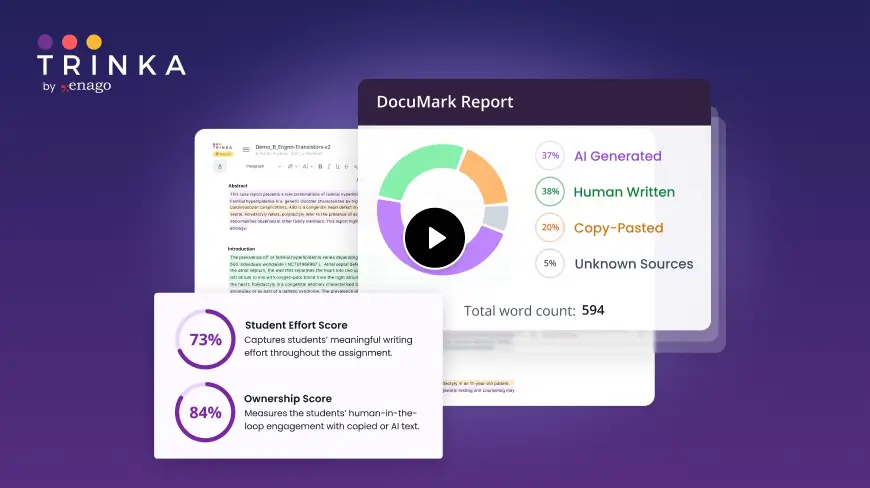
DocuMark: Responsible AI Use for Academic Integrity
Knowing your institution's AI policy is step one. DocuMark helps enforce it fairly by empowering universities to manage AI-generated content, prevent cheating, and support student writing through responsible AI use.
Common Questions About Rhode Island School of Design's AI Policies
Rhode Island School of Design has defined AI policies in 10 of 12 categories, with an overall coverage score of 83%.
RISD requires proper citation when AI-generated content is used and says attribution practices may vary by discipline. The teaching guidance also recommends that instructors require documentation of the AI tool and process, and includes an example policy where undisclosed AI-generated writing is not allowed.
RISD's teaching guidance tells instructors to be skeptical of AI detection software because it may be unreliable and inequitable. For enforcement, suspected academic misconduct is handled through faculty consultation with the student and internal reporting procedures, and undisclosed AI use may be treated as academic misconduct where course policy says so.
RISD does not identify an approved institutional AI platform list or a formal AI data-classification policy in the provided sources. The available guidance only advises caution about privacy, security, data use, and entering thesis material or data into ChatGPT.