Teaching & Learning
- The Rice Honor Council states that using AI to generate ideas and present them as one’s own constitutes plagiarism under the Honor System
- The Honor Council notes that while its general AI policy applies to all academic work, individual professors may set course-specific AI policies and those policies override the general Honor Council policy
“Utilizing AI software to generate ideas and pass them off as one’s own will also be considered plagiarism and will be adjudicated as such.”
This policy was voted on and ratified as of 2023. While this policy governs all academic work, professors are allowed to create their own course-specific AI policies. Furthermore, any course-specific AI policy supersedes the Honor Council’s general AI policy.
Utilizing AI software to generate ideas and pass them off as one's own will also be considered plagiarism and will be adjudicated as such by the Honor Council.
- However, the provided sources do not explicitly define AI-specific permissions or prohibitions during exams beyond the general unauthorized aid framework and the AI-as-plagiarism statement
- Rice’s academic fraud guidance states that students must follow the professor’s requirements for assignments and references the Honor pledge covering “examination” and “quiz,” indicating unauthorized aid violates the pledge
"On my honor, I have neither given nor received any unauthorized aid on this (examination, quiz or paper)."
It is the responsibility of each student to complete all assignments according to the requirements set forth by the professor.
Utilizing AI software to generate ideas and pass them off as one's own will also be considered plagiarism and will be adjudicated as such by the Honor Council.
- The provided Rice sources do not define a university-wide policy explicitly permitting or restricting generative AI for non-graded personal study or tutoring
- The student-facing Responsible AI page points students to learn how policies address generative AI in academic work, but it does not itself state rules for study assistance
not defined
- The provided Rice sources do not define course policy for using AI to generate, debug, or complete programming assignments
- OIT’s AI usage guidance describes generative AI as able to produce outputs including code, but it does not specify academic rules for code generation in coursework
Generative AI, at its core, refers to a class of artificial intelligence systems capable of producing original and innovative outputs, such as text, images, audio, code, and more, in response to given prompts.
Research
- OIT’s AI usage guidance is general in nature and focuses on considerations and privacy/security rather than research writing rules
- The provided Rice sources do not define a research-specific policy governing the use of AI for drafting, editing, or preparing scholarly manuscripts (e.g., papers, theses, dissertations)
not defined
- The sources do not otherwise define research-specific permissions for AI-based data analysis or generation
- Rice’s OIT AI usage guidance includes security and privacy restrictions relevant to research data, stating that information considered sensitive or confidential (including protected research data) should not be used with consumer-focused or publicly available AI services
Information considered sensitive or confidential by University Policy 808 (https://policy.rice.edu/808), including private information about individuals and protected research data, should not be used with consumer-focused or publicly available AI services, including any AI plugins or addons included with other publicly available services. Information shared with these types of services may be exposed to unauthorized parties.
- The provided Rice sources do not define research-ethics-specific requirements for AI use in grant proposals, IRB applications, or research integrity declarations
- The sources include general data protection requirements and general AI privacy/security cautions, but they do not specify AI-specific research ethics or compliance processes
not defined
Academic Integrity
- Rice’s academic fraud guidance requires students to properly credit sources and states that what counts as proper crediting is left to the professor’s discretion, and that neglect of proper citation is academic fraud
- The provided sources do not specify a distinct AI-use disclosure format or citation method for generative AI beyond the general requirement not to pass off AI-generated ideas as one’s own and to credit sources as required by the professor
Any time a student draws particularly or generally from another's work, the source should be properly credited. What is meant by proper crediting is left to the discretion of the professor.
However, it is the student's responsibility to find out from each professor how work for that professor should be credited. Neglect of proper citation shall be considered academic fraud.
Utilizing AI software to generate ideas and pass them off as one's own will also be considered plagiarism and will be adjudicated as such by the Honor Council.
- Rice’s Honor Council guidance indicates faculty may submit AI detector software results (e.g., GPTZero) as evidence and that such results are sufficient to proceed to an investigative meeting
- However, it states the Council will not use detector software as the sole or primary evidence in adjudication due to inaccuracy, and will only treat it as supplementary evidence during deliberation
Professors are allowed to send in detector software results, such as GPTZero, and these results will be sufficient evidence to proceed to an investigative meeting. However, due to their inaccuracy, the Council will not use detector software as the sole or primary evidence in an adjudication but can serve as supplementary evidence for deliberation.
Therefore, professors can submit detector results as evidence if most of the writing is flagged as AI-generated. However, as noted earlier, detector results will only serve as supplementary evidence during deliberation due to their frequent inaccuracy.
Institutional & Administrative
- Rice’s Honor Council states that professors may create their own course-specific AI policies and that these supersede the Honor Council’s general AI policy
- The provided sources do not define specific rules for faculty/staff use of AI for grading, feedback, lesson planning, recommendation letters, or administrative communications
While this policy governs all academic work, professors are allowed to create their own course-specific AI policies. Furthermore, any course-specific AI policy supersedes the Honor Council’s general AI policy.
- It also states that before licensing new services (including generative AI services), users should contact the Information Security Office for a security review
- Rice’s OIT AI usage guidance instructs users not to use sensitive or confidential information (including protected research data) with consumer-focused or publicly available AI services (including plugins/addons) because information may be exposed to unauthorized parties
- Rice Policy 808 defines protection obligations for confidential and sensitive information, and Rice’s ISO Approved Services page indicates that classifications of data are allowed on selected Rice IT services and references Policies 832 and 808 for the data classifications
Information considered sensitive or confidential by University Policy 808 (https://policy.rice.edu/808), including private information about individuals and protected research data, should not be used with consumer-focused or publicly available AI services, including any AI plugins or addons included with other publicly available services. Information shared with these types of services may be exposed to unauthorized parties.
Before licensing new services, including Generative AI services, contact the Information Security Office. The Information Security Office will perform a thorough review of the service to ensure that the service has security in place to maintain the protection of sensitive and confidential information appropriately.
Any Confidential and Sensitive Information obtained or used by Rice University employees in the performance of their duties, or that is stored on Rice University equipment, computers, or devices, stored in the cloud, or that is stored on a personal device of any type must be appropriately protected at all times.
This table indicates which classifications of data are allowed on a selection of commonly used Rice IT Services.
- The committee’s stated purpose includes providing cross-functional guidance, fostering responsible adoption, and advising on policies, tools, and educational opportunities
- Rice has an AI Advisory Committee convened by the Office of the Provost to support the ethical, effective, and innovative use of AI across teaching, learning, research, and operations, and to align institutional efforts with Rice’s mission, values, and strategic goals
The AI Advisory Committee is a cross-campus group convened by the Office of the Provost to support the ethical, effective, and innovative use of artificial intelligence in teaching, learning, research, and operations at Rice. The committee works to ensure that institutional efforts align with Rice’s mission, values, and strategic goals for the future of higher education.
A: The committee supports Rice University’s institutional response to artificial intelligence by providing cross-functional guidance, fostering responsible adoption, and advising on policies, tools, and educational opportunities.
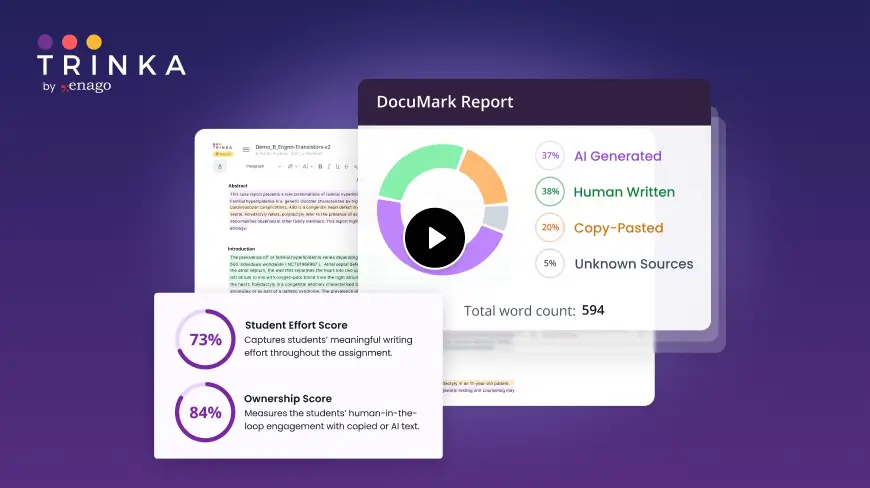
DocuMark: Responsible AI Use for Academic Integrity
Knowing your institution's AI policy is step one. DocuMark helps enforce it fairly by empowering universities to manage AI-generated content, prevent cheating, and support student writing through responsible AI use.
Common Questions About Rice University's AI Policies
Rice University has defined AI policies in 12 of 12 categories, with an overall coverage score of 100%.
Rice’s academic fraud guidance requires students to properly credit sources and states that what counts as proper crediting is left to the professor’s discretion, and that neglect of proper citation is academic fraud. The provided sources do not specify a distinct AI-use disclosure format or citation method for generative AI beyond the general requirement not to pass off AI-generated ideas as one’s own and to credit sources as required by the professor.
Rice’s Honor Council guidance indicates faculty may submit AI detector software results (e.g., GPTZero) as evidence and that such results are sufficient to proceed to an investigative meeting. However, it states the Council will not use detector software as the sole or primary evidence in adjudication due to inaccuracy, and will only treat it as supplementary evidence during deliberation.
Rice’s OIT AI usage guidance instructs users not to use sensitive or confidential information (including protected research data) with consumer-focused or publicly available AI services (including plugins/addons) because information may be exposed to unauthorized parties. It also states that before licensing new services (including generative AI services), users should contact the Information Security Office for a security review. Rice Policy 808 defines protection obligations for confidential and sensitive information, and Rice’s ISO Approved Services page indicates that classifications of data are allowed on selected Rice IT services and references Policies 832 and 808 for the data classifications.