Teaching & Learning
- RIT does not set a single university-wide rule for student AI use in graded coursework
- Its teaching guidance tells instructors to set course-specific expectations, and the sample syllabus statements show that AI use can be prohibited for graded assignments in some courses, limited to conceptual help in others, or actively required in courses built around generative AI
When it comes to using generative AI in this course, the rule of thumb is to treat it as if it were a human. In general, you may use generative AI to do anything you are allowed to do with another person, and things you are prohibited from doing with another person cannot be done with generative AI either.
* Only for non-graded assignments – this means that AI will not be used to generate content for graded assignments.
"Unlike any other course you may have had, the expectation in this class is that you use Gen AI tools as much as possible. “Cheating,” in this class, may constitute not using enough Gen AI in your work. Please be sure to include your own actual observations and reflections in your self-reflection submissions, though you are also encouraged to use Gen AI to enhance those as well."
- RIT’s examples indicate that AI use during exams can be prohibited at the course level
- Separately, the student academic integrity policy says using unapproved tools on an exam or other evaluated work is cheating, so exam use depends on whether the instructor has approved it
* Attempting to prompt generative AI to get solutions or reusable code for an assignment or an exam question, including but not limited to adding any amount of assignment instructions and starter code to the prompt.
* Representing any amount of generative AI output as if it were your own work in an assignment or an exam. Neither the verbatim output nor any derivation of it is allowed.
1. Cheating: Cheating is any form of fraudulent or deceptive academic act, including falsification of data, possessing, providing, or using unapproved materials, sources, or tools for a project, exam, or body of work submitted for faculty evaluation.
- This guidance is presented as course-level expectation setting rather than a single uniform rule for all students
- RIT permits AI for study support in some course examples, such as asking about concepts, getting explanations, or being quizzed, and one sample policy allows use only to deepen understanding on non-graded work with citation and acknowledgment
* Asking generative AI about a concept in this course per se.
* Having a conversation with a chat-based LLM (such as ChatGPT, Claude, Gemini, etc.) about high-level concepts. Asking it to explain a specific snippet of code (one or two functions, say). Asking it to quiz you on course topics.
* Only to formulate alternative meaning to specific engineering topics with the intention of developing deeper understanding.
* Only with proper citations and acknowledgement.
* Only for non-graded assignments – this means that AI will not be used to generate content for graded assignments.
- Students are also told they remain responsible for the integrity of submitted code and should not copy and paste code without understanding it
- RIT’s sample programming guidance allows limited AI assistance for high-level conceptual help and code explanation, but it prohibits using AI to obtain assignment or exam solutions or reusable code
* Having a conversation with a chat-based LLM (such as ChatGPT, Claude, Gemini, etc.) about high-level concepts. Asking it to explain a specific snippet of code (one or two functions, say). Asking it to quiz you on course topics.
* Regardless of tools used, you take ultimate responsibility for the integrity of the code you submit
* Uploading/pasting large sections of assignments with the intent of having the AI complete a portion of the assignment for you.
This is tricky and the line between what is allowed and what is not allowed is a bit fuzzy. Sometimes you ask a chat model for high-level clarifications and it generates code anyways. It is then good practice to try out that code and try to understand how it works. But it is bad practice to "merely copy/paste" without understanding.
* Attempting to prompt generative AI to get solutions or reusable code for an assignment or an exam question, including but not limited to adding any amount of assignment instructions and starter code to the prompt.
Research
- RIT does not define a university-wide rule for using AI to draft or edit research papers, theses, or manuscripts
- The libraries provide citation guidance for research uses of generative AI, but no explicit policy position on manuscript drafting or editing is stated in the provided sources
Guidance on how to cite work created using GenAI can be found on our RIT Libraries Citation InfoGuide.
- RIT does not define a specific AI policy for research data analysis or synthetic data generation in the provided sources
- Its libraries guidance prohibits uploading library-sourced materials into third-party systems, and its security guidance says users must not provide sensitive or confidential data to AI systems and should use RIT logins for RIT data
Repurposing content from library databases is not allowed. The library has contractual agreements with our vendors which usually includes not uploading library sourced content into third party systems. Please respect the rights of content creators and content distributors.
Repurposing content from the library (including journal articles, eBooks datasets, etc.) is not allowed. The library has contractual agreements with our vendors which precludes users from uploading library sourced content into third party systems. Please respect the rights of content creators and content distributors.
Use Only RIT Logins for RIT Data
* Login to Copilot with Enterprise Data Protection through your RIT account.
* Login to Gemini/NotebookLM with your g.rit.edu account.
Refrain from providing sensitive data such as student records, financial details, personal identifiable information (PII), intellectual property, or any other confidential material to AI systems.
Academic Integrity
- RIT requires disclosure or acknowledgment of AI use in some course-level examples rather than through a single universal student rule
- The sample teaching guidance explicitly requires proper citations and acknowledgment in at least one course policy, and the libraries direct users to citation guidance for research uses of generative AI
* Only with proper citations and acknowledgement.
Guidance on how to cite work created using GenAI can be found on our RIT Libraries Citation InfoGuide.
- For enforcement, the university’s academic integrity policy treats use of unapproved tools in projects, exams, or other work for faculty evaluation as cheating
- RIT’s teaching guidance recommends against relying on AI detection tools, stating they are unreliable and suggesting assignment redesign and clear expectations instead
As generative AI tools become increasingly integrated into education, we encourage faculty to move beyond dependence on AI detection software as part of their pedagogy. Instead, faculty should consider taking a proactive approach that prioritizes academic integrity, ethical AI use, and critical thinking through the intentional design of assignments within a course.
* AI detection tools are unreliable, prone to false positives, and lack transparency
While many educators long for the AI equivalent of Turnitin, there is no reliable AI detection tool.
1. Cheating: Cheating is any form of fraudulent or deceptive academic act, including falsification of data, possessing, providing, or using unapproved materials, sources, or tools for a project, exam, or body of work submitted for faculty evaluation.
Institutional & Administrative
- RIT provides faculty-facing guidance and examples for using AI to support instruction, including instructional efficiency and formative feedback
- Its security guidance also says faculty and staff should not rely solely on generative AI to complete tasks or generate content and must verify outputs for accuracy
CTL has a variety of resources and opportunities for faculty to share their experiences and practices with using generative AI in teaching.
Ideas for using generative AI to help you design and facilitate your courses more effectively and efficiently.
Presented by Clark Hochgraf (Associate Professor, Department of Electrical and Computer Engineering Technology, CET) at CTL’s “Teaching With AI Showcase” webinar held on February 14, 2024.
* Don’t rely solely on GenAI tools to complete tasks, answer questions, or generate any type of content.
* Do verify that the information provided through GenAI is accurate.
- RIT provides institutionally available AI tools for students, faculty, and staff and directs users to access them with RIT accounts
- It requires users to avoid entering private or confidential information into AI systems, says sensitive information may only be shared if pre-approved with RIT, and applies its information handling standard to everyone who accesses RIT information resources
RIT students, faculty, and staff have free access to a variety of Generative AI (GenAI) tools designed to enhance productivity, streamline processes, and more.
Available for RIT students, faculty, and staff.
*Please note that these tools are available as part of our existing agreements/licenses with Microsoft, Google, and Zoom.
Use Only RIT Logins for RIT Data
* Login to Copilot with Enterprise Data Protection through your RIT account.
* Login to Gemini/NotebookLM with your g.rit.edu account.
Refrain from providing sensitive data such as student records, financial details, personal identifiable information (PII), intellectual property, or any other confidential material to AI systems.
Don’t share sensitive or private information (student records, financial records, PII, etc.) with GenAI tools– unless pre-approved with RIT.
This Standard applies to everyone who accesses RIT Information Resources, whether affiliated with RIT or not, from on campus or from remote locations, including but not limited to: students, faculty, staff, contractors, consultants, temporary employees, alumni, guests, and volunteers.
- RIT has an AI Task Force that was charged by the Provost to deliver recommended action steps and an implementation timeline
- The task force report frames AI as a strategic institutional priority, ties it to instruction, research, and ethical governance, and recommends establishing faculty governance and administrative structures, including a faculty senate committee on AI in teaching and curriculum
The Task Force was first convened on December 14, 2023 and charged with providing the Provost with a report by April 1, 2024, which would include recommended action steps and an implementation timeline.
How can our campus community operate as a living laboratory for human-AI coexistence, in turn translating our experiences into innovations in instruction and research in AI and its ethical governance?
Recommendation 1: Establish governance and
administrative structures to support AI in teaching
and curriculum
1.1 Create a new faculty senate committee for AI in teaching &
curriculum
Faculty governance must be involved in changes to curriculum and educational policies. A new standing committee on AI in teaching and curriculum is proposed as part of Faculty Senate.
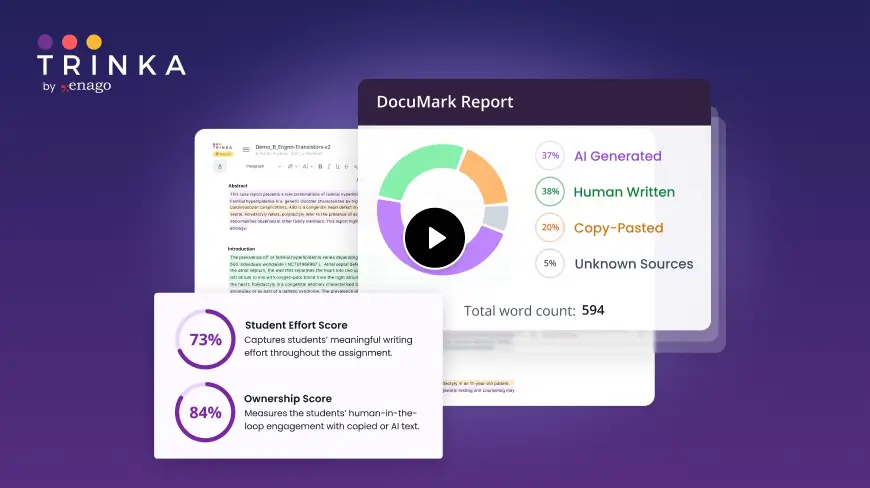
DocuMark: Responsible AI Use for Academic Integrity
Knowing your institution's AI policy is step one. DocuMark helps enforce it fairly by empowering universities to manage AI-generated content, prevent cheating, and support student writing through responsible AI use.
Common Questions About Rochester Institute of Technology (RIT)'s AI Policies
Rochester Institute of Technology (RIT) has defined AI policies in 11 of 12 categories, with an overall coverage score of 92%.
RIT requires disclosure or acknowledgment of AI use in some course-level examples rather than through a single universal student rule. The sample teaching guidance explicitly requires proper citations and acknowledgment in at least one course policy, and the libraries direct users to citation guidance for research uses of generative AI.
RIT’s teaching guidance recommends against relying on AI detection tools, stating they are unreliable and suggesting assignment redesign and clear expectations instead. For enforcement, the university’s academic integrity policy treats use of unapproved tools in projects, exams, or other work for faculty evaluation as cheating.
RIT provides institutionally available AI tools for students, faculty, and staff and directs users to access them with RIT accounts. It requires users to avoid entering private or confidential information into AI systems, says sensitive information may only be shared if pre-approved with RIT, and applies its information handling standard to everyone who accesses RIT information resources.