Teaching & Learning
- Rose-Hulman does not state an AI-specific rule for coursework and assignments in the provided sources
- It does state that submitted work must be the student's own original work, that students must properly acknowledge others' contributions, and that dishonest use of others' material or reusing the same work across courses is treated as academic dishonesty
Your original work will document your own creativity and ability to apply what you have learned here, and you will want your work to be properly acknowledged.
Likewise, it is important for you to learn how to properly acknowledge the contributions of others.
Ignorance is not an excuse for lack of academic integrity. It is each student's responsibility to know the Rose-Hulman policy on academic honesty, including plagiarism, cheating, dishonest conduct and collusion, and to abide by the rules as stated in the Student Handbook.
This not only includes misrepresenting others' work as your own, but also summarizing, paraphrasing, use of any other material in your work and incorrect or incomplete citations and references. Using the same work for multiple courses is also dishonest.
Research
Academic Integrity
- However, they do not provide any AI-specific disclosure or citation requirement
- The provided sources require students to properly acknowledge others' contributions and to avoid incorrect or incomplete citations and references
Likewise, it is important for you to learn how to properly acknowledge the contributions of others.
Understanding how to work in collaboration with others and how to properly incorporate their work into your own labors, and acknowledge them appropriately, demonstrates your intellectual maturity and professionalism.
This not only includes misrepresenting others' work as your own, but also summarizing, paraphrasing, use of any other material in your work and incorrect or incomplete citations and references.
- Rose-Hulman does not mention AI detection tools in the provided sources
- For academic misconduct generally, instructors may reduce or deny credit and impose additional penalties, and cases can be escalated to the Institute Integrity and Discipline Committee; written reports are required and suspension is possible through committee or dean processes
Academic Misconduct includes actions such as cheating, plagiarizing, or interfering with the academic progress of other students.
In such cases, the instructor may choose to give reduced credit or no credit for work dishonestly done. This may result in a lowering of the student's course grade.
In addition, the instructor may appropriately levy some further penalty, since the student has violated the Institute Code. Penalties include but are not limited to a warning, (further) lowering the course grade, failure in the course, or turning the case over to the Institute Integrity and Discipline Committee.
In all instances, the instructor shall submit a brief written report of the case and any action taken to the Dean of Students, the Head of department, and the student.
A Committee decision to suspend may be appealed to the Faculty (see below, "V: Appealing a Suspension to the Faculty"). In all other cases the decision of the Committee is final.
The Dean is specifically delegated by the Faculty the authority to suspend a student, temporarily or permanently.
Institutional & Administrative
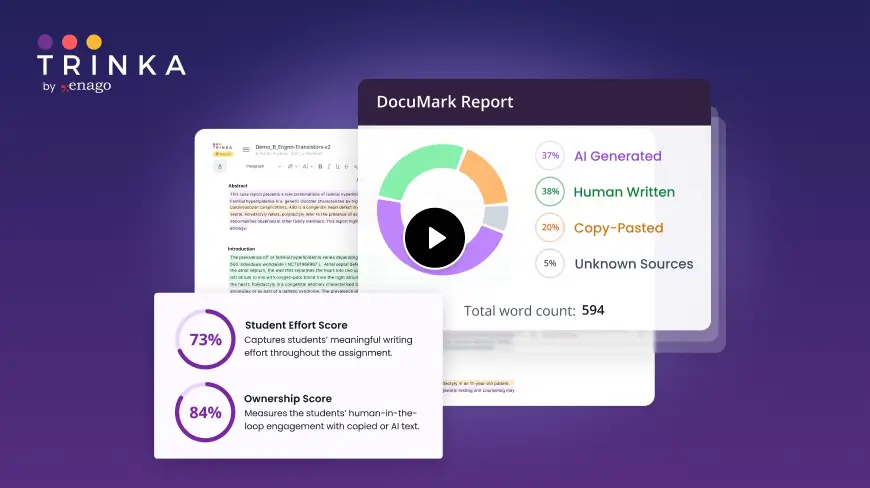
DocuMark: Responsible AI Use for Academic Integrity
Knowing your institution's AI policy is step one. DocuMark helps enforce it fairly by empowering universities to manage AI-generated content, prevent cheating, and support student writing through responsible AI use.
Common Questions About Rose-Hulman Institute of Technology's AI Policies
Rose-Hulman Institute of Technology has defined AI policies in 3 of 12 categories, with an overall coverage score of 25%.
The provided sources require students to properly acknowledge others' contributions and to avoid incorrect or incomplete citations and references. However, they do not provide any AI-specific disclosure or citation requirement.
Rose-Hulman does not mention AI detection tools in the provided sources. For academic misconduct generally, instructors may reduce or deny credit and impose additional penalties, and cases can be escalated to the Institute Integrity and Discipline Committee; written reports are required and suspension is possible through committee or dean processes.
No explicit data protection or approved AI platform policy is currently defined in the available policy sources.