Teaching & Learning
- It specifically warns that AI use can fall under cheating, falsification, or plagiarism depending on how it is used
- The university states that using AI to complete work and then presenting it as a student's own can be treated as academic misconduct
Artificial Intelligence (AI) can be used to support students with their work, and while the university recognises this, if AI is used to complete work and then a student tries to pass that work off as their own, then this could be investigated as academic misconduct.
The use of AI can therefore come under one of the offences above depending on how it was used:
• Cheating - using AI to complete work and then trying to pass it off as your own.
• Falsification - where a student submits work generated by AI and claims it as their own work.
• Plagiarism - where work generated by AI using content from other sources is not properly referenced.
- They discuss academic misconduct generally, but do not define an exam-specific AI policy
- The provided sources do not give a specific AI rule for exams, quizzes, or formal assessments
not defined
- Students are also reminded that understanding the work they submit remains their responsibility
- The university says AI may be used to support students with their work, but warns students to use it carefully because it can produce inaccurate or biased outputs
Artificial Intelligence (AI) can be used to support students with their work, and while the university recognises this, if AI is used to complete work and then a student tries to pass that work off as their own, then this could be investigated as academic misconduct.
One of the risks with AI is that some systems can "hallucinate" and give inaccurate information or make up information all together. Systems can also be biased depending on where they source their information from.
You are expected to understand the work you submit, and the ideas and arguments you develop are your own.
Research
Academic Integrity
- The university requires students to reference material taken from AI-generated output and not present it as their own work
- It also directs students to check module guidance and academic integrity resources to understand when AI use is acceptable and how to acknowledge it
• Plagiarism - where work generated by AI using content from other sources is not properly referenced.
What can I do to avoid academic misconduct concerns if I use AI in my studies?
Firstly, do not use AI generated text and then include it in your work as your own. If you use or paraphrase ideas from AI generated text then you need to reference it in the same way as any other source.
The Library has information on Generative AI and Referencing and there is online guidance on AI and Academic Integrity. Different courses or departments may have different guidance on how AI can be used or referred to - make sure to check this as well.
- Undisclosed or improper AI use may be investigated as academic misconduct
- The sources characterize AI misuse as possible cheating, falsification, or plagiarism, but they do not specify AI detection tools
Artificial Intelligence (AI) can be used to support students with their work, and while the university recognises this, if AI is used to complete work and then a student tries to pass that work off as their own, then this could be investigated as academic misconduct.
The use of AI can therefore come under one of the offences above depending on how it was used:
• Cheating - using AI to complete work and then trying to pass it off as your own.
• Falsification - where a student submits work generated by AI and claims it as their own work.
• Plagiarism - where work generated by AI using content from other sources is not properly referenced.
Institutional & Administrative
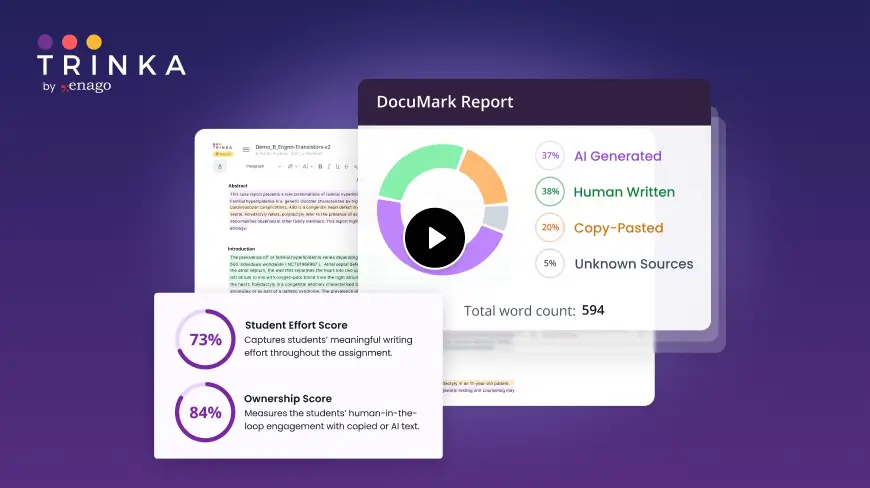
DocuMark: Responsible AI Use for Academic Integrity
Knowing your institution's AI policy is step one. DocuMark helps enforce it fairly by empowering universities to manage AI-generated content, prevent cheating, and support student writing through responsible AI use.
Common Questions About Royal Holloway, University of London's AI Policies
Royal Holloway, University of London has defined AI policies in 5 of 12 categories, with an overall coverage score of 42%.
The university requires students to reference material taken from AI-generated output and not present it as their own work. It also directs students to check module guidance and academic integrity resources to understand when AI use is acceptable and how to acknowledge it.
Undisclosed or improper AI use may be investigated as academic misconduct. The sources characterize AI misuse as possible cheating, falsification, or plagiarism, but they do not specify AI detection tools.
No explicit data protection or approved AI platform policy is currently defined in the available policy sources.