Teaching & Learning
- Students are expected to follow the instructor's stated rules for each course
- Use of AI in graded coursework is treated as an academic honesty issue when a student uses unauthorized assistance or presents AI-generated work as their own
- The university-wide academic honesty policy does not create a blanket rule specific to AI for all assignments, but the faculty AI guidance states that instructors should communicate course-level expectations and can prohibit or limit AI use in assignments
Misrepresenting the work of another person or of generative AI as one’s own is a violation of this policy.
Academic dishonesty includes, but is not limited to, cheating on a test, plagiarism, collusion, and the abuse of resource materials.
Faculty are encouraged to be proactive and transparent in their course design and communication around AI use.
Sample syllabus statements can help faculty clearly communicate expectations for students regarding AI use in coursework.
Because AI use may be appropriate in some contexts and not in others, expectations should be clearly stated for each course or assignment.
- The faculty AI guidance also indicates that faculty should set and communicate assessment-specific expectations, so use may depend on instructor rules for a given exam or assessment
- AI use during exams or formal assessments is not separately defined as a university-wide AI rule, but unauthorized assistance on tests is prohibited under the academic honesty policy
Academic dishonesty includes, but is not limited to, cheating on a test, plagiarism, collusion, and the abuse of resource materials.
cheating on a test—copying from another student’s test paper, using test materials not authorized by the person administering the test, collaborating with another student during a test without authority, knowingly using, buying, selling, stealing, transporting, or soliciting in whole or in part the contents of an unadministered test, or substituting for another student—or permitting another student to substitute for oneself—to take a test.
Because AI use may be appropriate in some contexts and not in others, expectations should be clearly stated for each course or assignment.
- Faculty guidance emphasizes that acceptable use depends on course and assignment expectations set by the instructor
- The university provides AI guidance and resources that frame AI as a tool that can support learning, but it does not set a single binding university-wide rule specifically governing student use of AI for personal study or tutoring
Artificial Intelligence can be used to support learning, teaching, and productivity, but it should be approached critically and ethically.
Because AI use may be appropriate in some contexts and not in others, expectations should be clearly stated for each course or assignment.
The Teaching and Learning Center is available to support faculty in designing assignments, discussions, and learning activities that thoughtfully engage AI in educational settings.
- The provided sources do not define a university-wide policy specifically addressing AI use for code generation or programming assignments
- Any use in coursework would still be subject to the general academic honesty policy and to instructor-specific assignment rules where stated
not defined
Research
- Not defined
- The provided sources do not establish a university-wide policy specifically addressing the use of AI for research writing, drafting theses, or manuscript preparation
not defined
- Researchers are also instructed to disclose planned bot or large language model use in the IRB protocol and participant materials when AI is part of the study protocol, intervention, or stimulus
- The research guidance explicitly addresses bot-generated responses in studies: if a response is identified as likely bot-generated, it should not be treated as meaningful participation or counted as valid data in analyses
If bot detection software identifies a response as likely generated by a bot (e.g., ChatGPT, bots in online participant pools), then researchers should not use this response as meaningful participation or count it as a valid participant in data analyses.
Researchers who use bots or large language models as part of a study protocol, intervention, or stimulus should clearly describe this use in the IRB protocol and related participant materials.
- For human-subjects research involving bots or large language models, researchers are required to describe that use in IRB materials
- The guidance also treats bot-generated responses as invalid for meaningful participation if detected as likely AI-generated, linking AI use to research integrity and protocol transparency
Researchers who use bots or large language models as part of a study protocol, intervention, or stimulus should clearly describe this use in the IRB protocol and related participant materials.
If bot detection software identifies a response as likely generated by a bot (e.g., ChatGPT, bots in online participant pools), then researchers should not use this response as meaningful participation or count it as a valid participant in data analyses.
Academic Integrity
- The sources require transparency about AI use in research protocols when bots or large language models are part of a study
- For student academic work, the academic honesty policy prohibits presenting generative AI output as one's own, and faculty guidance indicates instructors should clearly communicate expectations, but the provided sources do not set a single university-wide citation format for AI use in coursework
Misrepresenting the work of another person or of generative AI as one’s own is a violation of this policy.
Researchers who use bots or large language models as part of a study protocol, intervention, or stimulus should clearly describe this use in the IRB protocol and related participant materials.
Sample syllabus statements can help faculty clearly communicate expectations for students regarding AI use in coursework.
- In research, bot detection software may be used to identify likely AI-generated responses, and such responses should not be counted as valid participants in analyses
- The academic honesty policy states that misrepresenting generative AI as one's own work is a policy violation, and suspected violations are handled through the university's academic misconduct procedures
Misrepresenting the work of another person or of generative AI as one’s own is a violation of this policy.
When a faculty member or instructor discovers a violation or has reason to believe that a violation has occurred, they shall attempt to arrange a conference with the student and at that conference the faculty member or instructor shall inform the student of the allegations and give the student the opportunity to explain.
If bot detection software identifies a response as likely generated by a bot (e.g., ChatGPT, bots in online participant pools), then researchers should not use this response as meaningful participation or count it as a valid participant in data analyses.
Institutional & Administrative
- Faculty are encouraged to engage AI thoughtfully in teaching and to be transparent about expectations for students
- The provided sources do not establish a detailed university-wide rule set for using AI in grading, recommendation letters, or administrative communications
- The university also cautions employees not to rely on AI outputs without human verification and warns against entering sensitive institutional information into public AI tools
Faculty are encouraged to be proactive and transparent in their course design and communication around AI use.
The Teaching and Learning Center is available to support faculty in designing assignments, discussions, and learning activities that thoughtfully engage AI in educational settings.
Artificial Intelligence can be used to support learning, teaching, and productivity, but it should be approached critically and ethically.
Always verify AI-generated output before using it.
Do not input confidential, sensitive, or personally identifiable information into public AI tools.
- The university instructs users not to enter confidential, sensitive, or personally identifiable information into public AI tools and to use AI tools safely
- It provides institutionally curated AI information and resources, but the provided sources do not clearly identify a single mandatory approved-platform list or a formal data-classification tier policy specific to AI
Do not input confidential, sensitive, or personally identifiable information into public AI tools.
Always verify AI-generated output before using it.
Artificial Intelligence can be used to support learning, teaching, and productivity, but it should be approached critically and ethically.
- However, the provided sources do not define a formal overarching AI governance structure, named committee, or detailed university-wide AI strategy roadmap
- The university has institution-level AI guidance and resource pages that frame AI use around ethical, critical, and productive adoption in teaching and work
Artificial Intelligence can be used to support learning, teaching, and productivity, but it should be approached critically and ethically.
The Teaching and Learning Center is available to support faculty in designing assignments, discussions, and learning activities that thoughtfully engage AI in educational settings.
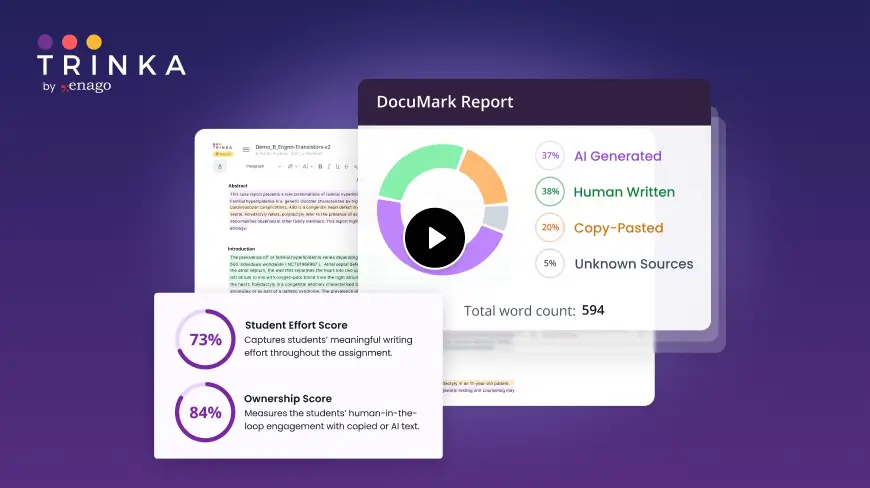
DocuMark: Responsible AI Use for Academic Integrity
Knowing your institution's AI policy is step one. DocuMark helps enforce it fairly by empowering universities to manage AI-generated content, prevent cheating, and support student writing through responsible AI use.
Common Questions About Sam Houston State University's AI Policies
Sam Houston State University has defined AI policies in 12 of 12 categories, with an overall coverage score of 100%.
The sources require transparency about AI use in research protocols when bots or large language models are part of a study. For student academic work, the academic honesty policy prohibits presenting generative AI output as one's own, and faculty guidance indicates instructors should clearly communicate expectations, but the provided sources do not set a single university-wide citation format for AI use in coursework.
The academic honesty policy states that misrepresenting generative AI as one's own work is a policy violation, and suspected violations are handled through the university's academic misconduct procedures. In research, bot detection software may be used to identify likely AI-generated responses, and such responses should not be counted as valid participants in analyses.
The university instructs users not to enter confidential, sensitive, or personally identifiable information into public AI tools and to use AI tools safely. It provides institutionally curated AI information and resources, but the provided sources do not clearly identify a single mandatory approved-platform list or a formal data-classification tier policy specific to AI.