Teaching & Learning
- San Francisco State University does not set a single university-wide student rule for AI use in coursework and assignments in the provided sources
- Instead, the institution requires faculty to state in the syllabus how generative AI tools may and may not be used, and university guidance emphasizes transparency with students
This document does not address: (1) specific instructional guidance to faculty on teaching with AI or (2) student-specific guidance related to appropriate use of AI – which may be developed in the future with the support of campus governance.
SFSU's revised Course Syllabus Policy #S25-257 , Section I requires faculty to include "A statement as to how and why generative AI tools can and cannot be used".
Whatever your stance is with AI, CEETL recommends transparency with students.
- The guidance instead frames assessment design as a faculty decision focused on protecting student learning
- The provided sources do not define a university-wide rule about student AI use during exams or formal assessments
This document does not address: (1) specific instructional guidance to faculty on teaching with AI or (2) student-specific guidance related to appropriate use of AI – which may be developed in the future with the support of campus governance.
Consider the planning that goes into determining whether an assessment should be open-book or open-note, take-home or in-class. These decisions are rooted in the third law: what would most protect student learning from shortcuts (textbooks; access to help) that undermine their learning?
- The sources present AI as something students can explore and use with current information and resources
- The university provides students with AI resources and access to AI tools for learning support, but the provided sources do not define a specific student policy governing AI for tutoring, studying, or non-graded learning
You will find resources, information and support for faculty, students and staff to explore the technology's potential.
Our vision for this website is to offer objective and informative resources that provide educators and students current information about the applications, implications, and ethical considerations of Gen AI. We endeavor to equip learners with resources to make informed decisions regarding the use of these quickly evolving technologies.
ChatGPT Edu is available to current SFSU students, faculty, and staff.
- The provided sources do not define a university-wide student policy for AI-assisted coding or programming assignments
- The university does provide access to AI tools with coding capabilities, and course-level rules are expected to be set by faculty in the syllabus
This document does not address: (1) specific instructional guidance to faculty on teaching with AI or (2) student-specific guidance related to appropriate use of AI – which may be developed in the future with the support of campus governance.
SFSU's revised Course Syllabus Policy #S25-257 , Section I requires faculty to include "A statement as to how and why generative AI tools can and cannot be used".
Access to GPT-4o, OpenAI's flagship model, excelling in text interpretation, coding, and mathematics
Research
- The provided sources do not define a general university-wide policy for using AI to draft or edit research papers, theses, dissertations, or manuscripts
- The only explicit research-writing guidance in the sources is limited to IRB submission materials, where AI assistance is allowed but human review and editing are required
Artificial Intelligence (AI) may be used to assist with IRB submission materials; however, researchers are responsible for reviewing and editing all content to ensure it is accurate, concise, and specific to their study. Submissions containing generic or irrelevant information or excessive formatting may be returned for revision, which can delay review.
- The provided sources do not define a research-specific policy on AI for data collection, analysis, statistics, synthetic data, or interpretation of results
- The institutional guidance that does apply says sensitive or FERPA-related university data must not be entered into AI systems, and projects involving sensitive data require consultation with IT and campus administrators
Sensitive or FERPA-related university data or materials should not be uploaded or input into any GenAI system (including the campus licensed such as Microsoft Copilot). GenAI tools ingest data into their training model putting sensitive data at risk.
Before using GenAI tools, consult your unit’s IT provider and appropriate campus administrator on proposals or projects that may benefit from the inclusion or use of sensitive data generated by the University or on projects impacting confidential campus processes or critical decision-making, such as recruitment and hiring.
- The provided sources do not define broader university rules for AI use in grant proposals or research integrity declarations beyond this IRB guidance
- For IRB submission materials, AI use is permitted, but researchers must review and edit all AI-assisted content for accuracy, concision, and study-specific relevance
Artificial Intelligence (AI) may be used to assist with IRB submission materials; however, researchers are responsible for reviewing and editing all content to ensure it is accurate, concise, and specific to their study. Submissions containing generic or irrelevant information or excessive formatting may be returned for revision, which can delay review.
Academic Integrity
- For faculty and staff work products, SFSU requires AI output to be referenced through citation or notes
- The provided sources do not define a university-wide student disclosure or citation requirement for submitted coursework
- In teaching, faculty are required to tell students in the syllabus how and why AI tools can and cannot be used, and the guidance recommends transparency with students
GenAI output should be referenced in work products through citation or notes (refer to section below).
SFSU's revised Course Syllabus Policy #S25-257 , Section I requires faculty to include "A statement as to how and why generative AI tools can and cannot be used".
Whatever your stance is with AI, CEETL recommends transparency with students.
- Instructors are also told not to use AI tools such as ChatGPT to detect AI-generated text
- SFSU states that AI detection software is ineffective and says the university does not provide a tool for detecting AI-generated text
- The sources reference existing academic integrity policy and an Academic Senate resolution for teaching and student integrity concerns, but they do not state new AI-specific penalties in the provided text
AI detection software is ineffective, as it can result in false positives and create inequities in student learning. SFSU does not provide a tool for detecting AI-generated text (e.g. TurnItIn). Additionally, instructors should not use AI tools, like ChatGPT, to detect AI-generated text.
Instructors can refer to Academic Senate academic integrity policy and the Spring 2024 Resolution on the Use of GenAI in Teaching and Learning for guidance on teaching or student integrity concerns.
Institutional & Administrative
- SFSU provides employee guidance rather than a formal AI policy
- Faculty are also required to include a syllabus statement explaining how and why generative AI tools can and cannot be used in their courses
- Faculty and staff may use AI to support work, but it is intended to supplement human work rather than replace it; employees must remain actively involved, carefully evaluate outputs, cross-check and corroborate them, and review AI use with an appropriate administrator
These guidelines focus on the general use of GenAI by SF State employees (including staff, administrators, and faculty), encouraging responsible and effective use at SF State.
This is not a policy document, but highlights existing California State University (CSU) and SF State policies that are relevant to the use of GenAI (refer to table below).
GenAI is intended to support and enhance human work, not replace it. GenAI should serve as a complement to work, and employees should maintain an active role in the creation of work products and should carefully evaluate it. Human work plays a critical role in maintaining accuracy, fairness, and integrity. The use of GenAI in work should be reviewed with an appropriate administrator. GenAI output should be referenced in work products through citation or notes (refer to section below). Output generated by GenAI tools or platforms should be cross-checked and corroborated.
SFSU's revised Course Syllabus Policy #S25-257 , Section I requires faculty to include "A statement as to how and why generative AI tools can and cannot be used".
- SFSU explicitly prohibits entering sensitive or FERPA-related university data into AI systems, including campus-licensed tools such as Microsoft Copilot
- For projects involving sensitive data, confidential campus processes, or critical decision-making, employees must consult their IT provider and appropriate campus administrators
- The university also identifies campus-available AI platforms, including ChatGPT Edu and Microsoft Copilot, and states that ChatGPT Edu conversations and data are not used to train OpenAI models and remain private to SFSU
Do not upload or input sensitive data into GenAI tools or platforms. For projects or tasks that may require the upload of sensitive data, consult with an IT provider.
Sensitive or FERPA-related university data or materials should not be uploaded or input into any GenAI system (including the campus licensed such as Microsoft Copilot). GenAI tools ingest data into their training model putting sensitive data at risk.
Before using GenAI tools, consult your unit’s IT provider and appropriate campus administrator on proposals or projects that may benefit from the inclusion or use of sensitive data generated by the University or on projects impacting confidential campus processes or critical decision-making, such as recruitment and hiring.
ChatGPT Edu is available to current SFSU students, faculty, and staff.
Copilot is included with campus Microsoft licenses, available for all students, faculty, and staff.
Conversations and data are not used to train OpenAI models
SFSU’s ChatGPT Edu environment, and its encompassing data, will remain private to SFSU.
No SFSU conversations or data will be shared with OpenAI or other universities, for training purposes or AI models.
- The provided sources also state that the Chancellor’s Office and SF State are drafting generative AI guidelines
- SFSU states an institutional commitment to responsible and ethical AI use and frames its approach as a campus-wide response led by Academic Technology and CEETL
- The university describes a mission of "Sensemaking Through Community," offers training and resources for faculty, students, and staff, and notes that guidance documents will be periodically reviewed and updated as AI evolves
SF State is committed to responsible and ethical use of Generative AI (Gen AI).
Academic Technology (AT) and the Center for Equity and Excellence in Teaching and Learning (CEETL) have partnered to facilitate a campus response to Gen AI.
Our approach is simple – Sensemaking through Community – in this disruptive phase of Gen AI, we need to understand the opportunities and risks posed to our community, to instruction, and to our students’ success, by bringing together faculty exactly where they are at – overwhelmed, curious, concerned, excited.
Our vision for this website is to offer objective and informative resources that provide educators and students current information about the applications, implications, and ethical considerations of Gen AI.
As GenAI evolves, these guidelines will be periodically reviewed and updated.
The Chancellor's Office and SF State are currently drafting generative AI guidelines.
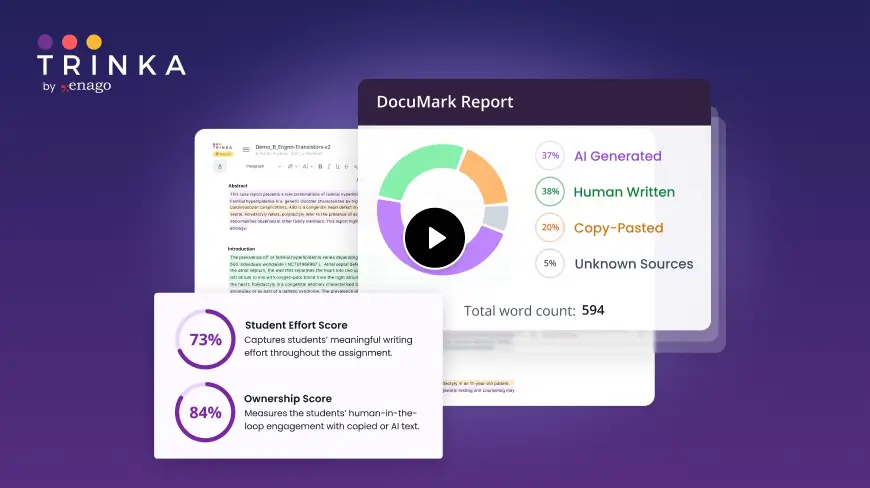
DocuMark: Responsible AI Use for Academic Integrity
Knowing your institution's AI policy is step one. DocuMark helps enforce it fairly by empowering universities to manage AI-generated content, prevent cheating, and support student writing through responsible AI use.
Common Questions About San Francisco State University's AI Policies
San Francisco State University has defined AI policies in 12 of 12 categories, with an overall coverage score of 100%.
For faculty and staff work products, SFSU requires AI output to be referenced through citation or notes. In teaching, faculty are required to tell students in the syllabus how and why AI tools can and cannot be used, and the guidance recommends transparency with students. The provided sources do not define a university-wide student disclosure or citation requirement for submitted coursework.
SFSU states that AI detection software is ineffective and says the university does not provide a tool for detecting AI-generated text. Instructors are also told not to use AI tools such as ChatGPT to detect AI-generated text. The sources reference existing academic integrity policy and an Academic Senate resolution for teaching and student integrity concerns, but they do not state new AI-specific penalties in the provided text.
SFSU explicitly prohibits entering sensitive or FERPA-related university data into AI systems, including campus-licensed tools such as Microsoft Copilot. For projects involving sensitive data, confidential campus processes, or critical decision-making, employees must consult their IT provider and appropriate campus administrators. The university also identifies campus-available AI platforms, including ChatGPT Edu and Microsoft Copilot, and states that ChatGPT Edu conversations and data are not used to train OpenAI models and remain private to SFSU.