Teaching & Learning
- The policy does not provide AI-specific coursework rules or instructor-discretion language in the provided sources
- SCAD prohibits students from using unauthorized assistance, materials, or technology in academic work and requires submitted work to reflect the student's own level of accomplishment
Under all circumstances, students must be honest in their dealings with faculty, administrative staff, and fellow students, and they must submit work that accurately reflects their level of accomplishment.
1. Cheating: Using unauthorized assistance, materials, or technology in any academic work.
- SCAD does not define a separate AI rule for exams or assessments in the provided sources
- Its general academic integrity policy prohibits using unauthorized assistance, materials, or technology in any academic work
1. Cheating: Using unauthorized assistance, materials, or technology in any academic work.
- SCAD provides students access to AI tools for learning and program-related exploration through the AI Advantage Portal
- The provided sources describe this access as available to all students for exploring emerging AI technology and incorporating it into their programs of study, but they do not set specific restrictions for non-graded study assistance
## AI Advantage Portal — Harness the power of new AI tools
SCADask, the university's applied research unit, launched the AI Advantage Portal in Spring 2024 to assist SCAD students in exploring emerging AI technology and incorporating it into their programs of study. All SCAD students have access to the portal, which connects to several industry standard AI programs — including Claude, Adobe Firefly, ChatGPT, Midjourney, and more — offering the opportunity for students to create from the precipice of new creative frontiers.
Research
Academic Integrity
- The university's academic integrity policy is framed as a general attribution rule rather than an AI transparency standard
- SCAD requires proper attribution when using someone else's work, ideas, or words, but the provided sources do not define any AI-specific disclosure or citation requirement
2. Plagiarism: Using someone else's work, ideas, or words without proper attribution.
- The provided sources do not mention AI detection tools specifically, but they do define enforcement procedures and penalties for violations involving unauthorized technology or other academic dishonesty
- SCAD states that suspected academic dishonesty is reported by faculty, investigated by an appointed academic administrator, and can result in an F in the course, additional sanctions, suspension, or dismissal
If a faculty member suspects a student of academic dishonesty, the faculty member notifies the student of this concern. Once this notification has occurred, the student is prohibited from seeking to withdraw from the course pending the result of a possible investigation. If academic dishonesty is suspected, the faculty member must email all evidence and documentation to [email protected] .
If the allegation warrants investigation, an academic administrator is appointed to investigate the allegation. If the investigator finds that academic dishonesty has occurred, the student is informed in writing that they will receive an F in the course. The student has five business days from the date on the written notice to appeal the decision of the investigator.
A student found to be in violation of the academic integrity policy may not withdraw from the course(s) in question. Additional sanctions may also be imposed, including suspension or dismissal. A second finding of academic dishonesty may result in dismissal from SCAD.
Institutional & Administrative
- A formal AI data classification or protection policy is not defined
- SCAD provides students with access to approved AI tools through the AI Advantage Portal, which connects to industry standard AI programs including Claude, Adobe Firefly, ChatGPT, and Midjourney
SCADask, the university's applied research unit, launched the AI Advantage Portal in Spring 2024 to assist SCAD students in exploring emerging AI technology and incorporating it into their programs of study. All SCAD students have access to the portal, which connects to several industry standard AI programs — including Claude, Adobe Firefly, ChatGPT, Midjourney, and more — offering the opportunity for students to create from the precipice of new creative frontiers.
- SCAD presents an institutional AI strategy centered on student access to AI tools and broader university research and thought leadership through SCADask and AI Insights
- The provided sources frame AI Insights as a roadmap and describe SCADask as a university research unit working under qualified university leadership, but they do not define a formal AI governance committee or binding university-wide AI policy framework
SCADask, the university's applied research unit, launched the AI Advantage Portal in Spring 2024 to assist SCAD students in exploring emerging AI technology and incorporating it into their programs of study.
As generative AI takes over the production layer of creative work, what moves to the center? Drawing on insights from more than 100 creative leaders across industries as well as the proceedings of SCAD's 2026 AI Summit and its 48-hour student AI Jam, SCAD AI Insights maps five layers in this paradigm shift: Emergence, Acceleration, Transformation, Foundation, and Horizon. Together, these pillars outline a movement from production toward direction, where creative authority lives.
To navigate this new transformation, the skills are interpretive, not executional: judgment, taste, and the ability to hold intention through change are what AI cannot replicate. AI Insights is a road map for a new design mindset.
SCADask generates timely research at the intersection of commerce, creativity, and culture.
Under the supervision of qualified university leaders, SCADask identifies, formulates, and tackles research questions that are relevant to SCAD disciplines and appealing to a general interest audience.
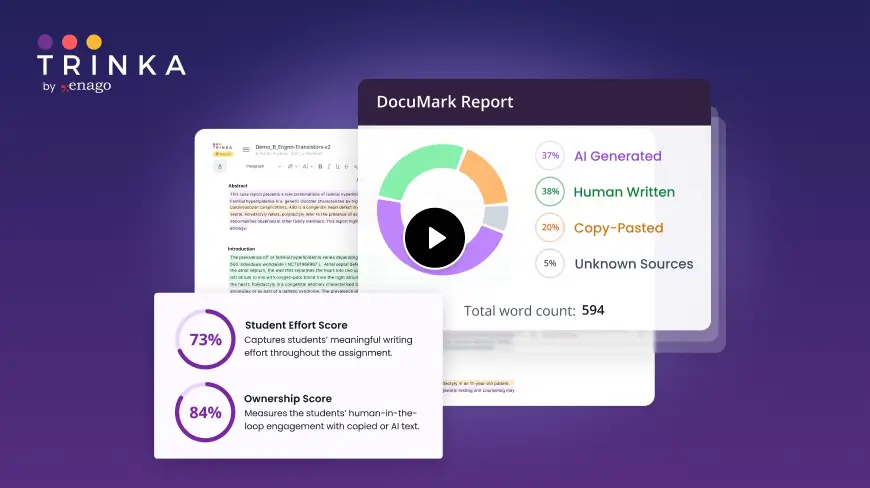
DocuMark: Responsible AI Use for Academic Integrity
Knowing your institution's AI policy is step one. DocuMark helps enforce it fairly by empowering universities to manage AI-generated content, prevent cheating, and support student writing through responsible AI use.
Common Questions About Savannah College of Art and Design's AI Policies
Savannah College of Art and Design has defined AI policies in 7 of 12 categories, with an overall coverage score of 58%.
SCAD requires proper attribution when using someone else's work, ideas, or words, but the provided sources do not define any AI-specific disclosure or citation requirement. The university's academic integrity policy is framed as a general attribution rule rather than an AI transparency standard.
SCAD states that suspected academic dishonesty is reported by faculty, investigated by an appointed academic administrator, and can result in an F in the course, additional sanctions, suspension, or dismissal. The provided sources do not mention AI detection tools specifically, but they do define enforcement procedures and penalties for violations involving unauthorized technology or other academic dishonesty.
SCAD provides students with access to approved AI tools through the AI Advantage Portal, which connects to industry standard AI programs including Claude, Adobe Firefly, ChatGPT, and Midjourney. A formal AI data classification or protection policy is not defined.