Teaching & Learning
- Course-level policy is at instructor discretion
- Seattle University provides faculty syllabus language for three approaches: banning generative AI, limiting it to specified assignments, or permitting it for any assignment
- Across these models, using AI beyond what the instructor allows is treated as an academic integrity violation, and presenting AI output as one's own without citation or acknowledgment is prohibited
While Seattle University has revised its Academic Integrity Policy to account for the misuse of ChatGPT and generative AI, it is up to you to decide what tasks you would like students to accomplish without AI assistance and what tasks you think appropriate for ChatGPT.
Use of GenAI tools in this course counts as an academic integrity violation and will be penalized as such, following the University’s Academic Integrity Policy guidelines.
You are allowed to use generative AI tools for some, but not all, assignments in this course. Where GenAI tools can be used for an assignment, the assignment document will explain clearly how you are permitted to use them.
You are allowed to use generative AI tools for any assignment or work in this course.
Any use of GenAI tools in this class beyond those permitted by this policy counts as an academic integrity violation and will be dealt with following the University’s Academic Integrity Policy.
Plagiarism: The use of the work or intellectual property of other persons or the outputs of Generative Artificial Intelligence (“AI”) programs when presented as one’s own work without appropriate citation, attribution, or acknowledgment, and regardless of intent.
- In the School of Law, using generative artificial intelligence on graded assessments is explicitly a violation when the faculty member has not authorized it
- For the university generally, unauthorized materials or devices during examinations are prohibited, and whether AI is allowed depends on faculty authorization
■ Using, receiving, or transmitting unauthorized materials or information during an examination (e.g., through use of a phone or other device).
b. Devices: The use of any electronic device during an examination is expressly prohibited unless explicitly authorized by the instructor of the course.
It is a violation of the Academic Integrity Code knowingly: 1) to give, seek, or receive information, answers, or solutions to assessments, including, but not limited to, examination questions; 2) having taken a graded assessment, to divulge questions or answers or comment upon the substantive nature of the assessment under circumstances in which it is reasonable to believe that a person learning of the statements could use the information to improve their performance on the same assessment; 3) to use resources not authorized by the faculty member, including generative artificial intelligence; 4) without the faculty member’s permission, either to discuss a take-home graded assessment with another person or to work with another person on a take-home assessment; 5) to violate any other rules established to ensure the integrity of the graded assessment;
- Separate sample syllabus language allows instructors to prohibit, limit, or permit AI use
- Seattle University describes AI use in teaching and learning as contextual rather than governed by a single blanket rule
- The university notes students use AI to identify learning resources and generate educational material, and faculty are told to decide what uses are appropriate in their courses
AI-generated or AI-curated content has become integral to educational practices. Students and instructors use such content in a variety of ways:
* Identification of academic and non-academic literature, news sources, datasets, and other learning resources
* Development of course plans, syllabi, and other outlines and templates
* Development of research questions, discussion prompts, simulations, exam questions, and similar educational material
* Generation of responses to research questions, discussion prompts, exam questions, and similar educational material
* Assessment of exams
* Copy-editing of text
* Translation of text
* Drafting of sentences, paragraphs, and full essays
* Generation of audiovisual material out of textual data
The educational value of using AI-generated or AI-curated content depends on factors like the subject, students' learning needs, instructors' pedagogical approaches and preferences, and course and assessment design. Thus, an outright permission or ban is a poor substitute for instructor leadership.
While Seattle University has revised its Academic Integrity Policy to account for the misuse of ChatGPT and generative AI, it is up to you to decide what tasks you would like students to accomplish without AI assistance and what tasks you think appropriate for ChatGPT.
You are allowed to use generative AI tools for some, but not all, assignments in this course. Where GenAI tools can be used for an assignment, the assignment document will explain clearly how you are permitted to use them.
You are allowed to use generative AI tools for any assignment or work in this course.
- Beyond that, the university does not publish a coding-specific AI rule; course-level use is governed by instructor policy on generative AI
- Seattle University's academic integrity policy expressly includes code among materials that cannot be copied from another person or an AI program without proper citation and acknowledgment
Examples of Plagiarism include, but are not limited to, copying, paraphrasing, summarizing, or borrowing ideas, phrases, sentences, quotations, paragraphs, code, images, or an entire paper from another person’s work or AI program’s output without proper citation and/or acknowledgment, as required by faculty.
You are allowed to use generative AI tools for some, but not all, assignments in this course. Where GenAI tools can be used for an assignment, the assignment document will explain clearly how you are permitted to use them.
You are allowed to use generative AI tools for any assignment or work in this course.
Any use of GenAI tools in this class beyond those permitted by this policy counts as an academic integrity violation and will be dealt with following the University’s Academic Integrity Policy.
Research
- Seattle University provides general guidance rather than a mandatory university-wide rule for AI in research writing
- The formal research misconduct policy applies if writing-related misconduct amounts to plagiarism, falsification, or fabrication
- Its research guidance says AI can be used in academic research but emphasizes research integrity, transparency, and area-specific guidance by departments and programs
These guidelines offer general guidance for the safe, fair, and accountable development and use of AI in academic research. They cover three areas: research integrity; data privacy and protection; and research excellence. Academic departments and programs are encouraged to develop area-specific guidelines in communication with their professional organizations in accordance with the needs and norms in their fields of study.
Research excellence: research safety, fairness, and transparency
Research misconduct. Research misconduct means fabrication, falsification, or plagiarism in proposing, performing, or reviewing research, or in reporting research results. Research misconduct does not include honest error or differences of opinion.
- The research misconduct policy separately prohibits fabrication and falsification of data or results
- The university does not provide a detailed AI-specific rule for statistical analysis or synthetic data use in the provided sources
- Seattle University's research AI guidance focuses on protecting sensitive data and integrating privacy review into human-subjects research
Research in numerous academic fields relies on the collection of data from human subjects. Researchers should avoid sharing sensitive personal data with AI tools, as those tools may leak the data collected for training or context-building purposes. Thus, human subjects ethics review should incorporate a component of data privacy and protection vis-à-vis AI tools.
Fabrication. Fabrication means making up data or results and recording or reporting them.
Falsification. Falsification means manipulating research materials, equipment, or processes, or changing
Research misconduct. Research misconduct means fabrication, falsification, or plagiarism in proposing, performing, or reviewing research, or in reporting research results.
- Its AI research guidance also says human-subjects ethics review should address AI-related data privacy and protection
- The provided sources do not contain a specific rule about AI use in grant proposals or IRB applications beyond those general research integrity and privacy requirements
- Seattle University treats research integrity issues under its research misconduct framework, which covers plagiarism, fabrication, and falsification in proposing, performing, reviewing, or reporting research
Research misconduct. Research misconduct means fabrication, falsification, or plagiarism in proposing, performing, or reviewing research, or in reporting research results. Research misconduct does not include honest error or differences of opinion.
Plagiarism. Plagiarism means the appropriation of another person’s ideas, processes, results, or words, without giving appropriate credit.
Researchers should avoid sharing sensitive personal data with AI tools, as those tools may leak the data collected for training or context-building purposes. Thus, human subjects ethics review should incorporate a component of data privacy and protection vis-à-vis AI tools.
Academic Integrity
- The guidance also says instructors should be transparent about their own use of AI in course design
- Seattle University requires attribution when AI output is used and treats unacknowledged AI output presented as one's own work as plagiarism
- Faculty sample syllabus language also requires students, when AI use is allowed, to provide proper citation and an AI disclosure statement describing what tools were used and for what purpose
Plagiarism: The use of the work or intellectual property of other persons or the outputs of Generative Artificial Intelligence (“AI”) programs when presented as one’s own work without appropriate citation, attribution, or acknowledgment, and regardless of intent.
Examples of Plagiarism include, but are not limited to, copying, paraphrasing, summarizing, or borrowing ideas, phrases, sentences, quotations, paragraphs, code, images, or an entire paper from another person’s work or AI program’s output without proper citation and/or acknowledgment, as required by faculty.
When using AI, you must include proper citation for AI-generated text, images, or other media following [preferred citation style, e.g., APA, MLA, Chicago].
You must also include an AI disclosure statement. For example: “For this assignment, I used [list of AI tools used in assignment] for [specific purpose, e.g., generating an outline, summarizing sources, grammar revision] but not for [list of student contribution, e.g., direct content creation.]” This should make it clear to me which is your original work and which is assisted by Gen-AI.
Just as students are obligated to acknowledge their use of AI, instructors should also be transparent about their use of AI tools in their design of course activities.
- Seattle University advises faculty not to rely on AI detection software because the tools can be erroneous and the university has not approved any AI detection software for professional use
- Enforcement instead proceeds through academic integrity processes: unauthorized AI use may count as an academic integrity violation, and sanctions can include no credit for the assignment or examination, lower course grades, failure in the course, probation, or dismissal depending on the case
Enforcing an AI ban policy may not always be feasible because AI-generated or AI-curated content is more difficult to detect than content plagiarized from a human-written source. Tools to detect AI-generated content are known to have produced errors. Seattle University has not approved any AI detection software for professional uses. Thus, faculty are advised to rely on their pedagogical expertise rather than AI detection software to assess academic integrity.
Use of GenAI tools in this course counts as an academic integrity violation and will be penalized as such, following the University’s Academic Integrity Policy guidelines.
Any use of GenAI tools in this class beyond those permitted by this policy counts as an academic integrity violation and will be dealt with following the University’s Academic Integrity Policy.
C. No Credit - The faculty member may give the student no credit (“zero”) for the assignment, examination, or other activity with respect to which the academic integrity violation has occurred and may count the no-credit (“zero”) as an “F,” or allow the student to fully or partially make up such assignment, examination, or activity. The faculty member may also lower the student’s course grade or fail the student for the course.
D. Probation - At the dean’s discretion, the student may be placed on academic probation, beginning with the quarter following the violation.
Dismissal: Immediate dismissal (expulsion) from the University and no right to return.
Institutional & Administrative
- Faculty are also advised not to rely on AI detection software
- Seattle University explicitly addresses faculty use of AI in teaching
- Instructors are encouraged to decide what student tasks may involve AI, to be transparent about their own use of AI in course design, and not to rely exclusively on AI for assessment because human judgment and faculty leadership are necessary
While Seattle University has revised its Academic Integrity Policy to account for the misuse of ChatGPT and generative AI, it is up to you to decide what tasks you would like students to accomplish without AI assistance and what tasks you think appropriate for ChatGPT.
Just as students are obligated to acknowledge their use of AI, instructors should also be transparent about their use of AI tools in their design of course activities. Instructors should refrain from exclusively using AI tools for assessment, as human judgment is almost always a necessary component of assessment. Furthermore, excellence in teaching includes detailed feedback on assignments, which necessitates faculty leadership.
Enforcing an AI ban policy may not always be feasible because AI-generated or AI-curated content is more difficult to detect than content plagiarized from a human-written source. Tools to detect AI-generated content are known to have produced errors. Seattle University has not approved any AI detection software for professional uses. Thus, faculty are advised to rely on their pedagogical expertise rather than AI detection software to assess academic integrity.
- It also states that no AI detection software has been approved for professional uses
- The provided sources do not identify a general list of approved AI platforms beyond that negative statement
- Seattle University instructs students, instructors, and researchers to avoid entering sensitive personal data into AI tools because such tools may leak data used for training or context building
Students and instructors should avoid sharing sensitive personal data with AI tools, as those tools may leak the data collected for training or context-building purposes. Seattle University's Information Technology Services should provide the campus community with basic training on the data privacy and protection implications of commonly used AI tools.
Researchers should avoid sharing sensitive personal data with AI tools, as those tools may leak the data collected for training or context-building purposes. Thus, human subjects ethics review should incorporate a component of data privacy and protection vis-à-vis AI tools.
Seattle University has not approved any AI detection software for professional uses.
- The sources do not describe a formal university AI committee or a detailed adoption roadmap
- Seattle University has institution-level AI guidance framed around safe, fair, and accountable AI development and use in teaching, learning, and research
- Its guidance emphasizes educational benefit, academic integrity, and data privacy and protection, and encourages academic departments and programs to develop area-specific guidelines aligned with professional norms
Keeping in mind the highly contextual nature of effective AI use in teaching and learning, the General Principles for Safe, Fair and Accountable AI Development and Use translate to (1) educational benefit; (2) academic integrity; and (3) data privacy and protection.
These guidelines offer general guidance for the safe, fair, and accountable development and use of AI in academic research. They cover three areas: research integrity; data privacy and protection; and research excellence. Academic departments and programs are encouraged to develop area-specific guidelines in communication with their professional organizations in accordance with the needs and norms in their fields of study.
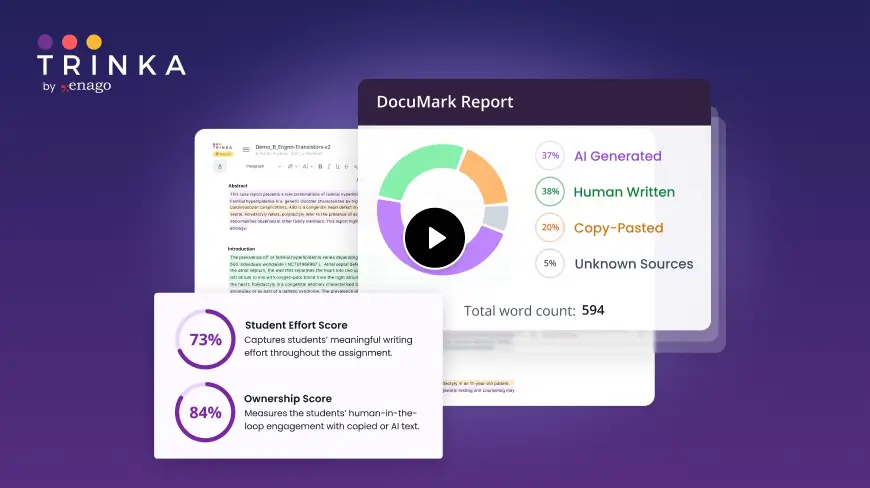
DocuMark: Responsible AI Use for Academic Integrity
Knowing your institution's AI policy is step one. DocuMark helps enforce it fairly by empowering universities to manage AI-generated content, prevent cheating, and support student writing through responsible AI use.
Common Questions About Seattle University's AI Policies
Seattle University has defined AI policies in 12 of 12 categories, with an overall coverage score of 100%.
Seattle University requires attribution when AI output is used and treats unacknowledged AI output presented as one's own work as plagiarism. Faculty sample syllabus language also requires students, when AI use is allowed, to provide proper citation and an AI disclosure statement describing what tools were used and for what purpose. The guidance also says instructors should be transparent about their own use of AI in course design.
Seattle University advises faculty not to rely on AI detection software because the tools can be erroneous and the university has not approved any AI detection software for professional use. Enforcement instead proceeds through academic integrity processes: unauthorized AI use may count as an academic integrity violation, and sanctions can include no credit for the assignment or examination, lower course grades, failure in the course, probation, or dismissal depending on the case.
Seattle University instructs students, instructors, and researchers to avoid entering sensitive personal data into AI tools because such tools may leak data used for training or context building. It also states that no AI detection software has been approved for professional uses. The provided sources do not identify a general list of approved AI platforms beyond that negative statement.