Teaching & Learning
- Some departments also treat unauthorized AI assistance as academic dishonesty
- Seton Hall does not set a single university-wide rule for student use of AI in coursework
- The central AI guidance says students must follow the instructions on each syllabus, and the published syllabus statements show that instructors may prohibit AI entirely, allow limited use with disclosure, or permit broader use
Students are expected to read and adhere to the instructions and guidance on their course syllabus regarding the use of AI tools. If you have questions, ask your instructor.
No use of AI-generated text or images in this course is allowed. Please note that AI generated text often sounds authoritative and insightful but can contain factual inaccuracies, cite non-existent sources, and perpetuate biases. Work generated in this way does not represent your own original thinking and therefore is not allowed in this course.
The use of generative AI tools is allowed with proper attribution in this course for [insert examples of assignments] provided that [insert parameters]. Please note that AI generated text often sounds authoritative and insightful but can contain factual inaccuracies, cite non-existent sources, and perpetuate biases. You should critically assess any generated output.
Students are allowed use of Generative AI for all work after they have understood what that work would entail and are able to evaluate the effectiveness and validity of the generated content. Students should only use Generative AI in support of their own work and be able to explain how they used it, why it was useful, and any flaws or shortcomings they noticed.
There are several possible reasons for cheating, but all cheating by college students can ultimately be said to defraud. The offender claims credit for skills, knowledge, and understanding that either have not been acquired or cannot be demonstrated. The second purpose of this Academic Integrity Policy is to make clear both the nature and the consequences of academic dishonesty.
relying on others’ ideas or their expression without crediting them, using another person’s computer files and programs, using AI to write a paper or assignment, or anything else that gives a student an advantage to which he or she is not entitled is a form of academic dishonesty.
- For general university courses, AI use during assessments is governed by instructor syllabus rules rather than a single institution-wide AI exam policy
- In the School of Law, assessment rules are stricter: unauthorized technology use during examinations is prohibited, and students may not use generative AI to complete exams or graded assignments unless a faculty member expressly permits it
Students are expected to read and adhere to the instructions and guidance on their course syllabus regarding the use of AI tools. If you have questions, ask your instructor.
No use of AI-generated text or images in this course is allowed. Please note that AI generated text often sounds authoritative and insightful but can contain factual inaccuracies, cite non-existent sources, and perpetuate biases. Work generated in this way does not represent your own original thinking and therefore is not allowed in this course.
On examinations, students may not use any unauthorized technologies such as cell phones, iPods, palm pilots, laptops, or other technologies capable of communicating or storing data, to store and/or convey exam information.
The use of generative artificial intelligence tools to complete student work, including but not limited to papers and graded assignments, should be undertaken only if specifically authorized by the faculty member. Students should continue to provide in-person learning and performance. Work generated by generative artificial intelligence tools without the express permission of the faculty member may violate this Honor Code.
- Students are told to verify outputs, avoid overreliance, and follow any course-specific restrictions in the syllabus
- Seton Hall encourages thoughtful educational use of AI for learning support, such as brainstorming, creating summaries, generating review questions, and simulating practice conversations
Potential Uses:
Brainstorming ideas
Creating summaries and generating study/review questions
Understanding complex concepts
Language learning and practicing conversations
Email writing and formatting
Checking grammar and clarity
Creating images and visual content
Getting feedback on writing
Resume and cover letter drafting
Verify information from AI tools with reliable sources.
AI can generate incorrect or biased information.
Avoid over-reliance on AI; use it as a supplement, not a replacement for critical thinking and your own skills.
Protect your personal and university data.
Students are expected to read and adhere to the instructions and guidance on their course syllabus regarding the use of AI tools. If you have questions, ask your instructor.
- The verified sources do not provide a coding-specific AI policy
- Any use of AI for programming assignments would therefore fall under course-level instructor rules or broader assignment integrity rules where applicable
not defined
Research
- The university-level AI guidance warns against entering unpublished or proprietary research into third-party AI tools and emphasizes that authors remain responsible for any AI-assisted content
- In at least one graduate program handbook, AI may be used in writing only for limited support functions and only when acknowledged under APA guidance, while the substantive scholarly work must remain the student's own
Do not input unpublished or proprietary research, grant applications, or manuscripts under review.
You are responsible for all content submitted to journals, conferences, or funding agencies.
Review and verify all AI-assisted work for accuracy and compliance with academic integrity standards.
Some publishers prohibit or restrict AI-generated text and images.
AI tools may be used only for editing and proofreading, language translation, helping to identify ideas and key points in literature, or for grammar assistance, not to write text. The use of AI should be acknowledged according to APA standards.
The substantial writing, editing, and critical thinking involved in developing all submissions and academic work are expected to be solely the student’s own work.
- Seton Hall's explicit research-data AI rules focus on confidentiality and data handling rather than permitting specific analytic uses
- The university says users must not input unpublished research or restricted data into public AI systems and must follow institutional data-classification rules before using AI tools
Do not input unpublished or proprietary research, grant applications, or manuscripts under review.
Do not input restricted, regulated, or sensitive data into public AI tools.
Use only with approved data classifications and in accordance with university data governance policies.
Data are classified into one of four categories based on the sensitivity and risk posed should that data be released, modified, or destroyed without authorization. The data categories are: Public, Internal, Confidential, and Restricted.
Users shall take precautions to comply with this policy by implementing and adhering to the minimum security standards outlined for each data classification category. This includes all files, records, email, and messages when storing, processing, or transmitting university information, including both paper and electronic records.
- Seton Hall states that researchers remain accountable for AI-assisted work and must check compliance with publication and funding rules
- The university also prohibits entering grant applications and other unpublished research materials into public AI tools, and it notes that some publishers restrict AI-generated content
You are responsible for all content submitted to journals, conferences, or funding agencies.
Review and verify all AI-assisted work for accuracy and compliance with academic integrity standards.
Some publishers prohibit or restrict AI-generated text and images.
Do not input unpublished or proprietary research, grant applications, or manuscripts under review.
Do not input restricted, regulated, or sensitive data into public AI tools.
Academic Integrity
- Disclosure of AI use is required when a course or program permits AI with attribution
- The law school's honor code also requires students to identify AI-generated material as required by faculty or school policy
- The university's sample syllabus language requires proper attribution, and a graduate program handbook specifically requires acknowledgment of AI use according to APA standards
The use of generative AI tools is allowed with proper attribution in this course for [insert examples of assignments] provided that [insert parameters].
AI tools may be used only for editing and proofreading, language translation, helping to identify ideas and key points in literature, or for grammar assistance, not to write text. The use of AI should be acknowledged according to APA standards.
More generally, students, faculty, and administrators should know that the use of generative AI tools should be identified and acknowledged as may be required by a faculty member and/or school and university policies.
- The university's AI guidance cautions faculty not to rely solely on AI-detection tools because they can produce false positives
- Enforcement instead proceeds through existing academic-integrity structures: undisclosed or unauthorized AI use may be treated as academic dishonesty or an honor code violation, depending on the school or department
Do not solely rely on AI detector software to determine if a student has cheated, these tools can have false positives.
using AI to write a paper or assignment, or anything else that gives a student an advantage to which he or she is not entitled is a form of academic dishonesty.
Work generated by generative artificial intelligence tools without the express permission of the faculty member may violate this Honor Code.
Institutional & Administrative
- Faculty are told to review outputs for accuracy, bias, and compliance, avoid confidential inputs, and not rely exclusively on AI detectors when evaluating student work
- Seton Hall permits faculty and staff to use AI for teaching and administrative support tasks such as brainstorming, planning, drafting, and feedback preparation, but requires human oversight
Potential Uses:
Brainstorming ideas
Developing course content and lesson plans
Creating rubrics and discussion prompts
Drafting communications and documentation
Checking grammar and clarity
Research assistance and literature summaries
Administrative support and workflow automation
Practice and feedback scenarios
Meeting summaries and note organization
Image and content generation
Review all outputs for accuracy, relevance, and bias.
Do not input student records, grades, health information, or employee/personnel data.
Do not solely rely on AI detector software to determine if a student has cheated, these tools can have false positives.
Use AI to support your work—not replace professional judgment or academic decision-making.
Respect copyright and licensing when using AI-generated content.
AI content generators can create false information, misleading citations, and biased language. Faculty should review all outputs carefully.
Faculty remain responsible for maintaining student privacy, following FERPA, and avoiding the upload of restricted institutional data to public AI systems.
- Seton Hall prohibits entering sensitive institutional information into public AI tools and ties AI use to its data-classification policy
- Users must follow the university's four-tier data classification system and related minimum security controls when storing, processing, or transmitting university information
Do not enter confidential, sensitive, or personally identifiable information into AI tools.
Do not input student records, grades, health information, or employee/personnel data.
Do not input restricted, regulated, or sensitive data into public AI tools.
Use only with approved data classifications and in accordance with university data governance policies.
Data are classified into one of four categories based on the sensitivity and risk posed should that data be released, modified, or destroyed without authorization. The data categories are: Public, Internal, Confidential, and Restricted.
Users shall take precautions to comply with this policy by implementing and adhering to the minimum security standards outlined for each data classification category. This includes all files, records, email, and messages when storing, processing, or transmitting university information, including both paper and electronic records.
- Seton Hall has an institutional AI governance structure centered on an Artificial Intelligence Advisory Council
- The council was created to advise the university on AI use, policy, ethics, and strategy, and the university's public AI pages frame AI adoption around responsible use, privacy, bias mitigation, and academic integrity
Seton Hall has established an Artificial Intelligence Advisory Council that will advise and guide the University on the potential and implications of AI in the teaching, learning and administrative environments.
The AI Advisory Council will provide expert guidance and strategic advice to the University concerning issues related to artificial intelligence (AI).
The council's responsibilities include, but are not limited to, the following:
Advising the University on the use of AI tools and platforms.
Recommending policies and procedures related to AI.
Monitoring developments in AI and assessing their potential impact on the University.
Helping to ensure the ethical, legal, and responsible use of AI at Seton Hall.
Supporting educational initiatives related to AI literacy and awareness.
Use AI responsibly and ethically.
Be aware of the tool’s privacy and data policies.
Verify information before relying on it.
Avoid using AI to misrepresent your work or identity.
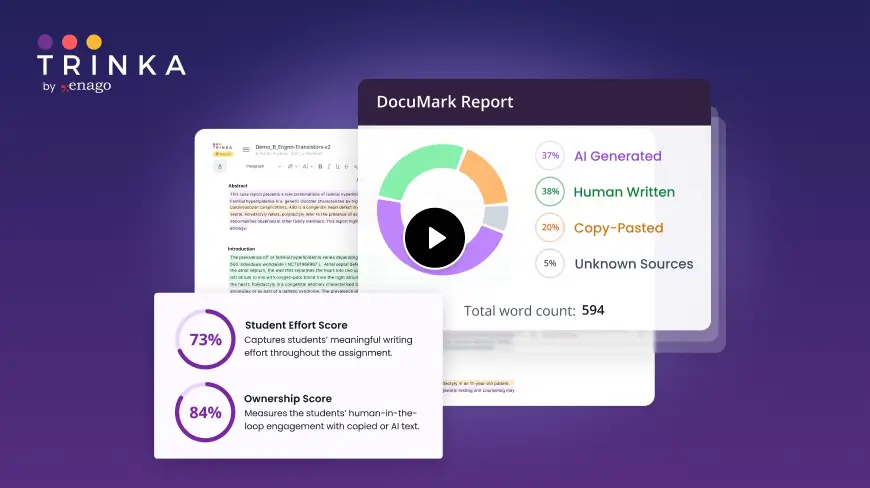
DocuMark: Responsible AI Use for Academic Integrity
Knowing your institution's AI policy is step one. DocuMark helps enforce it fairly by empowering universities to manage AI-generated content, prevent cheating, and support student writing through responsible AI use.
Common Questions About Seton Hall University's AI Policies
Seton Hall University has defined AI policies in 12 of 12 categories, with an overall coverage score of 100%.
Disclosure of AI use is required when a course or program permits AI with attribution. The university's sample syllabus language requires proper attribution, and a graduate program handbook specifically requires acknowledgment of AI use according to APA standards. The law school's honor code also requires students to identify AI-generated material as required by faculty or school policy.
The university's AI guidance cautions faculty not to rely solely on AI-detection tools because they can produce false positives. Enforcement instead proceeds through existing academic-integrity structures: undisclosed or unauthorized AI use may be treated as academic dishonesty or an honor code violation, depending on the school or department.
Seton Hall prohibits entering sensitive institutional information into public AI tools and ties AI use to its data-classification policy. Users must follow the university's four-tier data classification system and related minimum security controls when storing, processing, or transmitting university information.