Teaching & Learning
- For applicants, submitting AI-generated writing in application materials is prohibited unless the prompt explicitly asks for it
- For enrolled students, the university's general academic honesty rules prohibit submitting work produced by another source as one's own, but the provided sources do not set a single university-wide AI rule for ordinary course assignments beyond that general integrity standard
As Sewanee continues to innovate and adapt to changing educational circumstances, the Office of Admission seeks to identify an applicant’s unique voice and perspective. Therefore, if your application essay is generated by AI, we may not be able to accurately evaluate your application and reserve the right to deny your application for using AI in your written materials.
Any student found guilty of intentionally misrepresenting work or cheating in any way may be subject to suspension, dismissal, or other sanction.
Plagiarism and cheating are violations of Sewanee’s longstanding Honor Code. Plagiarism is using another’s words or ideas as one’s own without proper attribution. Work generated by AI, such as ChatGPT, is another source from which students may take information and present it as their own without proper attribution. As AI is woven into our educational contexts, students will need to navigate standards and expectations for ethical engagement, always upholding principles of honesty and transparency.
If the university has reason to believe that a candidate has misrepresented any of the information provided in connection with the application process, including through the use of AI generated essay responses where not specifically invited in an application prompt, Sewanee reserves the right to deny the application of the student at any time in the admission process, rescind an offer of admission, or remove a student from enrollment at the university.
- The provided sources do not define any AI-specific rule for exams, quizzes, tests, or other assessments
- The only relevant statement is the general prohibition on cheating and misrepresentation under the Honor Code
Any student found guilty of intentionally misrepresenting work or cheating in any way may be subject to suspension, dismissal, or other sanction.
- The provided sources do not set a specific rule saying whether AI tutoring or study assistance is permitted or prohibited
- Sewanee acknowledges AI as part of the educational environment and says students must engage with it ethically, with honesty and transparency
As AI is woven into our educational contexts, students will need to navigate standards and expectations for ethical engagement, always upholding principles of honesty and transparency.
Research
- The material is strategic and descriptive rather than regulatory
- Sewanee's strategic planning materials describe interest in using data analytics and machine learning in academic work and research-related activity, but the provided sources do not establish a policy governing how AI may be used for research data or analysis
Data analytics, coding, machine learning, and/or mathematics are transforming all walks of life. Sewanee is uniquely poised to explore the human dimensions of these new forms of knowing and understanding as students in all of our majors can now engage with and critique digital techniques and methods while acquiring technical skills and exploring broad disciplines.
Research demonstrates that digitally inflected forms of teaching, learning, and inquiry can broaden and deepen students’ understanding of their work and sharpen and support their critical and analytical skills.
Academic Integrity
- The policy frames student AI use around honesty and transparency, but it does not provide a detailed citation format or standardized disclosure statement
- Sewanee requires proper attribution when students use ideas or words from another source, and it explicitly says AI-generated work is a source that cannot be presented as a student's own without proper attribution
Plagiarism is using another’s words or ideas as one’s own without proper attribution. Work generated by AI, such as ChatGPT, is another source from which students may take information and present it as their own without proper attribution. As AI is woven into our educational contexts, students will need to navigate standards and expectations for ethical engagement, always upholding principles of honesty and transparency.
- The provided sources do not mention AI-detection software
- Sewanee states that students who intentionally misrepresent work or cheat may face suspension, dismissal, or other sanctions
- For admission materials, the university also reserves the right to deny an application, rescind admission, or remove a student from enrollment if it believes the applicant misrepresented information through AI-generated essay responses where AI was not invited
Any student found guilty of intentionally misrepresenting work or cheating in any way may be subject to suspension, dismissal, or other sanction.
If the university has reason to believe that a candidate has misrepresented any of the information provided in connection with the application process, including through the use of AI generated essay responses where not specifically invited in an application prompt, Sewanee reserves the right to deny the application of the student at any time in the admission process, rescind an offer of admission, or remove a student from enrollment at the university.
Institutional & Administrative
- However, the provided sources do not state data-classification rules, privacy restrictions for AI inputs, or a list of prohibited AI tools
- The university provides access to Microsoft Copilot through its technology training resources, indicating it is an available institutional platform
Microsoft Copilot
Get started with Microsoft Copilot, your AI-powered chat assistant
The University is offering chat access to Copilot.
- This is an institutional strategy statement rather than a formal governance policy with AI rules, committees, or compliance requirements in the provided sources
- Sewanee's strategic planning materials identify data analytics, coding, and machine learning as part of the university's academic direction and describe building curricular and faculty capacity in these areas
Data analytics, coding, machine learning, and/or mathematics are transforming all walks of life. Sewanee is uniquely poised to explore the human dimensions of these new forms of knowing and understanding as students in all of our majors can now engage with and critique digital techniques and methods while acquiring technical skills and exploring broad disciplines.
The University has made significant strides in these areas over the last five years. We now offer a major and minor in data analytics, and we have developed a strong and enthusiastic cohort of faculty in departments across the humanities, social sciences, natural sciences, and fine arts who are integrating digital and computational methods into their classes and research.
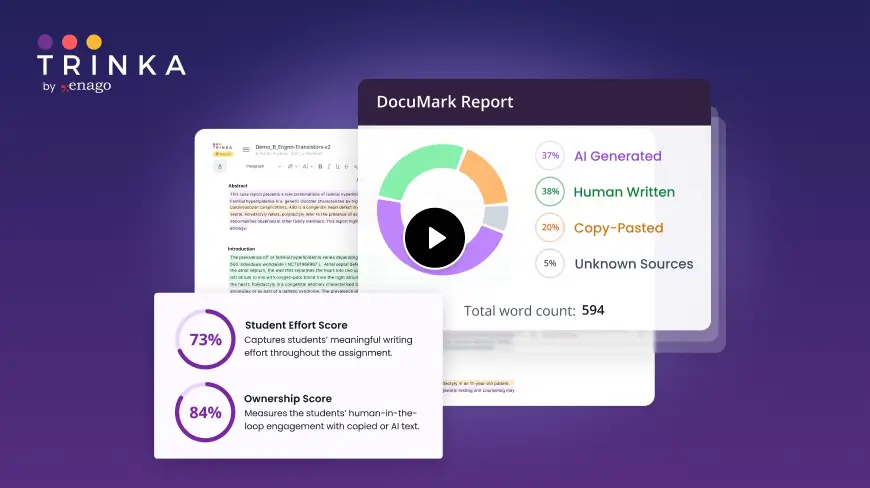
DocuMark: Responsible AI Use for Academic Integrity
Knowing your institution's AI policy is step one. DocuMark helps enforce it fairly by empowering universities to manage AI-generated content, prevent cheating, and support student writing through responsible AI use.
Common Questions About Sewanee, University of the South's AI Policies
Sewanee, University of the South has defined AI policies in 8 of 12 categories, with an overall coverage score of 67%.
Sewanee requires proper attribution when students use ideas or words from another source, and it explicitly says AI-generated work is a source that cannot be presented as a student's own without proper attribution. The policy frames student AI use around honesty and transparency, but it does not provide a detailed citation format or standardized disclosure statement.
Sewanee states that students who intentionally misrepresent work or cheat may face suspension, dismissal, or other sanctions. For admission materials, the university also reserves the right to deny an application, rescind admission, or remove a student from enrollment if it believes the applicant misrepresented information through AI-generated essay responses where AI was not invited. The provided sources do not mention AI-detection software.
The university provides access to Microsoft Copilot through its technology training resources, indicating it is an available institutional platform. However, the provided sources do not state data-classification rules, privacy restrictions for AI inputs, or a list of prohibited AI tools.