Teaching & Learning
- Submitting AI-created work as one's own is treated as misconduct
- Use of AI in graded coursework is set at assessment level rather than by a single blanket rule
- Students must follow the AI instructions in each assessment brief, and if no guidance is given, they are told to assume AI cannot be used
Your tutors should give you guidance about the level of AI which is allowed in your assessment task. This guidance on what is allowed and how to acknowledge any use of AI in your assessment should typically be included in your assessment brief. Your work will be marked according to the assessment criteria for each task, so it is important you read your assessment brief, and follow any AI-related guidance to succeed at the task and avoid academic misconduct.
Sometimes tutors may use the Artificial Intelligence Transparency Scale below to help communicate about how AI may be used, although they may use a different approach. If your tutor has not provided guidance on the use of AI-generated material for your assessment, please ask them. If in doubt, assume that AI cannot be used in your assessment task.
Examples of this sort of misconduct include: buying an assignment from an 'essay mill'/professional writer; submitting an assignment which you have downloaded from a file-sharing site; acquiring an essay from another student or family member and submitting it as your own; attempting to pass off work created by artificial intelligence as your own. These activities show a clear intention to deceive the marker and are treated as misconduct.
- For taught assessments, AI use is controlled through assessment briefs, which must state whether AI can or cannot be used and how students should communicate that use
- For PGR assessments, AI may be used to support learning and thinking, but AI output cannot be submitted as the student's own work, and students remain responsible for defending thesis content in the viva
All assessment briefs must be clear to students how AI can or cannot be used. A transparency statement must be included in assessment briefs which guides students as to the ways in which AI can be used and how to communicate the use of AI.
While generative AI tools may be used as aids to inform your thinking and support your learning, the AI output must not be submitted as your own work.
If you do use AI, you should be aware of the potential risk that you might not be able to evidence the degree award criteria1 to the satisfaction of your examiners. In particular, the requirements to critically investigate and evaluate a topic and to make an independent and original contribution to knowledge and/or professional practice. Use of AI may impact on your ability to defend your thesis in your viva examination if you have not fully understood the AI-generated aspects within your thesis.
- The university allows AI to support non-graded study activities
- PGR guidance also states that generative AI may be used to inform thinking and support learning
- Its student guidance presents Copilot as a study aid for summarising materials, creating revision resources, and similar learning support tasks
You can use Copilot to support your study, with tasks such as:
* summarising articles and documents
* creating revision materials
* creating a PowerPoint slideshow
* uploading files to use with Copilot
While generative AI tools may be used as aids to inform your thinking and support your learning, the AI output must not be submitted as your own work.
- The university does not provide a separate university-wide rule specifically for code generation in student programming work
- Programming-related AI use falls under the same assessment-brief rules as other assessment tasks, with tutor-set permissions and disclosure expectations
Your tutors should give you guidance about the level of AI which is allowed in your assessment task. This guidance on what is allowed and how to acknowledge any use of AI in your assessment should typically be included in your assessment brief.
All assessment briefs must be clear to students how AI can or cannot be used. A transparency statement must be included in assessment briefs which guides students as to the ways in which AI can be used and how to communicate the use of AI.
Research
- Students also remain responsible for understanding and defending any AI-influenced content
- The university requires an AI statement in thesis submissions and warns that failure to acknowledge AI could amount to research misconduct
- For PGR theses and related research degree assessments, AI may be used in limited ways, but students must acknowledge its use in the submission
If you do use AI, you should be aware of the potential risk that you might not be able to evidence the degree award criteria1 to the satisfaction of your examiners. In particular, the requirements to critically investigate and evaluate a topic and to make an independent and original contribution to knowledge and/or professional practice. Use of AI may impact on your ability to defend your thesis in your viva examination if you have not fully understood the AI-generated aspects within your thesis.
[You must acknowledge use of generative AI in your work. Failure to acknowledge use of AI tools could constitute research misconduct. Please refer to the guidance on use of generative AI in assessments on the Research Degrees Blackboard site.
You should include the relevant option below:]
[Or:]
• I used AI at AITS 2 (AI for Shaping) of the Artificial Intelligence Transparency Scale (AITS). I acknowledge the use of <insert AI system(s) name and URL> to <brief description of how you used the tool>.
• [For research projects involving AI only] AI-generated materials have been included in this submission. I acknowledge the use of <insert AI system(s) name and URL> to <brief description of how you used the tool>.
- The university permits AI use in research only with strict data-handling limits
- Thesis guidelines still require the student's own analysis and interpretation to be their own work
- PGR students must not upload personal or identifiable data into AI tools, must anonymise data before use, and may also be barred from using AI where research materials are sensitive or contractually restricted
PGR students must not upload personal data or any information that could directly or indirectly identify individuals into AI platforms or tools. All data must be fully anonymised prior to use.
Uploading identifiable data would constitute a breach of GDPR and may be treated as research misconduct under University ethics policies. Such breaches carry serious consequences for both the researcher and the institution. Students are therefore required to handle data responsibly and ensure participant confidentiality is never compromised.
In all cases, before using an AI tool, you must consider the nature of your research and the content of your work. For example, use of AI tools may not be permitted where your thesis contains personal, commercial or otherwise sensitive information, or where use of AI tools is not permitted under a contractual agreement (see AI & Research Integrity policy).
"The data presented in this thesis was obtained in an experiment carried out by the [name of collaboration] in [location of experiment/where collaboration happened]. I played a major role in the preparation and execution of the experiment, and the data analysis and interpretation are entirely my own work. Any contributions from colleagues in the collaboration, such as diagrams or calibrations, are explicitly referenced in the text."
- Failure to acknowledge AI use or misuse of data can be treated as research misconduct
- Researchers and PGR students must consider legality, consent, confidentiality, publisher requirements, and whether ethical approval is required
- The university has a dedicated AI and research integrity framework and requires AI use in research to comply with research misconduct and ethics requirements
however, you must take care not to breach the research misconduct policy or the AI & Research
Integrity policy.
Uploading identifiable data would constitute a breach of GDPR and may be treated as research misconduct under University ethics policies.
[You must acknowledge use of generative AI in your work. Failure to acknowledge use of AI tools could constitute research misconduct. Please refer to the guidance on use of generative AI in assessments on the Research Degrees Blackboard site.
You should include the relevant option below:]
• obtain ethical approval where required.
This page provides further supplementary policies and good research practice guidance.
#### Additional Policies
* AI & Research Integrity (policy) + Checklist for AI Use in Research + AI in Research (webpage)
Academic Integrity
- Disclosure of AI use is required in assessed work where AI has been used
- For research degree submissions, the university requires a formal AI acknowledgement statement in the thesis
- For taught assessment, assessment briefs must include a transparency statement telling students how to communicate AI use, and student guidance says they should provide a statement explaining how AI was used and may need both referencing and acknowledgement
If you have used AI in your work, you need to be clear about whether to reference your use of AI as a source, or to acknowledge your use of AI, or both. See the Library's guidance about when and how to reference AI.
If you are acknowledging the use of AI in your work, you should provide a statement about how you have used it.
All assessment briefs must be clear to students how AI can or cannot be used. A transparency statement must be included in assessment briefs which guides students as to the ways in which AI can be used and how to communicate the use of AI.
[You must acknowledge use of generative AI in your work. Failure to acknowledge use of AI tools could constitute research misconduct. Please refer to the guidance on use of generative AI in assessments on the Research Degrees Blackboard site.
You should include the relevant option below:]
• I used AI at AITS 2 (AI for Shaping) of the Artificial Intelligence Transparency Scale (AITS). I acknowledge the use of <insert AI system(s) name and URL> to <brief description of how you used the tool>.
- Sanctions can include reassessment, capped marks, module failure, repeat fees, or being required to leave the course
- The university treats undisclosed or prohibited AI use as academic misconduct when it breaches the conditions set by the tutor or assessment brief
- Staff are told that AI use is misconduct only when it contravenes those specified rules, and they may use supporting tools such as Turnitin as part of evidence gathering
Examples of this sort of misconduct include: buying an assignment from an 'essay mill'/professional writer; submitting an assignment which you have downloaded from a file-sharing site; acquiring an essay from another student or family member and submitting it as your own; attempting to pass off work created by artificial intelligence as your own. These activities show a clear intention to deceive the marker and are treated as misconduct.
Remember that you should be setting boundaries around the use of Artificial Intelligence (AI) in your assessment brief, as per the institutional position on AI in Assessment. Use of AI is only misconduct where students have used it in contravention of how you specify.
You should gather evidence of academic misconduct and there are some tools which can help support this.
There are a variety of ways students might breach the academic conduct regulations. Turnitin, Inc. has helpfully developed a spectrum describing these different ways.
If this was a reassessment task, you will have failed the module.
If your course permits, you may be eligible to repeat the module in the next academic year.
Any repeat modules will be subject to a fee and are capped at the minimum pass mark.
If you are not entitled to repeat, you may fail the module which will result in your being required to leave the course.
Institutional & Administrative
- Teaching staff are also expected to set clear AI boundaries in assessment briefs
- The university permits staff use of AI but imposes accountability, transparency, legality, and human oversight requirements
- Staff must be able to justify and explain their use of AI, check AI-generated content, follow university policies, and avoid using AI for decision-making in student assessment or staff/student recruitment
Staff must:
• use AI in ways they are prepared to justify and explain,
• take responsibility for their actions when using AI,
• ensure they have checked that any AI generated content that they are planning to use adheres to this policy and the AI principles,
and staff should:
• seek advice from the University’s specialist support services (e.g. DTS, Information Governance, IP, copyright) to inform their decisions to use AI.
• not use AI for decision making unless human supervision is in place,
• not use AI for decision making regarding student and staff recruitment and assessment,
Remember that you should be setting boundaries around the use of Artificial Intelligence (AI) in your assessment brief, as per the institutional position on AI in Assessment.
- The university also directs students to Microsoft Copilot through their Microsoft Office 365 account
- The university distinguishes between public AI services and private AI services restricted to university users, describing private services as safer because data is not shared outside the organisation
- Staff must not upload personal data or confidential information to public AI services, and PGR students must not upload personal or identifiable research data into AI tools and must fully anonymise data first
• not upload any personal data (as defined by GDPR) to public AI services, whether free or
paid for,
• not upload any confidential information to public AI services,
Public AI services
AI services that are available to users on the public internet whether free or paid for (e.g ChatGPT
Plus). These services typically retain data input for further training and may use it in responses to
future requests by any user.
Private AI services
AI services that are restricted to particular groups of users, for example members of the University
and require access to be granted. These services will protect data from being shared with other
users outside the organisation so are safer to use.
PGR students must not upload personal data or any information that could directly or indirectly
identify individuals into AI platforms or tools. All data must be fully anonymised prior to use.
Copilot is an AI-powered assistant, which you can access with your Microsoft Office 365 account.
- Its teaching guidance also states institutional commitments to consistent AI guidance, AI literacy, and responsible curriculum, pedagogy, and assessment integration
- The university has an institutional AI governance structure, including a formal university AI policy approved by an oversight group and an institutional working group that created the Artificial Intelligence Transparency Scale
Policy for the use of Artificial Intelligence
Approved by:
Committee/individual: Information Governance and Cyber
Security Oversight Group (IGCSOG)
The Artificial Intelligence Transparency Scale (AITS) has been created through an institutional
working group at Sheffield Hallam University. AITS uses 5 descriptors to communicate the way in
which AI may be used, and has been used, in assessments.
### Institutional Commitments
* Provide consistent guidance for appropriate AI use
* Support development of AI literacy for staff and students
* Embed AI into curriculum design, pedagogy and assessment responsibly
* Provide clarity of when AI can be used in assessment and support how staff and students can communicate about the transparent use of AI.
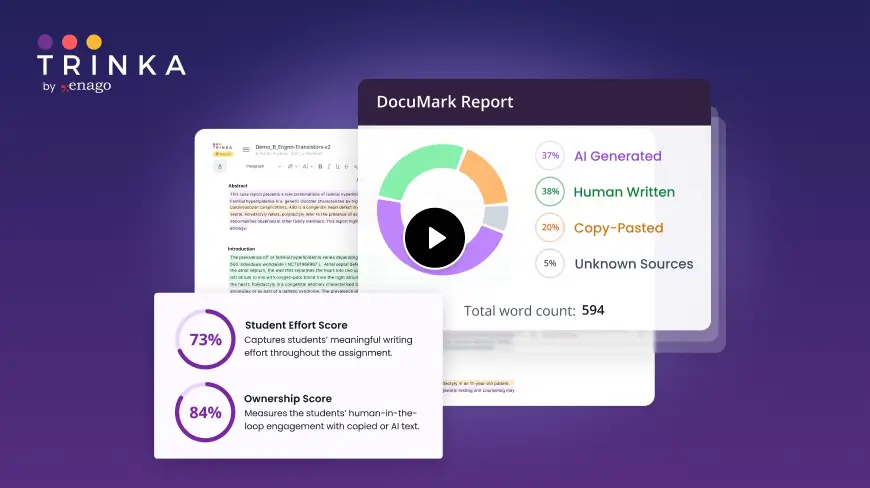
DocuMark: Responsible AI Use for Academic Integrity
Knowing your institution's AI policy is step one. DocuMark helps enforce it fairly by empowering universities to manage AI-generated content, prevent cheating, and support student writing through responsible AI use.
Common Questions About Sheffield Hallam University's AI Policies
Sheffield Hallam University has defined AI policies in 12 of 12 categories, with an overall coverage score of 100%.
Disclosure of AI use is required in assessed work where AI has been used. For taught assessment, assessment briefs must include a transparency statement telling students how to communicate AI use, and student guidance says they should provide a statement explaining how AI was used and may need both referencing and acknowledgement. For research degree submissions, the university requires a formal AI acknowledgement statement in the thesis.
The university treats undisclosed or prohibited AI use as academic misconduct when it breaches the conditions set by the tutor or assessment brief. Staff are told that AI use is misconduct only when it contravenes those specified rules, and they may use supporting tools such as Turnitin as part of evidence gathering. Sanctions can include reassessment, capped marks, module failure, repeat fees, or being required to leave the course.
The university distinguishes between public AI services and private AI services restricted to university users, describing private services as safer because data is not shared outside the organisation. Staff must not upload personal data or confidential information to public AI services, and PGR students must not upload personal or identifiable research data into AI tools and must fully anonymise data first. The university also directs students to Microsoft Copilot through their Microsoft Office 365 account.