Teaching & Learning
- When permission is granted, students must cite their AI use and provide any documentation the instructor requires
- More broadly under Policy 2:4, faculty set course requirements and written syllabus expectations for academic misconduct
- For the Professional Program in Veterinary Medicine, AI use in submitted assignments is prohibited unless the instructor gives explicit written permission
Generative Artificial Intelligence (AI) tools may not be used for any submitted
assignment unless explicitly permitted in writing by the instructor. If such permission is
granted, it is the student’s responsibility to properly cite the use of AI tools and submit
any required documentation in accordance with the instructor’s guidelines.
Faculty will inform Students at the beginning of each course of the objectives, requirements, performance standards, and evaluation procedures for the course. The Faculty Member determines course content, attendance requirements, performance requirements, and grading procedures for courses under their direct supervision, and they must distribute these in written form to their Students at the beginning of each semester.
Further, Faculty Members should call to the attention of Students the University policy regarding Academic Misconduct, answer any questions Students may have, and actively engage Students in understanding and avoiding academic dishonesty or misconduct. These provisions will be distributed in the course syllabus.
- No university-wide AI-specific exam rule is defined in the provided sources
- The PPVM handbook separately requires privacy screens during in-class exams, and Policy 2:4 treats unauthorized assistance on quizzes, tests, examinations, or other assignments as cheating
Students are required to use privacy screens on their laptops during all in-class exams to
maintain academic integrity. This requirement does not apply to group exams.
Using any unauthorized assistance in, or having unauthorized materials while, taking quizzes, tests, examinations, or other assignments, including copying from another’s quiz, test, examination, or other assignment or allowing another to copy from one’s own quiz, test, examination, or other assignment;
- SDSU highlights student AI literacy resources and makes AI tools embedded in D2L available, including AI Tutor Pro
- The university provides AI learning-support resources rather than a formal student use policy in the provided sources
As artificial intelligence continues to shape teaching and learning, we want to ensure you have easy access to high‑quality and research‑based AI resources to support your work at SDSU. Below is a curated list of AI resources highlights:
AAC&U 2025 Student Guide to Artificial Intelligence – a friendly guide aimed at building AI literacy and responsible use.
AIs Embedded in D2L: Accessible under SDSU Resources menu in D2L
AI Tutor Pro
Research
- Disclosure may be required if a funding agency asks for it
- AI-generated content must be checked for accuracy and originality, and proposal text should reflect the lead researcher or research team's voice
- For funding proposals, AI may be used with caution as a support tool for brainstorming, summarizing, drafting, and related early-stage writing tasks, but it is not a substitute for human creativity and expertise
Yes, but with caution. AI should be used as a support tool for brainstorming, summarizing and drafting, not as a replacement for human creativity and expertise. All AI-generated content must be verified for accuracy and originality.
2. Transparency: If the funding agency asks you to, make it clear what part AI played in the proposal development process. Make sure that all material created with AI meets the standards for originality and intellectual contribution by the applicant. This could be generating draft abstracts or initial idea brainstorming, to illustrate appropriate applications
6. As a guide: AI tools should be used to help and support human work, not in place of creativity, expertise and critical thinking. Ensure that the end proposals reflect the voice and goals of the lead researcher or research team.
AI can be used for:
* Drafting abstracts and summaries
* Identifying gaps or trends in literature
* Creating visual aids (charts, graphs)
* Improving grammar and clarity in writing
- AI must not be used to fabricate study data, findings, or outcomes
- In proposal development guidance, SDSU says AI can be used to help analyze large datasets and create visual aids, but researchers must verify AI-produced text, analysis, suggestions, and data against reliable sources
AI has become a useful tool for researchers and groups looking for funds, from making rough drafts and generating ideas to analyzing huge datasets.
3. Human oversight: Know that the results that AI produces might have mistakes or claims that are not backed up. Before putting any text, analysis or suggestions that were made by AI into your proposal, you should always check and make sure they are correct. Check data that was generated by AI against data from reliable sources.
4. Ethical use: Do not use AI to make up study data, findings or outcomes or to lie about them. When using material made by AI, make sure you follow the rules for authorship, attribution and intellectual property.
No. AI should never be used to fabricate data, findings or outcomes. Doing so violates ethical research standards and can lead to proposal rejection or reputational damage.
AI can be used for:
* Creating visual aids (charts, graphs)
- If an agency requires disclosure of AI use, researchers must explain AI's role in the proposal process
- For grant proposal work, SDSU requires researchers to follow funding-agency AI rules, protect confidential data, use human oversight, and avoid fabricated data or misleading results
1. Data privacy and confidentiality: Stay away from putting private, secret or sensitive data into AI tools that store data elsewhere, as this could make your data less safe. Make sure that data privacy laws and funding agency rules about using third-party AI tools are followed. Examples: names, addresses, phone numbers, Social Security numbers, etc. Example: Grammarly (for text editing), DALL-E (image generation) are AI tools that prioritize privacy and minimize data collection.
2. Transparency: If the funding agency asks you to, make it clear what part AI played in the proposal development process. Make sure that all material created with AI meets the standards for originality and intellectual contribution by the applicant. This could be generating draft abstracts or initial idea brainstorming, to illustrate appropriate applications
4. Ethical use: Do not use AI to make up study data, findings or outcomes or to lie about them. When using material made by AI, make sure you follow the rules for authorship, attribution and intellectual property.
5. Following the rules: Read and follow the funding organizations’ rules about how to use AI in proposals. Some funding groups might want clear explanations about how much AI was used in the proposal-making process.
It depends on the funding agency. Some agencies may require transparency regarding AI’s role in the writing process. Always check the specific guidelines of the funding organization.
Academic Integrity
- In proposal development, disclosure of AI use is conditional on funding-agency requirements
- In the PPVM, when an instructor permits AI use for a submitted assignment, students must properly cite the AI tool use and submit any documentation the instructor requires
If such permission is
granted, it is the student’s responsibility to properly cite the use of AI tools and submit
any required documentation in accordance with the instructor’s guidelines.
2. Transparency: If the funding agency asks you to, make it clear what part AI played in the proposal development process.
Do I need to disclose AI usage in my proposal?
It depends on the funding agency. Some agencies may require transparency regarding AI’s role in the writing process. Always check the specific guidelines of the funding organization.
- The provided sources do not define an AI-detection-tool policy
- In the PPVM, unauthorized AI use on submitted assignments would fall under a rule that prohibits such use unless the instructor gives written permission
- For academic misconduct generally, faculty who have evidence of misconduct must document and retain evidence, and allegations may be resolved informally or through the Student Code of Conduct; prior misconduct may affect consequences
Generative Artificial Intelligence (AI) tools may not be used for any submitted
assignment unless explicitly permitted in writing by the instructor.
Academic Misconduct occurs when a Faculty Member has evidence that a Student has cheated, plagiarized, fabricated, or otherwise misrepresented their work. It also involves contributing to or facilitating Academic Misconduct with others.
Faculty members who have evidence of alleged Academic Misconduct will:
1. thoroughly document all communications, actions, materials, and evidence regarding the Academic Misconduct;
2. review and retain the material (e.g. exam, quiz, report, term paper, etc.) and other data to ensure sufficient evidence for a charge of Academic Misconduct; and
3. inform the applicable Department Head(s)/School Director(s) and Dean(s).
Allegations of Academic Misconduct may be informally resolved between a Student and Faculty Member as set forth herein, or formally resolved pursuant to the Student Code of Conduct.
At the Faculty Member’s request, the Student Conduct Officer will inform the Faculty Member of the Student’s engagement in prior instances of Academic Misconduct, which information may be used in determining any academic consequences.
Institutional & Administrative
- SDSU provides faculty-facing AI resources and guidance rather than a single comprehensive faculty-use policy in the provided sources
- In accessibility work, staff are told to use AI to enhance rather than replace judgment, with required review, manual testing, and ongoing auditing
- For communications and marketing professionals, AI is allowed only as an assistive tool with required human review, editing, approval, and fact-checking, and fully AI-generated written pieces are prohibited
These guidelines are intended for communications and marketing professionals at SDState. They do not apply to other areas of the university, such as education, classroom settings, IT or chatbots. Instead, they specifically address the use of AI tools for generating content, including text, images, music, video and similar media.
South Dakota State University embraces a human-centered approach to AI that enhances and supports professionals. AI should serve as an assistive tool rather than operate autonomously.
· Human accountability remains paramount. All AI-generated content must be carefully reviewed, edited, approved and overseen by a human author, editor or designer.
· Accuracy is essential. We will verify all AI-generated information, recognizing that human fact-checkers play an irreplaceable role in ensuring credibility.
AI should not be used to generate entire written pieces. While it can assist with brainstorming, drafting headlines and refining messaging, fully AI-generated content is prohibited at this time.
As artificial intelligence continues to shape teaching and learning, we want to ensure you have easy access to high‑quality and research‑based AI resources to support your work at SDSU. Below is a curated list of AI resources highlights:
1. Use Artificial Intelligence to Enhance, Not Replace, Human Judgment
* AI can assist with tasks like checking color contrast, generating alt text or identifying missing headings — but always review its output.
* Human oversight is essential, especially for nuanced accessibility decisions (e.g., meaningful alt text or cognitive load considerations).
* But always pair automation with manual testing (e.g., keyboard navigation, screen reader checks).
* Regularly audit AI tools for accessibility, accuracy and usability.
- SDSU identifies Microsoft Copilot as its approved generative AI tool in the accessibility guidance
- The university also warns users not to enter proprietary, student, employee, patient, or other sensitive data into AI tools, and research proposal guidance says private or sensitive data should not be entered into third-party AI systems that store data elsewhere
Microsoft Copilot is South Dakota State University's approved generative AI tool.
AI tools are not encrypted or private. Do not input proprietary data, student or employee information, patient records or any other sensitive details that could breach state or federal privacy laws, including HIPAA, FERPA or other university policies.
Information submitted to many AI platforms may become public and part of the tool’s knowledge base.
1. Data privacy and confidentiality: Stay away from putting private, secret or sensitive data into AI tools that store data elsewhere, as this could make your data less safe. Make sure that data privacy laws and funding agency rules about using third-party AI tools are followed. Examples: names, addresses, phone numbers, Social Security numbers, etc.
- SDSU states that it has a campuswide AI initiative, an AI working group, and an effort to collaboratively develop strategy and solution recommendations for university AI use
- The university says participation in the AAC&U 2025-26 Institute on AI, Pedagogy and the Curriculum will support faculty and administrators as SDSU develops and implements AI policies and plans across campus
South Dakota State University has been selected by the American Association of Colleges and Universities to participate in the 2025-26 Institute on AI, Pedagogy and the Curriculum.
Last spring, SDSU initiated an effort to collaboratively develop strategy and solution recommendations that will aid the university in the application of AI and associated innovation. The institute will accelerate SDSU's knowledge of AI and will provide critical support to faculty and administrators as the university further develops and implements AI policies and plans across campus.
“The SDSU team is comprised of members from the SDSU AI working group, and we’ll be collaborating with units across campus throughout the year on a wide range of AI issues.”
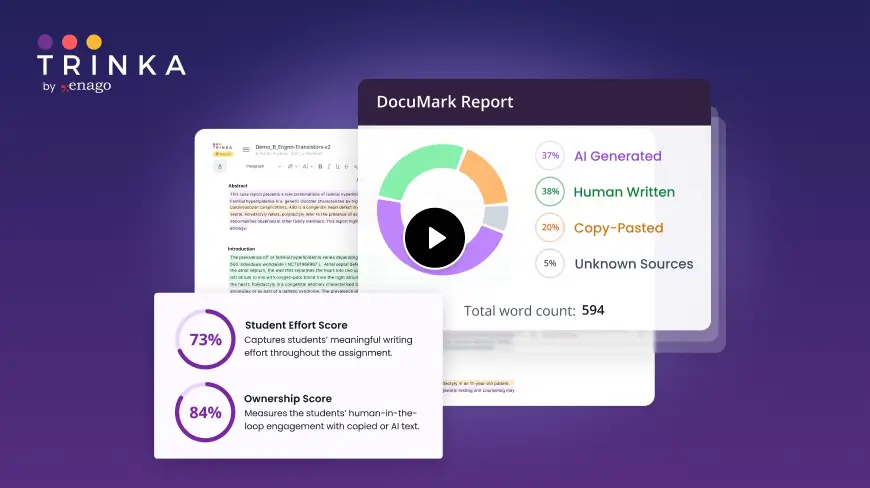
DocuMark: Responsible AI Use for Academic Integrity
Knowing your institution's AI policy is step one. DocuMark helps enforce it fairly by empowering universities to manage AI-generated content, prevent cheating, and support student writing through responsible AI use.
Common Questions About South Dakota State University's AI Policies
South Dakota State University has defined AI policies in 11 of 12 categories, with an overall coverage score of 92%.
In the PPVM, when an instructor permits AI use for a submitted assignment, students must properly cite the AI tool use and submit any documentation the instructor requires. In proposal development, disclosure of AI use is conditional on funding-agency requirements.
The provided sources do not define an AI-detection-tool policy. For academic misconduct generally, faculty who have evidence of misconduct must document and retain evidence, and allegations may be resolved informally or through the Student Code of Conduct; prior misconduct may affect consequences. In the PPVM, unauthorized AI use on submitted assignments would fall under a rule that prohibits such use unless the instructor gives written permission.
SDSU identifies Microsoft Copilot as its approved generative AI tool in the accessibility guidance. The university also warns users not to enter proprietary, student, employee, patient, or other sensitive data into AI tools, and research proposal guidance says private or sensitive data should not be entered into third-party AI systems that store data elsewhere.