Teaching & Learning
- Students are expected to follow assessment instructions on permitted AI use and disclosure, and the University frames inappropriate use as carrying risks and consequences under misconduct rules
- AI use in assessed coursework is permitted where the University considers it appropriate and relevant to student learning, but the allowed use must be made clear to students through assignment instructions
The University will enable the use of AI applications in assessment where this is appropriate and relevant to enhance student learning, making it clear to students when they can, and cannot, use AI in assessment, through a clear Assignment Template.
Follow assessment instructions around permitted AI use and disclosure
This Assessment, Marking and Feedback Policy, the University Proofreading Policy and the Academic Misconduct procedure reference appropriate usage of AI in assessment, explaining the risks and consequences of inappropriate usage for students.
- For assessments generally, AI may be enabled where appropriate, but exam security and academic integrity controls still apply
- In examinations, presenting work produced by unauthorized means is treated as academic misconduct, and all in-person and online examinations must be subject to appropriate security measures
The University will enable the use of AI applications in assessment where this is appropriate and relevant to enhance student learning.
All in person examinations must be subject to appropriate security measures to ensure academic integrity.
All online examinations must be subject to appropriate security measures to ensure academic integrity.
Presenting an examination script as one’s own work when the script includes material produced by unauthorised means.
- The university encourages students to use AI for personal learning in a critical and responsible way
- Students are expected to evaluate AI outputs for bias and inaccuracy, edit them using informed judgment before incorporating them into academic work, and explore how AI can enhance personal learning while maintaining academic integrity
Critically assess the limitations of generative AI outputs by identifying potential biases and inaccuracies, and edit the content using informed judgement before incorporating it into academic work.
As AI becomes more integrated into academic life, students are expected to develop ethical and effective use of these technologies to maintain academic integrity when using AI, recognise how AI can be applied within specific disciplines, and explore ways it can enhance personal learning.
Research
- Researchers are expected to understand the authorship implications of using AI in research writing and to disclose such use in research outputs and publications
- The framework also expects acknowledgment of AI outputs and basic referencing practices, including in-text citations, reference lists, and declaration statements
Understand the authorship implications of using AI tools in research and disclose their use (e.g. for writing assistance, data analysis) in research outputs and publications.
Show awareness of the importance to acknowledge AI outputs and demonstrate basic referencing practices, such as in-text citations, reference lists and declaration of use statements.
- The researcher framework expressly contemplates AI use for data analysis, but requires disclosure of that use in research outputs and publications
- It also expects researchers to maintain records of AI tool usage and to integrate responsible and ethical AI methods into research design and methodology
Understand the authorship implications of using AI tools in research and disclose their use (e.g. for writing assistance, data analysis) in research outputs and publications.
Maintain detailed records of AI tool usage, including versioning, prompts, and outputs, to ensure reproducibility and transparency.
Integrate responsible and ethical AI methods into research design and methodology with discipline-specific rigour.
- The university's researcher AI framework requires AI use in research to align with research integrity, ethical standards, and disciplinary standards
- Researchers are expected to develop protocols for documenting AI involvement in workflows and may contribute to institutional or wider standards for ethical AI use in research
In today’s research landscape, AI is not only a tool for discovery but also a factor reshaping how research is conducted, communicated, and managed. Role-specific AI literacy for researchers involves understanding how to uphold research integrity when using AI, applying AI meaningfully within specific disciplines, and leveraging it to improve efficiency in administrative and project-related tasks.
Developing these competencies enables researchers to ensure that AI is used in ways that are rigorous, ethical, and aligned with disciplinary standards.
Develop and follow clear protocols for documenting AI involvement in research workflows.
Take a leading role in the development of institutional or wider standards for ethical AI use in research.
Academic Integrity
- Swansea requires acknowledgment and referencing of AI-generated content in academic work, including in-text citations, reference lists, and university declaration statements
- Students are also expected to follow assessment instructions on permitted AI use and disclosure, while researchers are directed to use declaration of use statements and maintain transparency records
Apply appropriate referencing techniques to acknowledge the use of AI generated content in academic work, including accurate use of in-text citations in line with institutional academic integrity guidelines.
Apply institutional accepted referencing standards for AI tools, including in-text citations, reference lists, and university declaration statements.
Follow assessment instructions around permitted AI use and disclosure
Show awareness of the importance to acknowledge AI outputs and demonstrate basic referencing practices, such as in-text citations, reference lists and declaration of use statements.
Maintain detailed records of AI tool usage, including versioning, prompts, and outputs, to ensure reproducibility and transparency.
- Undisclosed or inappropriate AI use is enforced through the university's academic misconduct framework
- The university explicitly prohibits staff or students from uploading student assessments or identifiable data into AI applications for any reason, including attempts to check for AI-generated content, and staff are expected to follow institutional processes for AI-assisted misconduct
iv. Staff or students are not permitted to upload student assessment, or any identifiable data without explicit written consent, to AI applications for any reason (including attempts to check for AI generated content).
Confidently follow institutional processes on addressing AI-assisted academic misconduct.
Presenting an examination script as one’s own work when the script includes material produced by unauthorised means.
This Assessment, Marking and Feedback Policy, the University Proofreading Policy and the Academic Misconduct procedure reference appropriate usage of AI in assessment, explaining the risks and consequences of inappropriate usage for students.
Institutional & Administrative
- The policy applies to faculty staff and professional service staff involved in assessment and AI use
- Teaching staff are expected to use institutional tools, use AI to support teaching and learning activities, design assessments that reduce AI misuse, and may use the university's recommended Copilot tool for routine tasks and assessment review
This policy applies to all faculty staff, students, and professional service staff involved in assessment and/or the use of AI technologies within the University.
Analyse the core functions of commonly used AI tools and select appropriate applications to support specific teaching, learning or assessment activities within the professional context.
Access institutional tools and use their basic functionality.
Identify assessments that are vulnerable to AI misuse and adapt them to reduce the risk of over reliance on AI-generated content.
This quick-start EDT guide to Microsoft Copilot, the University's recommended Gen AI tool, contains some starter ideas and suggestions for using Copilot to save time and effort in routine tasks.
- Swansea requires AI use to comply with GDPR and prohibits staff and students from entering identifiable information into AI applications
- Student assessments or identifiable data cannot be uploaded to AI applications without explicit written consent, and both staff and researcher guidance identify Microsoft Copilot as the university's recommended generative AI tool
i. Use of any AI applications must comply with relevant General Data Protection Regulations (GDPR).
ii. Staff and students should not enter any identifiable information into any AI application.
iv. Staff or students are not permitted to upload student assessment, or any identifiable data without explicit written consent, to AI applications for any reason (including attempts to check for AI generated content).
This quick-start EDT guide to Microsoft Copilot, the University's recommended Gen AI tool, includes where to find Copilot, basic functions, different applications and other considerations including effective and responsible use and academic integrity.
This quick-start SALT guide to Microsoft Copilot, the University's recommended Gen AI tool, includes where to find Copilot, basic functions, different applications and other considerations including effective and responsible use and academic integrity.
- Swansea has an institution-level AI framework and an AI assessment policy positioned around responsible, ethical, transparent, and equitable use of AI
- The policy states that it supports the university's strategic vision, and the researcher framework also envisages staff helping to shape institutional standards for ethical AI use in research
This policy outlines the guidelines and principles for the responsible use of Artificial Intelligence (AI) applications, including generative AI, in assessment at Swansea University. The purpose of this policy is to promote ethical, transparent, and equitable use of AI, ensuring its potential benefits are harnessed while mitigating associated risks and challenges to maintaining standards.
The policy supports the University’s strategic vision and purpose “enabling local solutions to the global challenges that affect us all”.
Take a leading role in the development of institutional or wider standards for ethical AI use in research.
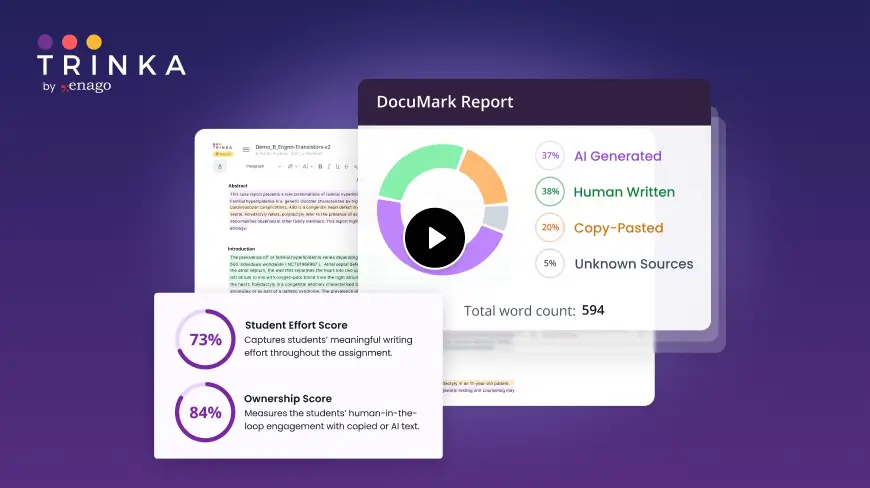
DocuMark: Responsible AI Use for Academic Integrity
Knowing your institution's AI policy is step one. DocuMark helps enforce it fairly by empowering universities to manage AI-generated content, prevent cheating, and support student writing through responsible AI use.
Common Questions About Swansea University's AI Policies
Swansea University has defined AI policies in 11 of 12 categories, with an overall coverage score of 92%.
Swansea requires acknowledgment and referencing of AI-generated content in academic work, including in-text citations, reference lists, and university declaration statements. Students are also expected to follow assessment instructions on permitted AI use and disclosure, while researchers are directed to use declaration of use statements and maintain transparency records.
Undisclosed or inappropriate AI use is enforced through the university's academic misconduct framework. The university explicitly prohibits staff or students from uploading student assessments or identifiable data into AI applications for any reason, including attempts to check for AI-generated content, and staff are expected to follow institutional processes for AI-assisted misconduct.
Swansea requires AI use to comply with GDPR and prohibits staff and students from entering identifiable information into AI applications. Student assessments or identifiable data cannot be uploaded to AI applications without explicit written consent, and both staff and researcher guidance identify Microsoft Copilot as the university's recommended generative AI tool.