Teaching & Learning
- Syracuse University does not set a single university-wide rule permitting or prohibiting AI for graded coursework
- Instead, use of AI in assignments is at instructor discretion, and students must follow the AI-related rules stated in each syllabus
- Submitting AI-generated or AI-assisted work beyond what an instructor allows can be treated as academic dishonesty under the university's academic integrity policy
Faculty should inform students in the course syllabus and at the first class meeting whether use of AI-generated tools is permitted on assignments and exams and, if so, to what extent.
Some examples of use of AI-generated tools include using text generated by AI language models in written assignments or scripts, images generated by AI image generators as original work in assignments, or translating words and passages using AI tools that include sentence revision or generated text beyond direct translation.
The following are some examples of academic dishonesty:
Use of dishonest or intentionally deceptive means in an oral or written assignment, examination, or other academic exercise.
Misrepresentation of authorship or source, including the use of commercially produced papers, online sources, or other students’ work, as one’s own work.
- If a student uses AI in ways that violate those rules, the conduct can fall under academic dishonesty provisions
- Use of AI on exams and assessments is governed by instructor rules rather than a single blanket institutional permission
- Faculty are expected to state in the syllabus and at the first class meeting whether AI tools are allowed on exams and to what extent
Faculty should inform students in the course syllabus and at the first class meeting whether use of AI-generated tools is permitted on assignments and exams and, if so, to what extent.
The following are some examples of academic dishonesty:
Use of dishonest or intentionally deceptive means in an oral or written assignment, examination, or other academic exercise.
- No explicit university-wide rule was found specifically governing private, non-graded study use
- This guidance is advisory and informational rather than a binding university-wide student-use policy
- The university libraries describe generative AI as a tool that may be used for learning support such as brainstorming, organizing, and reviewing writing, but they also warn users to verify outputs because AI can be inaccurate or fabricated
Generative AI is useful for all kinds of things. It can:
Help you think through ideas with your own writing process
Help you get organized or brainstorm
Support your review of final drafts for grammar, style, and tone
Generative AI can also produce fake or misleading information. If you are using Generative AI tools for any kind of writing support, be sure to verify the information with reliable sources before using it in your work.
These tools can absolutely be useful, but they also have significant flaws and can make things up. Always verify information generated by AI with reliable sources before using it in your work.
Research
Academic Integrity
- The library advises students to cite AI when they use generated text and notes that users should check instructor and publisher requirements, indicating that attribution expectations may vary by context
- Syracuse requires course-level transparency about AI rules from instructors, but the provided sources do not establish a university-wide student disclosure or citation standard for AI use in submitted work
Faculty should inform students in the course syllabus and at the first class meeting whether use of AI-generated tools is permitted on assignments and exams and, if so, to what extent.
If you use text generated by AI, make sure to cite and acknowledge it according to your style guide, and check requirements from your instructor or publisher.
The following are some examples of academic dishonesty:
Misrepresentation of authorship or source, including the use of commercially produced papers, online sources, or other students’ work, as one’s own work.
- The supplied sources do not state a university position on AI detection tools specifically
- Enforcement is handled through the academic integrity process, with possible grade penalties, suspension, or expulsion depending on the violation
- The university's academic integrity policy provides enforcement mechanisms and sanctions for dishonest academic conduct, which can apply to undisclosed or unauthorized AI use when it involves deception or misrepresentation
The following are some examples of academic dishonesty:
Use of dishonest or intentionally deceptive means in an oral or written assignment, examination, or other academic exercise.
Misrepresentation of authorship or source, including the use of commercially produced papers, online sources, or other students’ work, as one’s own work.
Academic dishonesty may result in any or all of the following penalties:
The grade of F for the course
The grade of zero for the assignment
Academic Warning
Probation for a specified period of time
Suspension from the University by the University Conduct Board, with transcript notation
Expulsion from the University by the University Conduct Board, with transcript notation
Institutional & Administrative
- This is a faculty-facing instructional requirement about setting course rules, not a broader policy on faculty use of AI for grading, feedback, or administrative tasks
- The provided sources require faculty to communicate in their syllabi and at the first class meeting whether AI-generated tools are allowed in their courses and on exams, and to specify the extent of permitted use
Faculty should inform students in the course syllabus and at the first class meeting whether use of AI-generated tools is permitted on assignments and exams and, if so, to what extent.
- The library guidance warns users not to submit certain sensitive or copyright-protected materials into external AI tools
- The provided sources do not name institutionally approved AI platforms or a broader formal data-classification framework for AI use
- Specifically, it says not to enter personally identifying information, unpublished work, or copyrighted content that one does not own
Never submit personally identifying information, unpublished work, or copyrighted work you don’t own to an external AI platform.
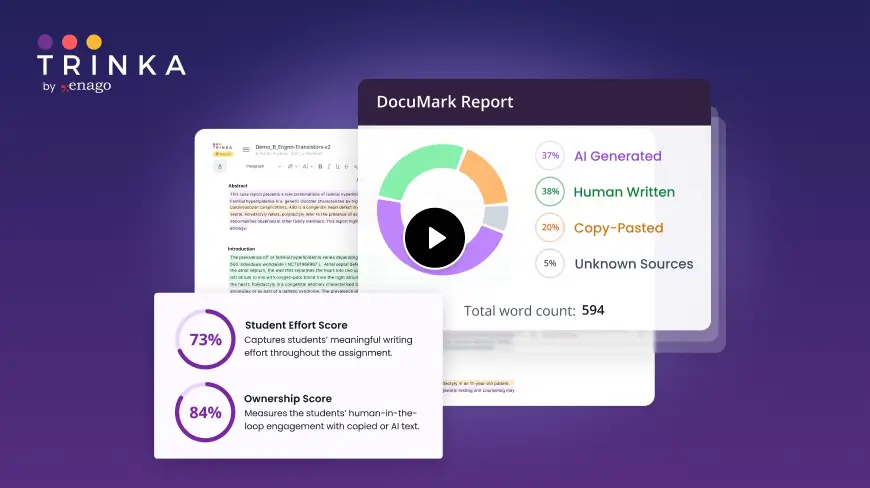
DocuMark: Responsible AI Use for Academic Integrity
Knowing your institution's AI policy is step one. DocuMark helps enforce it fairly by empowering universities to manage AI-generated content, prevent cheating, and support student writing through responsible AI use.
Common Questions About Syracuse University's AI Policies
Syracuse University has defined AI policies in 7 of 12 categories, with an overall coverage score of 58%.
Syracuse requires course-level transparency about AI rules from instructors, but the provided sources do not establish a university-wide student disclosure or citation standard for AI use in submitted work. The library advises students to cite AI when they use generated text and notes that users should check instructor and publisher requirements, indicating that attribution expectations may vary by context.
The university's academic integrity policy provides enforcement mechanisms and sanctions for dishonest academic conduct, which can apply to undisclosed or unauthorized AI use when it involves deception or misrepresentation. The supplied sources do not state a university position on AI detection tools specifically. Enforcement is handled through the academic integrity process, with possible grade penalties, suspension, or expulsion depending on the violation.
The library guidance warns users not to submit certain sensitive or copyright-protected materials into external AI tools. Specifically, it says not to enter personally identifying information, unpublished work, or copyrighted content that one does not own. The provided sources do not name institutionally approved AI platforms or a broader formal data-classification framework for AI use.