Teaching & Learning
- Teesside University permits students to use generative AI in assessed work only when it is used appropriately, ethically, and transparently
- Students must acknowledge AI use when it contributes to assessed work, and they must not submit AI-generated work as their own or rely solely on AI-generated content
Teesside University supports the appropriate and ethical use
of generative AI tools such as ChatGPT, Bard & Adobe Firefly.
Use AI tools in your studies responsibly, ethically, and transparently.
ALWAYS acknowledge the use of AI tools when
they contribute to the development of your
assessed work
NEVER submit AI-generated work as your own, it is
important to use your own words rather than relying
solely on the content generated by AI.
- For assessments, the university treats deliberate use of an AI tool to gain an unfair academic advantage as misconduct
- The regulations do not provide a separate general permission framework for exams; instead, they define misconduct in relation to submitted assessment work and failure to follow assessment instructions
Misrepresentation Where a student is not the author of the work that has been
submitted for an assessment. The student has deliberately
engaged with a third-party tool such as an Artificial
Intelligence (AI) Tool (ChatGPT for example), or by software
that generates other content for the purposes of gaining an
intentional unfair academic advantage.
• There has been a failure to follow assessment
instructions.
- The university allows students to use generative AI as part of their learning experience and encourages responsible use
- Students are told to check accuracy and bias, validate sources, and not accept AI outputs as factual simply because they sound convincing
Teesside University supports the appropriate and ethical use
of generative AI tools such as ChatGPT, Bard & Adobe Firefly.
These tools have the power to enhance and support your
learning experience in numerous ways, for example:
Use AI tools in your studies responsibly, ethically, and transparently.
ALWAYS assess the accuracy and potential
biases in the output generated by AI tools.
NEVER accept everything generated by AI tools as
factual and correct, even if it appears convincing.
Validate your sources
- The university does not set a separate AI rule specific to programming assignments
- However, programming results or codes used without proper acknowledgement are covered by plagiarism rules, and AI use for unfair advantage in assessment is treated as misconduct
Plagiarism The incorporation of another’s work, which can include items
or articles, images, equations, programming results or codes,
test results, judgements or ideas in an assessment either
verbatim or in substance without proper, clear and
unambiguous acknowledgement of the source or content
(for example, paraphrasing of a source with no attempt to
acknowledge the source, or failure to reference appropriately
the source of material used). This includes unacknowledged
material downloaded from electronic sources, published
sources or the work of another student.
Misrepresentation Where a student is not the author of the work that has been
submitted for an assessment. The student has deliberately
engaged with a third-party tool such as an Artificial
Intelligence (AI) Tool (ChatGPT for example), or by software
that generates other content for the purposes of gaining an
intentional unfair academic advantage.
Research
- Its explicit AI rule in the research materials is limited to applications to a School Research Ethics sub-Committee
- The university does not define a policy for AI use in drafting or editing research papers, theses, dissertations, or manuscripts generally
not defined
- Beyond that personal-data condition, the sources do not define a broader AI policy for research data analysis or synthetic data
- When AI technologies are used in proposed research methods and would process personal data, a completed Data Protection Impact Assessment is required and the university's Information Governance Team must have been informed and their advice followed
Where AI technologies are used in the proposed methods of applications
• Where AI technologies would be used to process any personal data the applicant
must
o submit a completed Data Protection Impact Assessment (DPIA) with the
application and
o verify that TU's Information Governance Team have been informed and have
provided advice which was adhered to in preparation of the application.
- For research ethics applications, any use of generative AI in preparing an application must be clearly stated and cited
- For student applications, GenAI use is allowed only if it is permitted under assessment and course regulations, and the academic supervisor is responsible for ensuring that it is permitted in the student's work
1.4.12 Use of artificial intelligence tools
Where Generative Artificial Intelligence (GenAI) has been used in the preparation of an
application to an SRESC
• In all applications – this must be clearly stated and cited
• In all student applications - the use of GenAI must be permitted under
TU Assessment Regulations and any specific Module/Course/Award regulations. It
is the responsibility of the Academic Supervisor to ensure the use of GenAI is
permitted in the student’s work.
Academic Integrity
- Students are required to acknowledge AI use when it contributes to assessed work
- In research ethics applications, any use of GenAI in preparing an application must be clearly stated and cited
ALWAYS acknowledge the use of AI tools when
they contribute to the development of your
assessed work
• In all applications – this must be clearly stated and cited
- The university treats deliberate AI use for unfair academic advantage as academic misconduct and applies staged penalties
- The regulations also explicitly reference Turnitin findings as an example used in minor cases involving unattributed material
Misrepresentation Where a student is not the author of the work that has been
submitted for an assessment. The student has deliberately
engaged with a third-party tool such as an Artificial
Intelligence (AI) Tool (ChatGPT for example), or by software
that generates other content for the purposes of gaining an
intentional unfair academic advantage.
Stage 1 Minor offence and/or first offence of Academic
Misconduct which includes, but is not limited to,
cases where:
• A small amount of work reproduced primarily
from the inclusion of unattributed material
including poorly applied citation conventions
(for example, normally on the basis of a finding
published by Turnitin).
Stage 2 Major cases and/or second or more offences of
Academic Misconduct, which includes, but is not
limited to, cases where:
• There are strong indications that the student
has intended to gain an unfair advantage.
Institutional & Administrative
- No broader policy is defined for staff use of AI in grading, feedback, lesson planning, recommendation letters, or administration
- The sources only define a faculty responsibility in relation to student research ethics applications: the academic supervisor must ensure that student GenAI use is permitted in the student's work
• In all student applications - the use of GenAI must be permitted under
TU Assessment Regulations and any specific Module/Course/Award regulations. It
is the responsibility of the Academic Supervisor to ensure the use of GenAI is
permitted in the student’s work.
- The sources do not identify any approved university AI platforms
- Students are told not to provide personal or sensitive information to AI tools because of uncertainty about storage, access, and reuse
- In research ethics applications, if AI technologies would process personal data, a DPIA is required and the Information Governance Team must be informed and their advice followed
NEVER provide personal or sensitive
information to AI tools, as it is uncertain
how such data will be stored, accessed, and
potentially used by others.
• Where AI technologies would be used to process any personal data the applicant
must
o submit a completed Data Protection Impact Assessment (DPIA) with the
application and
o verify that TU's Information Governance Team have been informed and have
provided advice which was adhered to in preparation of the application.
- However, the provided sources do not set out a university-wide AI strategy, roadmap, or dedicated AI governance framework beyond those statements
- The university has an institutional position on AI in learning and teaching and states that research ethics and integrity activity is coordinated by the Research & Enterprise Office and the University Research Ethics and Integrity sub-Committee
### Artificial intelligence in learning & teaching
Learn more about the institution's position in relation to artificial intelligence in learning and teaching.
Research ethics and research integrity activity is co-ordinated by Research & Enterprise Office and the University Research Ethics and Integrity sub-Committee (UREISC). Research governance functions within RIS are overseen by the secretary to UREISC and, who in tandem with Chair of UREISC, is responsible for leading the University's work in research ethics and integrity assurance.
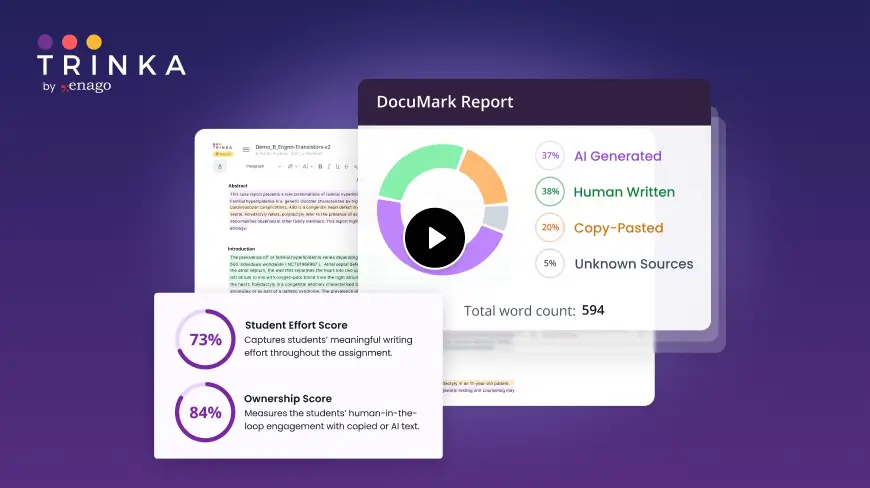
DocuMark: Responsible AI Use for Academic Integrity
Knowing your institution's AI policy is step one. DocuMark helps enforce it fairly by empowering universities to manage AI-generated content, prevent cheating, and support student writing through responsible AI use.
Common Questions About Teesside University's AI Policies
Teesside University has defined AI policies in 12 of 12 categories, with an overall coverage score of 100%.
Students are required to acknowledge AI use when it contributes to assessed work. In research ethics applications, any use of GenAI in preparing an application must be clearly stated and cited.
The university treats deliberate AI use for unfair academic advantage as academic misconduct and applies staged penalties. The regulations also explicitly reference Turnitin findings as an example used in minor cases involving unattributed material.
Students are told not to provide personal or sensitive information to AI tools because of uncertainty about storage, access, and reuse. In research ethics applications, if AI technologies would process personal data, a DPIA is required and the Information Governance Team must be informed and their advice followed. The sources do not identify any approved university AI platforms.