Teaching & Learning
- Temple does not set a single university-wide rule for student use of AI on coursework
- Sample course language allows limited uses such as brainstorming or grammar checking while prohibiting AI from drafting or writing assignments
- The faculty guidance and sample syllabus statements place this at instructor discretion, with faculty expected to decide whether and to what extent AI is permitted in their classes and assignments, and to state where use is allowed or disallowed
If you’re not sure where to begin in deciding whether, and to what extent, students will be permitted to use generative AI tools to support their learning, we offer you this decision tree as a helpful tool.
The following guidance is provided to assist you in developing coherent policies on the use of generative AI tools in your course. Please adjust the guidance to fit your particular context. Remember also to note in specific assignment descriptions where AI use is allowed or disallowed.
The use of generative AI tools (e.g. ChatGPT, Dall-e, etc.) is permitted in this course for the following activities:
● Brainstorming and refining your ideas;
● Fine tuning your research questions;
● Finding information on your topic;
● Drafting an outline to organize your thoughts; and
● Checking grammar and style.
The use of generative AI tools is not permitted in this course for the following activities:
● Impersonating you in classroom contexts, such as by using the tool to compose discussion board prompts assigned to you or content that you put into a Zoom chat.
● Completing group work that your group has assigned to you, unless it is mutually agreed upon that you may utilize the tool.
● Writing a draft of a writing assignment.
● Writing entire sentences, paragraphs or papers to complete class assignments.
- Temple’s professional schools explicitly prohibit unauthorized AI use in exams and other assessed work
- The law school’s code of conduct, for example, treats the use of generative AI as an unauthorized online source during an examination unless the professor has expressly authorized it
it shall be a sanctionable violation of this Code for a Law School student knowingly to do or to attempt to do or to assist in any of the following: ... consult or copy from books, papers, notes, or online sources, including generative artificial intelligence, of any kind during an examination, except as authorized by the examining professor; ... make use of generative and other artificial intelligence tools on any exam, written submission, or classroom or course presentation unless expressly authorized by the faculty member.
- At the same time, Temple warns that uncritical use can reduce productive struggle and skill development, so use should be integrated thoughtfully in support of course goals
- Temple’s faculty guidance recognizes AI as potentially useful for student learning and study support, including helping students get started on assignments, receive immediate feedback on writing, and develop communication and planning skills
Tools such as ChatGPT can provide useful suggestions for succeeding in college or getting started on assignments, offer immediate feedback on writing and help students develop communication and planning skills.
As noted above, AI tools can function as assistive technologies that support students in meeting course goals. However, if used uncritically, they can reduce productive struggle with course content and skill development.
There are ways to use generative AI to provoke deep learning and valuable skill building (see , What are some approaches to using or working around AI in my class?) however, for this to happen, these tools must be integrated into our course thoughtfully and in support of course goals.
- Temple does not provide a standalone, university-wide programming policy
- The faculty guide notes that AI can generate code but warns that having the tool complete the task may limit learning, and the broader course-use guidance indicates that instructors decide whether and how students may use AI in their classes
While an AI tool may be able to quickly generate code that performs a task, answer a difficult mathematical problem or summarize a challenging text, oftentimes, the learning comes in grappling with the algorithm, working through the problem, or synthesizing ideas in a text Allowing a tool to step in and complete the task or quickly outline for the student the exact steps to take may limit the actual learning that may have derived from working through the process on one’s own., There are ways to use generative AI to provoke deep learning and valuable skill building (see , What are some approaches to using or working around AI in my class?) however, for this to happen, these tools must be integrated into our course thoughtfully and in support of course goals.
If you’re not sure where to begin in deciding whether, and to what extent, students will be permitted to use generative AI tools to support their learning, we offer you this decision tree as a helpful tool.
Research
- Temple’s July 2024 GenAI guidelines address research use at a general level but do not set a specific policy for drafting or editing research papers, theses, dissertations, or manuscripts
- The only explicit writing-related guidance in the provided materials is course-level sample language that allows checking grammar and style and requires documentation and citation of AI use, but this is framed as syllabus guidance rather than a research-manuscript rule
Publicly available GenAI tools such as ChatGPT, Google Gemini, Perplexity, Poe, and Microsoft CoPilot have gained tremendous visibility over the past year. They are used by individuals for teaching, learning, completing work tasks, and conducting research but may lack security and data regulation compliance risks when used with university systems and data.
The use of generative AI tools (e.g. ChatGPT, Dall-e, etc.) is permitted in this course for the following activities:
● Brainstorming and refining your ideas;
● Fine tuning your research questions;
● Finding information on your topic;
● Drafting an outline to organize your thoughts; and
● Checking grammar and style.
Your use of AI tools must be properly documented and cited in order to stay within university policies on academic honesty.
- Temple’s GenAI guidelines impose data-protection limits on research-related AI use
- Research, grant, contract, and export-controlled research data may not be entered into GenAI tools when confidentiality or privacy could be compromised, and any use of non-public data requires pre-approval and authorization
Please adhere to the following guidelines, which align with Temple’s data, privacy, compliance, research, and security policies.
• Confidentiality and Privacy: Data shared with GenAI tools may be used or stored in ways that expose institutional, research, grant, or contract data (including, but not limited to, personally identifiable information (PII), Protected Health Information (PHI), institutional defined sensitive data, student data as defined under FERPA, and research data with export control restrictions) to third parties. Do not store or use data in any GenAI tool where confidentiality and/or privacy may be compromised. Public data may be used and retained within any GenAI application. Note that incognito features in certain AI applications do not guarantee confidentiality and privacy.
Any use of GenAI with data defined as other than public requires pre-approval and authorization
- Temple’s GenAI guidelines set general research-integrity expectations rather than specific rules for grant proposals or IRB applications
- The university requires transparency about AI use, proper citation, participant awareness and consent, and human responsibility for verifying accuracy, appropriateness, and legal compliance
Publicly available GenAI tools such as ChatGPT, Google Gemini, Perplexity, Poe, and Microsoft CoPilot have gained tremendous visibility over the past year. They are used by individuals for teaching, learning, completing work tasks, and conducting research but may lack security and data regulation compliance risks when used with university systems and data.
• Accuracy and Appropriateness: Verify all GenAI outputs for factual accuracy, appropriateness, and compliance with university and external rules and regulations. You are responsible for the content generated by GenAI.
• Transparency: Ensure transparency regarding your use of GenAI. When using GenAI, cite its use properly. Also, be sure participants are all aware and consent to its use.
Academic Integrity
- Temple requires transparency and citation when AI is used
- The faculty guide also recommends that faculty disclose when they use AI in course-material preparation
- The university’s GenAI guidelines say users should cite AI use properly, and the sample course statements say student AI use must be properly documented and cited to comply with academic honesty rules
• Transparency: Ensure transparency regarding your use of GenAI. When using GenAI, cite its use properly. Also, be sure participants are all aware and consent to its use.
Your use of AI tools must be properly documented and cited in order to stay within university policies on academic honesty.
If you plan on using AI in preparation of course materials, you should consider disclose that fact to students. For example, a statement like the following could be added to your syllabus:
At the CAT many of our staffers make use of A.I. daily! We often use it for ideation, such as to come up with a punchier title for a workshop. When we use it to generate longer text, we have agreed to disclose its use.
- Temple allows faculty access to Turnitin’s AI detector but warns that detectors are unreliable and should be used with great caution
- Enforcement for unauthorized AI use is tied to existing academic misconduct structures; sample syllabus guidance says unauthorized use may violate academic honesty rules, and the law school code classifies unauthorized AI use as sanctionable misconduct
Temple has acquired a university-wide license for Turnitin’s AI Detector tool, designed to detect AI-generated text. This AI-detection tool should be used with great caution, as it is often inaccurate and does not allow the ability to verify its results. ... The use of generative AI tools (such as ChatGPT, DALL-E, etc.) are not permitted in this class; therefore, any use of AI tools for work in this class may be considered a violation of Temple University’s Academic Honesty policy. ... it shall be a sanctionable violation of this Code for a Law School student knowingly to do or to attempt to do or to assist in any of the following: 6. make use of generative and other artificial intelligence tools on any exam, written submission, or classroom or course presentation unless expressly authorized by the faculty member.
Institutional & Administrative
- Temple permits faculty and staff use of AI, but expects responsible use, human responsibility for outputs, and disclosure in some contexts
- For AI notetakers, Temple provides additional rules around consent, accommodations, and avoiding use for sensitive or controversial content
- The faculty guide recommends disclosing AI use in course-material preparation, while the GenAI guidelines require users to verify outputs and cite AI use properly
If you plan on using AI in preparation of course materials, you should consider disclose that fact to students. For example, a statement like the following could be added to your syllabus:
At the CAT many of our staffers make use of A.I. daily! We often use it for ideation, such as to come up with a punchier title for a workshop. When we use it to generate longer text, we have agreed to disclose its use.
• Accuracy and Appropriateness: Verify all GenAI outputs for factual accuracy, appropriateness, and compliance with university and external rules and regulations. You are responsible for the content generated by GenAI.
• Transparency: Ensure transparency regarding your use of GenAI. When using GenAI, cite its use properly. Also, be sure participants are all aware and consent to its use.
If the material discussed is of a sensitive or controversial nature, Zoom AI Companion should not be used for a number of reasons.
If no other students or staff decline consent to use the tool, you should enable it and provide notes for the entire group. If there are students or staff who do decline consent to use the tool, you need to work with DRS or HR to find a suitable option that includes all students and staff or use an alternative manner of providing notes.
- Temple restricts what data may be entered into GenAI tools and requires review before using non-public data or purchasing tools
- Temple also requires a pre-approval request before purchasing or using any GenAI tool, and AI notetaker use is limited when sessions involve sensitive or controversial content
- Public data may be used in any GenAI application, but institutional, student, health, sensitive, research, grant, contract, and export-controlled data must not be used where confidentiality or privacy may be compromised; non-public-data use requires pre-approval and authorization
• Confidentiality and Privacy: Data shared with GenAI tools may be used or stored in ways that expose institutional, research, grant, or contract data (including, but not limited to, personally identifiable information (PII), Protected Health Information (PHI), institutional defined sensitive data, student data as defined under FERPA, and research data with export control restrictions) to third parties. Do not store or use data in any GenAI tool where confidentiality and/or privacy may be compromised. Public data may be used and retained within any GenAI application. Note that incognito features in certain AI applications do not guarantee confidentiality and privacy.
Any use of GenAI with data defined as other than public requires pre-approval and authorization
Note: Before purchasing or using any GenAI tool, submit a Temple pre-approval request to verify product security, accessibility, and integration requirements.
If the material discussed is of a sensitive or controversial nature, Zoom AI Companion should not be used for a number of reasons. The AI tool will gather data and record comments made during the session.
- Temple has an institution-level AI governance approach centered on responsible adoption rather than prohibition
- The GenAI guidelines are issued by the Office of the President with a designated responsible officer and emphasize responsible use across teaching, learning, work tasks, and research
- The faculty guide and related guidance frame Temple’s strategy as preparing students for a world that uses AI while using the technology carefully, transparently, and in support of learning goals
Issuing Authority: Office of the President
Responsible Officer: Vice President for Information Technology
This document provides guidelines for using Generative Artificial Intelligence (GenAI) technologies, Including when they should and should not be used within the Temple University environment. As a university dedicated to exchanging ideas, distributing knowledge, and fostering innovation, we must embrace GenAI carefully and responsibly.
Therefore, we must think about what our responsibility is as educators to get our students prepared for a world of work that leverages these tools’ power.
So engaging with these tools so that we understand what they can do, how they might impact teaching and learning, and how we can move forward productively is the only path forward that makes sense.
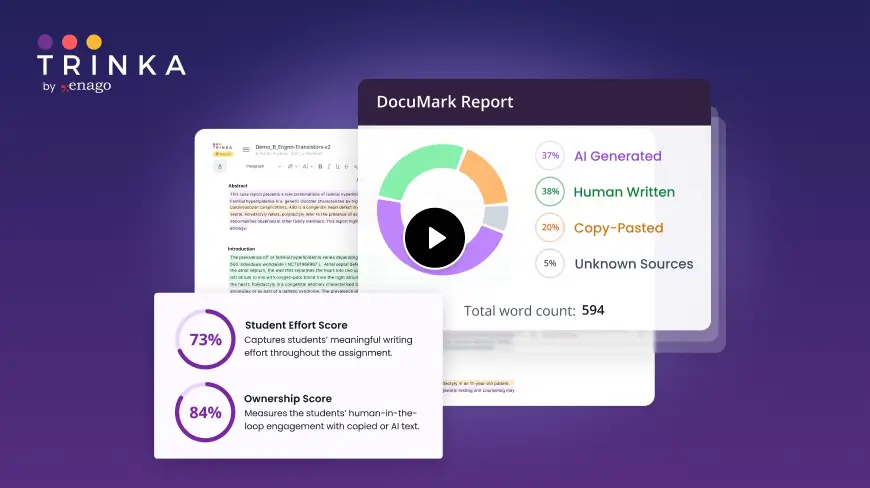
DocuMark: Responsible AI Use for Academic Integrity
Knowing your institution's AI policy is step one. DocuMark helps enforce it fairly by empowering universities to manage AI-generated content, prevent cheating, and support student writing through responsible AI use.
Common Questions About Temple University's AI Policies
Temple University has defined AI policies in 12 of 12 categories, with an overall coverage score of 100%.
Temple requires transparency and citation when AI is used. The university’s GenAI guidelines say users should cite AI use properly, and the sample course statements say student AI use must be properly documented and cited to comply with academic honesty rules. The faculty guide also recommends that faculty disclose when they use AI in course-material preparation.
Temple allows faculty access to Turnitin’s AI detector but warns that detectors are unreliable and should be used with great caution. Enforcement for unauthorized AI use is tied to existing academic misconduct structures; sample syllabus guidance says unauthorized use may violate academic honesty rules, and the law school code classifies unauthorized AI use as sanctionable misconduct.
Temple restricts what data may be entered into GenAI tools and requires review before using non-public data or purchasing tools. Public data may be used in any GenAI application, but institutional, student, health, sensitive, research, grant, contract, and export-controlled data must not be used where confidentiality or privacy may be compromised; non-public-data use requires pre-approval and authorization. Temple also requires a pre-approval request before purchasing or using any GenAI tool, and AI notetaker use is limited when sessions involve sensitive or controversial content.