Teaching & Learning
- For graded academic work, AI use is governed primarily by instructor direction
- The university also advises faculty to state course-specific AI expectations in syllabi and assignments
- Students may use AI only when the instructor has allowed it and within the stated limits; unauthorized use can violate the Academic Honor Code
Students should know and abide by the expectations regarding AI use in each class.
Follow your instructor’s policies about whether and to what extent AI can be used on an assignment.
Submitting work created by AI as your own if your instructor does not allow AI use may violate the Academic Honor Code.
Instructors should indicate in their syllabus and assignment directions whether and how students are permitted to use AI for learning and on coursework. Instructors should also clearly state the limits of allowable aid on assignments and should encourage students to ask questions if they are uncertain.
- Use of AI during exams and similar assessments is controlled by the instructor’s rules
- The university states that using AI in an unauthorized way on tests or other assignments may breach academic integrity rules
Use of AI tools in unauthorized ways on tests, exams, and assignments can violate the Academic Honor Code.
Follow your instructor’s policies about whether and to what extent AI can be used on an assignment.
- This guidance is framed as support for learning rather than graded submission
- The university permits and encourages students to use AI for personal learning support such as reviewing material, clarifying concepts, generating practice questions, and studying, while warning students to verify output and protect personal information
Students can use AI tools as a supplemental source to support their learning by helping them review course concepts and prepare for assignments and exams.
Examples of ways students can use AI to support learning include the following:
Generate study guides or summaries from class notes to review prior to quizzes and tests
Generate flashcards from class readings or notes to help review and study course concepts and terms
Explain difficult concepts in simpler terms if students are having trouble understanding a concept from class, textbook, or reading
Provide examples of concepts in real world applications
Ask for clarifications or examples to reinforce understanding
Generate practice quizzes or review questions based on lecture topics or assigned readings
Get feedback on draft work as a check before submitting to help improve clarity, grammar, and organization without replacing your own ideas and effort
While AI can be useful for understanding, studying, and generating ideas, students should carefully assess and verify any generated outputs, as inaccuracies are common, and should avoid entering personal or sensitive information because it may not be secure.
- Texas State does not provide a university-wide rule specific to coding assignments
- Programming-related AI use falls under the general course-level rule that instructors decide whether and how AI may be used on assignments
Students should know and abide by the expectations regarding AI use in each class.
Follow your instructor’s policies about whether and to what extent AI can be used on an assignment.
Research
- Graduate College forms also require students to disclose any generative AI use in completing the thesis or dissertation
- Authors remain fully responsible for all submitted content, and use of AI for copy editing or citation assistance must be disclosed in an acknowledgements section
- For theses and dissertations, the university permits AI tools only for limited assistance such as copy editing, formatting, and citation help, but not for writing, developing arguments, or generating ideas
The use of Artificial Intelligence (AI) tools and software to produce content for the thesis/dissertation narrative is strictly prohibited. This extends to all creative activities and intellectual contributions, including writing any part of the thesis/dissertation, developing arguments or ideas, conducting analyses, or generating visual data representations. AI tools may only be utilized for copy editing, formatting and citation management under explicit acknowledgment. The student is considered the author of the thesis/dissertation and therefore is fully accountable and liable for all submitted content.
Candidates must include an acknowledgment statement of any use of AI or AI-assisted technologies in the acknowledgements section of their thesis/dissertation. This should indicate if AI was used and for what purpose in the course of the work. Example statements are below:
No generative AI used: No content generated by generative AI technologies was used in the writing process, analyses, or visual representation of this thesis/dissertation.
Generative AI used for copy editing only: During the writing process, [name and version of AI technology] was used for copy editing [name specific content]. After using this tool, the author reviewed and edited the content as needed and takes full responsibility for the publication's content.
Generative AI used for citation management only: During the writing process, [name and version of AI technology] was used for citation management. After using this tool, the author reviewed and edited the content as needed and takes full responsibility for the publication's content.
This work does / does not involve the use of generative artificial intelligence and the use of any such tools in the completion of the thesis/dissertation has been documented in the acknowledgements section in accordance with the published Texas State University Graduate College policy on the use of AI in thesis/dissertation writing.
- For thesis and dissertation work, the university prohibits using AI tools to conduct analyses or generate visual data representations
- No broader university research-data rule specific to AI was identified in the provided sources beyond this graduate thesis/dissertation restriction
The use of Artificial Intelligence (AI) tools and software to produce content for the thesis/dissertation narrative is strictly prohibited. This extends to all creative activities and intellectual contributions, including writing any part of the thesis/dissertation, developing arguments or ideas, conducting analyses, or generating visual data representations.
- The provided sources do not define AI-specific rules for grant proposals or IRB applications
- For graduate theses and dissertations, authors are fully accountable for all content and must disclose any permitted AI assistance in the acknowledgements
The student is considered the author of the thesis/dissertation and therefore is fully accountable and liable for all submitted content.
Candidates must include an acknowledgment statement of any use of AI or AI-assisted technologies in the acknowledgements section of their thesis/dissertation. This should indicate if AI was used and for what purpose in the course of the work.
Academic Integrity
- The university advises faculty to tell students how AI use should be documented
- When instructors allow AI, students are expected to follow the instructor’s directions for acknowledgment and citation
- For theses and dissertations, disclosure of any AI use in acknowledgements is mandatory, with the purpose of the AI use stated
If AI use is allowed, acknowledge or cite the AI use if your instructor or style guide requires it. Examples include citing output in APA style or noting which sections were edited for grammar or generated with AI assistance.
Instructors should explain to students when and how AI use should be cited or acknowledged and should provide citation examples or direct students to style guide resources. Students should also be reminded to follow the citation guidance specific to their discipline and course requirements.
Candidates must include an acknowledgment statement of any use of AI or AI-assisted technologies in the acknowledgements section of their thesis/dissertation. This should indicate if AI was used and for what purpose in the course of the work.
- The university cautions faculty that AI detectors are not reliable enough to serve as sole evidence and recommends using multiple forms of documentation when concerns arise
- Unauthorized AI use may be treated as academic misconduct under the Academic Honor Code, and the university points students and faculty to normal honor-code procedures for reporting and adjudication
Use of AI tools in unauthorized ways on tests, exams, and assignments can violate the Academic Honor Code.
Submitting work created by AI as your own if your instructor does not allow AI use may violate the Academic Honor Code.
Proceed as you would with any suspected violation of the Academic Honor Code. Carefully document your concerns and observations and review all available evidence. Please note that AI detection software can produce false positives. Detection reports should not be used as the sole basis for charging a student with a policy violation. Faculty should gather additional evidence whenever possible, such as writing samples, assignment drafts, revision history, citations, unusual changes in writing style, or student inability to explain submitted work.
By the initiation of the act of submitting academic work, a student agrees that no unfair advantage has been or will be given, received, or tolerated in the academic community. Academic work can include, but is not limited to, tests, quizzes, examinations, assignments, compositions, or projects. The term “unfair advantage” includes any form of inappropriate assistance, such as unauthorized use of books, notes, student work, examinations, consultation with others, or use of generative artificial intelligence or other electronic devices in one’s academic work.
Institutional & Administrative
- The university also advises instructors to avoid using AI as the sole basis for grading and to preserve their own academic judgment
- Faculty are specifically told not to upload student work or personally identifying information into public AI tools unless permitted by university data-security guidance
- Faculty may use AI to support course design, feedback drafting, assessment creation, and administrative efficiency, but they are expected to review outputs for accuracy and bias and remain responsible for final decisions
AI tools can assist instructors in developing course materials, designing learning activities, creating assessments, preparing examples, drafting student feedback, brainstorming ideas, and improving efficiency in administrative tasks.
Faculty are ultimately responsible for all course content, instruction, feedback, grading, and communication with students. Any AI-generated outputs should be reviewed and revised carefully to ensure they are accurate, appropriate, inclusive, and aligned with course objectives.
Faculty should avoid uploading student work, grades, or personally identifying information into AI tools unless such use is explicitly permitted under university data security guidance.
Instructors should not rely on AI-generated content or analysis as the sole basis for evaluating student work. Faculty judgment remains essential to fair and meaningful assessment.
- The university requires use of approved AI tools and restricts what institutional data may be entered based on data classification
- Texas State also identifies institutionally supported platforms, including Gemini and Copilot Chat, and routes other AI purchases or use through review and approval processes
- Public data may be used with approved services, internal data may be used only with department approval and an approved service, and confidential or restricted data must not be entered into generative AI systems
Only approved AI tools and models may be used for university business or educational use. Current AI services approved for use are:
Gemini App integrated with your TXST Google Workspace account
NotebookLM integrated with your TXST Google Workspace account
Copilot Chat integrated with your TXST Microsoft 365 account
The data security requirements for use of approved AI tools are detailed below:
Public Data: You may use publicly available institutional data with approved AI services.
Internal Data: You may use internal institutional data with department approval and an approved AI service.
Confidential or Restricted Data: Confidential or restricted data may not be entered into AI systems. These are not approved for use with generative AI tools.
Examples:
Personal data, student education records, protected health information, employee records, legal or research data with restrictions may not be entered.
The Office of the Vice President for Information Technology supports the use of Gemini App and NotebookLM under Texas State’s Google Workspace for Education Plus agreement, and Copilot Chat under the university’s Microsoft 365 agreement, as approved AI tools.
A review of intended use, desired features, and potential risks will be conducted. Some applications may not be approved or may require additional contract and security review before purchase or implementation.
- The university publicly states that it adopted Gemini for Education and positions AI use within structured guidance, training, and security oversight rather than unrestricted campus use
- Texas State has an institution-level AI adoption strategy centered on approved enterprise tools, teaching support, and governance through information-security and technology review processes
Texas State University has officially adopted Gemini for Education, a suite of generative artificial intelligence tools, to support teaching, learning, and administrative productivity across the university.
The Office of the Vice President for Information Technology supports the use of Gemini App and NotebookLM under Texas State’s Google Workspace for Education Plus agreement, and Copilot Chat under the university’s Microsoft 365 agreement, as approved AI tools.
Only approved AI tools and models may be used for university business or educational use.
A review of intended use, desired features, and potential risks will be conducted. Some applications may not be approved or may require additional contract and security review before purchase or implementation.
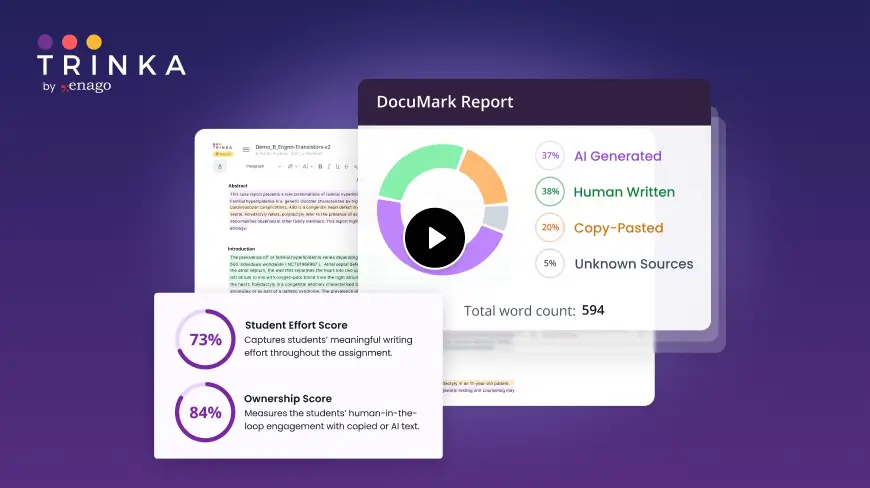
DocuMark: Responsible AI Use for Academic Integrity
Knowing your institution's AI policy is step one. DocuMark helps enforce it fairly by empowering universities to manage AI-generated content, prevent cheating, and support student writing through responsible AI use.
Common Questions About Texas State University's AI Policies
Texas State University has defined AI policies in 12 of 12 categories, with an overall coverage score of 100%.
When instructors allow AI, students are expected to follow the instructor’s directions for acknowledgment and citation. The university advises faculty to tell students how AI use should be documented. For theses and dissertations, disclosure of any AI use in acknowledgements is mandatory, with the purpose of the AI use stated.
Unauthorized AI use may be treated as academic misconduct under the Academic Honor Code, and the university points students and faculty to normal honor-code procedures for reporting and adjudication. The university cautions faculty that AI detectors are not reliable enough to serve as sole evidence and recommends using multiple forms of documentation when concerns arise.
The university requires use of approved AI tools and restricts what institutional data may be entered based on data classification. Public data may be used with approved services, internal data may be used only with department approval and an approved service, and confidential or restricted data must not be entered into generative AI systems. Texas State also identifies institutionally supported platforms, including Gemini and Copilot Chat, and routes other AI purchases or use through review and approval processes.