Teaching & Learning
- In the Department of Mass Communication, AI-generated material is treated as plagiarism unless the instructor approves its use, and any authorized use must be cited
- University-wide guidance does not set a single mandatory rule and instead leaves AI use in coursework to instructor or department discretion under existing academic integrity rules
- In the School Psychology MA/CAS program, AI may be used in coursework only with instructor permission, limited to assistance such as outlining, grammar checking, brainstorming, or APA formatting, and students may not submit AI-generated content as their own
They are meant to orient, not to mandate. They apply the university's long-standing values to this new technology. The principles do not replace disciplinary judgment or existing university policy. They do not change the academic-integrity code: it continues to govern, including where AI-generated work is presented as a person's own. Nothing here is an enforcement instrument.
Departments and programs are encouraged to develop more specific guidance consistent with them, as some already have.
Passing off materials generated by artificial intelligence (AI) technology constitutes plagiarism. AI technology and other assistance tools should only be used if approved by the instructor. All authorized use of such technologies must be properly cited (see below).
AI tools may be used in coursework with instructor permission and within the following guidelines:
• Permitted uses include outlining, grammar checking, brainstorming, or reviewing APA formatting.
• Students may not submit AI-generated content as their own.
- The general academic integrity policy bars unauthorized assistance during quizzes, tests, and examinations
- In the School Psychology MA/CAS program, AI use during in-class assessments or exams is not permitted unless the instructor explicitly approves it
- Towson’s faculty guidance indicates that whether AI is prohibited or allowed in assessments depends on how instructors design the course and set limits
When designing assignments and assessments, whether you currently prohibit the use of AI or allow it within prescribed limits, you may want to make changes considering current developments in generative AI tools.
Some Examples: Copying from another student’s paper or receiving unauthorized assistance during a quiz, test or examination; using books, notes or other devices (e.g., calculators) when these are not authorized; procuring without authorization tests or examinations before the scheduled exercise (including discussion of the substance of examinations and tests when it is expected these will not be discussed); copying reports, laboratory work, computer programs or files and the like from other students; collaborating on laboratory or computer programs or files and the like from other students; collaborating on laboratory or computer work without authorization and without indication of the nature and extent of the collaboration; sending a substitute to take an examination.
• Use of AI tools during in-class assessments or exams is not permitted unless explicitly approved by the instructor.
- University-wide principles also state that AI outputs should be checked rather than trusted
- Faculty-facing guidance encourages course use of AI assistants, tutors, and tutorial support, while warning faculty to recognize AI limitations
- In the School Psychology MA/CAS program, students may use AI to explore academic content related to school psychology so long as no client information is included
Courses can be structured with AI from the beginning through the adoption of AI assistants, tutors and support.
Through careful prompting, faculty can build tutorial assistance into their course. Those can be tailored not only to the particular course but to the needs of the student. However, doing this is not without caveats. Faculty should be conscious of the limitations of generative AI in providing reliable answers and guidance to students.
Students may use AI tools to explore academic content related to school psychology (e.g., reviewing intervention strategies or theoretical frameworks), provided that no client information is included.
We treat what AI produces as a claim to check rather than an answer to trust, and we choose uses that deepen inquiry and build judgment rather than replace the effort by which expertise is formed.
- The university does not provide a specific AI rule for code generation or programming assignments
- The general student academic integrity policy prohibits unauthorized collaboration or copying in computer work, and department or instructor rules may impose more specific limits
not defined
Research
- For faculty research writing, Towson directs researchers to follow publisher, conference, and grantor guidelines when using AI for proposals, presentations, reports, and journal submissions
- In the School Psychology MA/CAS program, any AI-supported research work must be critically reviewed, edited, and appropriately attributed, and AI must not replace the student’s own research decision-making
Faculty should refer to publishing guidelines and conference codes of conduct when considering AI usage to prepare conference proposals and presentations as well as research reports.
Many publishers and grantors h ave instituted guidelines for AI-generated content, including prohibition, prop er us age an d cit ation.
So me publishers a nd grantors have also published guidelines on the usage of generative AI f or peer review. It is th e responsibility of a researcher to ensure that they have understood and incorporated guidelines for AI use in their submission to ac ade mic journals.
Students are responsible for the content of all academic, clinical, and research work they submit, regardless of whether AI tools were used. Any work supported by AI must be critically reviewed, edited, and appropriately attributed. AI tools must not replace the student’s own academic writing, clinical reasoning, or research decision-making.
- Towson does not state a university-wide AI rule specifically for research data analysis methods, but it does impose integrity and data-handling expectations
- The faculty/staff scholarly misconduct policy assigns responsibility for research integrity and prohibits falsification, fabrication, manipulation, alteration, and selective reporting of data
- Faculty and staff are also warned not to load research data onto third-party AI sites when there are data misuse concerns, and the School Psychology MA/CAS program prohibits entering real client information into non-approved AI tools
In faculty scholarship and research, primary responsibility for the integrity of scholarly efforts rests with the principal investigator. Other faculty and staff who collaborate in the scholarly work share responsibility for its integrity. Responsibility for joint faculty and undergraduate or graduate research projects is shared by the student(s) and the principal faculty advisor.
Falsification or Misrepresentation of Data. This includes falsification, fabrication, manipulation and/or alteration of data or background information, inaccurately quoting the work of others, deceptively selective reporting, purposeful omission of conflicting data and willful suppression, distortion or destruction of data.
When using generative AI tools, be cognizant that loading text or data onto a third-party site is not without risk.
Faculty and staff should avoid loading d ata (from students, from research or from finances) onto sites where there is a question about mis us e of data b y those sites.
Under no circumstances should students enter information about real clients into AI tools that are not institutionally approved. This includes both identified and de-identified clinical material.
- The faculty/staff scholarly misconduct policy places responsibility for research integrity on principal investigators and collaborators
- In the School Psychology MA/CAS program, AI use in research must remain ethically and legally compliant, with students retaining responsibility for the work and consulting faculty or supervisors in uncertain situations
- Towson’s faculty guidance requires researchers to follow external publishing, conference, and grantor rules on AI use, including rules about AI-generated content, citation, and peer review, and it points faculty to IRB guidance for human subjects research
Faculty should refer to publishing guidelines and conference codes of conduct when considering AI usage to prepare conference proposals and presentations as well as research reports.
IRB Guidance on the Use of Artificial Intelligence (AI) in Human Subjects Research
Many publishers and grantors h ave instituted guidelines for AI-generated content, including prohibition, prop er us age an d cit ation.
So me publishers a nd grantors have also published guidelines on the usage of generative AI f or peer review. It is th e responsibility of a researcher to ensure that they have understood and incorporated guidelines for AI use in their submission to ac ade mic journals.
In faculty scholarship and research, primary responsibility for the integrity of scholarly efforts rests with the principal investigator. Other faculty and staff who collaborate in the scholarly work share responsibility for its integrity. Responsibility for joint faculty and undergraduate or graduate research projects is shared by the student(s) and the principal faculty advisor.
This policy outlines expectations for the ethical, appropriate, and legally compliant use of artificial intelligence (AI) tools by students in the MA/CAS program. These expectations apply across all domains of training, including academic work, clinical practice, and research.
Students are encouraged to consult with faculty or supervisors before using AI tools in any new or uncertain context.
Academic Integrity
- Faculty resources also advise establishing citation guidelines if AI is allowed in a course
- Towson’s university-wide academic integrity policy requires acknowledgement when using others’ words, ideas, data, or materials, but it does not create a single AI-specific disclosure rule for all students
- Departmental and program-specific policies do: Mass Communication requires citation and an explanation of how generative AI was used when a professor has directed students to use it, and the School Psychology MA/CAS program requires a brief disclosure note stating when and how AI was used
“Plagiarism” is presenting work, products, ideas, words, or data of another as one’s own is plagiarism. Indebtedness must be acknowledged whenever:
Because expectations about academic assignments vary among disciplines and instructors, students should consult with their instructors about any special requirements related to citation.
If your professor has directed you to use generative AI for an assignment, then you must cite your source and explain how you used it. According to the APA, authors who use generative AI like ChatGPT should devote a paragraph or section of their paper to describe how the tool was used.
The APA also recommends that authors provide the prompt they used in the AI tool and the corresponding response. AI-generated material should be cited in the text of the assignment with a corresponding entry in the reference list.
Students should also provide a link to the generative AI tool used.
• When AI tools are used to assist with academic work, students must include a brief note of disclosure indicating when and how the tools were used. For example:
"Portions of this paper were assisted using ChatGPT on July 7, 2025 for outlining and grammar checking. All written content reflects the student's own original work."
If AI is allowed in your course, it may be helpful to establish guidelines for proper citation.
- Enforcement instead proceeds through existing academic integrity or program discipline processes
- Towson’s AI principles explicitly state they are not an enforcement instrument and do not alter the academic integrity code
- The provided sources do not define a university stance on AI detection tools, but they do state that plagiarism and AI misuse can result in significant penalties or discipline, with serious program-level consequences in School Psychology
They are meant to orient, not to mandate. They apply the university's long-standing values to this new technology. The principles do not replace disciplinary judgment or existing university policy. They do not change the academic-integrity code: it continues to govern, including where AI-generated work is presented as a person's own. Nothing here is an enforcement instrument. These principles should not be cited on their own in evaluation, integrity, or personnel proceedings.
Plagiarism is a serious offense. Towson University's Student Academic Integrity Policy defines plagiarism as "presenting work, products, ideas, words, or data of another as one’s own," and it often leads to significant penalties.
Misuse of AI tools may result in remediation, academic discipline, or removal from practicum or internship settings, depending on the severity of the situation. Repeated or serious violations may lead to dismissal from the program.
Institutional & Administrative
- Faculty and staff are also advised to avoid uploading student, research, or financial data to questionable third-party AI sites
- Towson provides faculty-facing AI resources for teaching, research, service, and university operations rather than a single mandatory policy for all faculty or staff uses
- Faculty are given sample syllabus language and support for assignment and assessment design, and they are encouraged to build AI tutors or assistants into courses while being mindful of AI limitations
Our AI resources are designed to empower faculty with the knowledge and tools to excel in a dynamic higher education environment.
Learn more AI tools and resources that affect teaching, research, service and university operations.
Many models for syllabus language reflect different approaches to using AI in teaching and learning. FACET has developed sample content that can be used i n course syllabi.
When designing assignments and assessments, whether you currently prohibit the use of AI or allow it within prescribed limits, you may want to make changes considering current developments in generative AI tools.
Courses can be structured with AI from the beginning through the adoption of AI assistants, tutors and support.
Faculty and staff should avoid loading d ata (from students, from research or from finances) onto sites where there is a question about mis us e of data b y those sites.
- The provided sources do not identify a single university-wide list of approved platforms
- Towson warns faculty and staff not to place sensitive student, research, or financial data into third-party AI systems where misuse is a concern
- The School Psychology MA/CAS handbook is more specific: students must not enter real client information into AI tools that are not institutionally approved, notes that many public AI tools are not HIPAA- or FERPA-compliant, and bans use of AI for client-related drafting or casework
When using generative AI tools, be cognizant that loading text or data onto a third-party site is not without risk.
Prompts, data, photos and other media loaded onto many AI sites become training data for the AI agent. In some cases, th e data may be retrievable through “jailbreaking” (or escape the con strain ts of) the AI agent.
D ata breaches become the material through which new media will be generated. Faculty and staff should avoid loading d ata (from students, from research or from finances) onto sites where there is a question about mis us e of data b y those sites.
Under no circumstances should students enter information about real clients into AI tools that are not institutionally approved. This includes both identified and de-identified clinical material.
Most publicly available AI tools (e.g., ChatGPT) are not HIPAA- or FERPA-compliant, and their use to process clinical information constitutes a serious breach of ethical and legal standards.
Students may not use AI tools to draft psychological reports, treatment plans, clinical notes, or emails involving client material.
• Students may not input clinical, client-related, or school-based case material into AI tools.
- The AI Statement for Academic Work is framed as evolving guidance rather than binding policy
- Towson has institution-level AI governance and strategy through the Towson AI Institute and the AI Hub
- The AI Institute describes a university-wide mission focused on practical, ethical, and sustainable AI application across research, education, and community engagement, while the AI Hub serves as a campus center for research and pedagogical advancement and is rolling out initiatives during the 2025-2026 academic year
This is a living statement, authored and maintained by the Towson University AI Institute. It will evolve as understanding matures and as people respond, and we welcome feedback from across the university.
The Towson AI Institute advances the practical, ethical and sustainable application of artificial intelligence through transdisciplinary research, education and community engagement.
The Towson AI Institute (TAI) is Towson University's home for work on artificial intelligence: research, teaching, and partnerships with the region.
TAI works as a coordinating partner, not a replacement, for the strong AI efforts already underway across campus. The Institute collaborates with colleges, the Albert S. Cook Library, and university centers dedicated to AI. Partners include the FACET AI Hub and the Cyber4All Center, a national leader in cybersecurity and CyberAI education. TAI's role is to connect these efforts and bring in resources, partners, and funding that no single unit could reach alone.
The AI Hub seeks to leverage the talents of faculty, students and staff across the university for innovations in teaching and research in order to position Towson University as a leader.
The AI Hub will serve as a one-stop academic center for faculty and student research and pedagogical advancement in artificial intelligence. It will host an AI resource depot, bringing together AI-related resources from across the campus.
The AI Hub is developing multiple initiatives, which are being phased in over the course of the 2025-2026 academic year.
DocuMark: Responsible AI Use for Academic Integrity
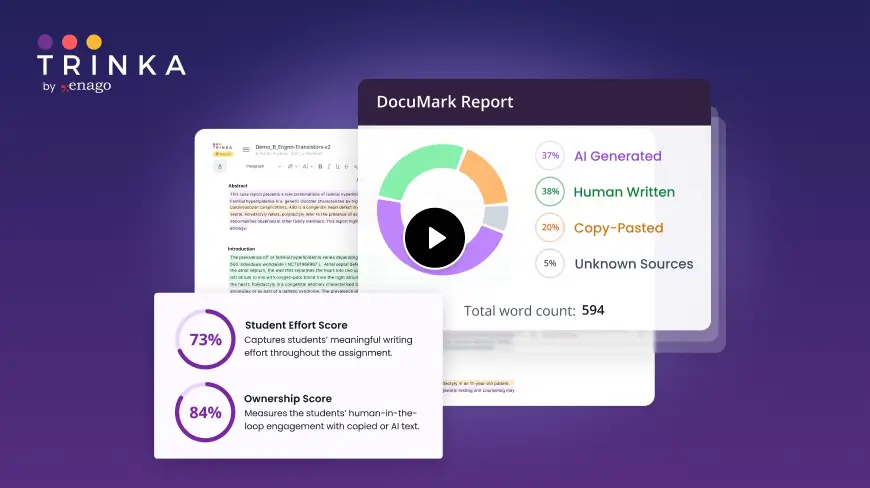
Knowing your institution's AI policy is step one. DocuMark helps enforce it fairly by empowering universities to manage AI-generated content, prevent cheating, and support student writing through responsible AI use.
Common Questions About Towson University's AI Policies
Towson University has defined AI policies in 12 of 12 categories, with an overall coverage score of 100%.
Towson’s university-wide academic integrity policy requires acknowledgement when using others’ words, ideas, data, or materials, but it does not create a single AI-specific disclosure rule for all students. Departmental and program-specific policies do: Mass Communication requires citation and an explanation of how generative AI was used when a professor has directed students to use it, and the School Psychology MA/CAS program requires a brief disclosure note stating when and how AI was used. Faculty resources also advise establishing citation guidelines if AI is allowed in a course.
Towson’s AI principles explicitly state they are not an enforcement instrument and do not alter the academic integrity code. Enforcement instead proceeds through existing academic integrity or program discipline processes. The provided sources do not define a university stance on AI detection tools, but they do state that plagiarism and AI misuse can result in significant penalties or discipline, with serious program-level consequences in School Psychology.
Towson warns faculty and staff not to place sensitive student, research, or financial data into third-party AI systems where misuse is a concern. The School Psychology MA/CAS handbook is more specific: students must not enter real client information into AI tools that are not institutionally approved, notes that many public AI tools are not HIPAA- or FERPA-compliant, and bans use of AI for client-related drafting or casework. The provided sources do not identify a single university-wide list of approved platforms.