Teaching & Learning
- Students are directed to follow each instructor's syllabus and assignment-specific rules
- Truman State University treats unauthorized AI use in coursework as academic dishonesty, but it does not impose a single blanket rule for all assignments
- The Writing Center states that using AI as a substitute for doing one's own writing is prohibited, while also stating that instructors may set their own course-specific AI policies
Every student should know and understand the syllabus and assignment sheet for every assignment and the policies there with regard to AI use.
This means that if your professor does not specifically ban all use of AI, you can use it within the confines of the parameters established by your professor.
Students should not use AI as a substitute for writing and turning in their own work. This violates Truman’s policy regarding plagiarism under the rules of Academic Dishonesty.
It can also be plagiarizing to use AI to rewrite what the student has written if the student copied and pasted their writing into the AI and copied and pasted the AI’s changes into the paper without their own intervention.
By our understanding, using AI to substitute for one’s own writing is plagiarism. This would likely include having an AI write part or all of your paper for you, especially if there are no citations for the AI’s use.
Students are ultimately responsible for the material they hand in, whether it’s to a class or to the Writing Center.
Plagiarism – Presenting as one’s own, without proper attribution, the ideas, work, or creations of another, whether oral, written, artistic, or in an electronic format. The use of artificial intelligence, computer generated text, or online assignment help is prohibited, unless authorized by the instructor.
- Specific permissions depend on the instructor
- The university prohibits AI use in exams and other assessments unless the instructor authorizes it
- Its academic dishonesty rules also prohibit obtaining unauthorized assistance on examinations and using unauthorized materials during tests, which would apply when AI is not permitted
Plagiarism – Presenting as one’s own, without proper attribution, the ideas, work, or creations of another, whether oral, written, artistic, or in an electronic format. The use of artificial intelligence, computer generated text, or online assignment help is prohibited, unless authorized by the instructor.
Cheating – Any act of dishonesty or breach of integrity in academic work, including, but not limited to:
• obtaining or attempting to obtain unauthorized information, such as by copying another’s work, stealing examination questions, or using unauthorized electronic devices or other aids during an examination;
• obtaining, using, buying, selling, transporting, or soliciting a copy of any examination, test, quiz, or other assignment;
• taking an examination, test, quiz, or other assignment for another student or permitting another to take one for you;
• collaborating with other students on an examination, test, quiz, or other assignment without the specific approval of the instructor;
- The guidance warns that factual information from AI should be checked against class materials or reliable sources
- Truman State University permits limited AI use for learning support when it does not replace the student's own work
- The Writing Center says students may use AI for brainstorming, getting unstuck, summarizing sources, reviewing notes, and checking mechanics, but students remain responsible for the final work and must still follow instructor rules
Thus, if students are struggling to get started, they may use AI to brainstorm or to ask questions to gain ideas and inspiration.
You can use AI to summarize and explain the point of sources as long as you go back to the source and verify that the AI is correctly representing it and make your own judgment on what the source says.
Similarly, AI could summarize a difficult lecture and review notes.
You can use AI for limited mechanical and structural revision after you have written your own paper.
You should make sure that all your details are accurate according to either what the professor said in class, the notes from class, or source material. Since generative AI often hallucinates, it can provide false information. Students are ultimately responsible for the material they hand in, whether it’s to a class or to the Writing Center.
The Writing Center consultant can show students ways to use AI ethically and effectively to get started, get unstuck, or improve the grammar and mechanics of a draft.
Research
Academic Integrity
- Instructor-specific policies may impose additional disclosure requirements
- The Writing Center says using AI-written text without citation is plagiarism, and students must be transparent when a writing consultant asks about AI use
- Truman does not publish a detailed university-wide AI citation standard in the provided sources, but it does state that AI use should be cited when the tool's language or ideas are relied on
If a student uses AI and is honest and clear about it when a Writing Center consultant asks, then the consultant can help the writer use AI to improve the draft ethically. Since every class policy is different, the Writing Center consultant cannot decide if a use of AI is ethical in the student’s situation. The student is responsible for making sure their AI use is ethical and for making sure they have properly cited any AI use if they have used the wording or ideas of the AI.
By our understanding, using AI to substitute for one’s own writing is plagiarism. This would likely include having an AI write part or all of your paper for you, especially if there are no citations for the AI’s use.
The Writing Center consultant can ask the student if they used AI to write any of the material in the draft or if they copy and pasted their work into AI to make revisions.
- The provided sources do not state a university position on AI detection tools
- Truman's provided sources frame unauthorized AI use as academic dishonesty and subject it to the university's normal misconduct process
- The Student Handbook defines plagiarism to include prohibited AI use and states that academic misconduct can result in sanctions under the Code of Student Conduct
Plagiarism – Presenting as one’s own, without proper attribution, the ideas, work, or creations of another, whether oral, written, artistic, or in an electronic format. The use of artificial intelligence, computer generated text, or online assignment help is prohibited, unless authorized by the instructor.
Violations of these standards may result in sanctions under the Code of Student Conduct.
Academic Dishonesty – Conduct that violates standards of academic integrity, such as plagiarism, cheating, collusion, fabrication, abuse of resource materials, computer misuse, and complicity in academic dishonesty.
Institutional & Administrative
- Instructors are expected to specify their course rules on AI use
- The provided sources give faculty control over whether students may use AI in coursework, but they do not set a broader university-wide policy on faculty or staff using AI for grading, feedback, lesson planning, recommendation letters, or administrative writing
Every student should know and understand the syllabus and assignment sheet for every assignment and the policies there with regard to AI use.
This means that if your professor does not specifically ban all use of AI, you can use it within the confines of the parameters established by your professor.
Plagiarism – Presenting as one’s own, without proper attribution, the ideas, work, or creations of another, whether oral, written, artistic, or in an electronic format. The use of artificial intelligence, computer generated text, or online assignment help is prohibited, unless authorized by the instructor.
- The general privacy statement describes the university's handling of personal information but does not set AI-specific data entry rules
- The admissions RFP indicates the university sought an AI platform with security, role-based access, logging, and privacy controls, including compliance with FERPA and GDPR
- Truman has approved an institutional AI platform for admissions and procurement records show the university is purchasing AI-related services, but the provided sources do not state a general university-wide rule about what categories of institutional data may or may not be entered into public AI tools
Truman State University (hereinafter referred to as University) seeks proposals from experienced and qualified vendors to provide an advanced artificial intelligence (AI) platform to support the efforts of our admissions team.
The proposed solution should leverage AI to assist the admissions office in engaging prospective students and families via our website and in facilitating seamless, timely communication throughout the recruitment and application process.
Role-based access controls and comprehensive administrative features.
The system should securely support prospective student and admissions data in alignment with FERPA and other data privacy standards.
Security and privacy compliance, including FERPA and GDPR.
Data encryption and secure data handling practices.
Audit trails and administrative monitoring tools.
Truman State University respects your privacy. The University acquires and uses your personal information in accordance with our responsibilities as an educational institution. This Privacy Statement outlines the information we may collect, hold, and use about individuals, as well as how we use it, and with whom we share it.
- The admissions procurement document is limited to a functional project for that office rather than a campus-wide governance policy
- The provided sources show Truman is pursuing AI adoption in admissions and has communicated about AI in student writing support, but they do not provide a university-wide AI governance framework, standing committee, or institution-level AI strategy
Truman State University (hereinafter referred to as University) seeks proposals from experienced and qualified vendors to provide an advanced artificial intelligence (AI) platform to support the efforts of our admissions team.
The proposed solution should leverage AI to assist the admissions office in engaging prospective students and families via our website and in facilitating seamless, timely communication throughout the recruitment and application process.
Artificial intelligence (AI) is becoming a major issue for teachers and students, and here at the Truman State University Writing Center we are also trying to come to terms with how this new technology affects writing and writing instruction.
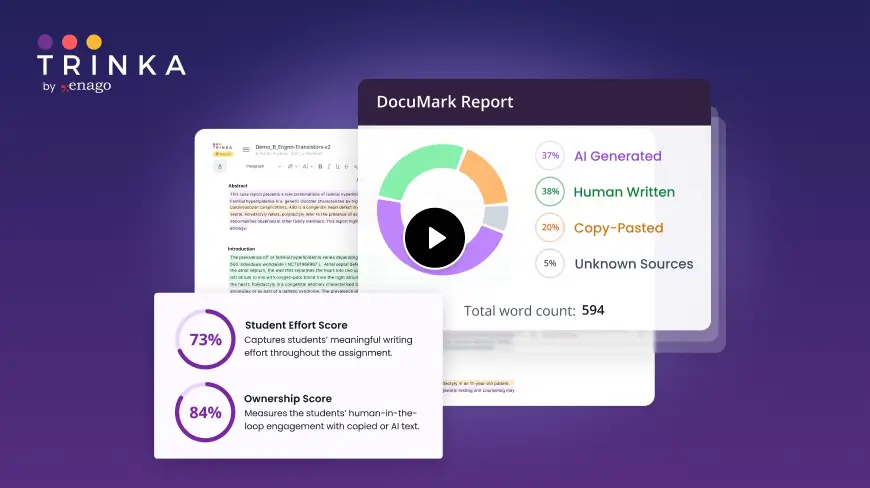
DocuMark: Responsible AI Use for Academic Integrity
Knowing your institution's AI policy is step one. DocuMark helps enforce it fairly by empowering universities to manage AI-generated content, prevent cheating, and support student writing through responsible AI use.
Common Questions About Truman State University's AI Policies
Truman State University has defined AI policies in 8 of 12 categories, with an overall coverage score of 67%.
Truman does not publish a detailed university-wide AI citation standard in the provided sources, but it does state that AI use should be cited when the tool's language or ideas are relied on. The Writing Center says using AI-written text without citation is plagiarism, and students must be transparent when a writing consultant asks about AI use. Instructor-specific policies may impose additional disclosure requirements.
Truman's provided sources frame unauthorized AI use as academic dishonesty and subject it to the university's normal misconduct process. The Student Handbook defines plagiarism to include prohibited AI use and states that academic misconduct can result in sanctions under the Code of Student Conduct. The provided sources do not state a university position on AI detection tools.
Truman has approved an institutional AI platform for admissions and procurement records show the university is purchasing AI-related services, but the provided sources do not state a general university-wide rule about what categories of institutional data may or may not be entered into public AI tools. The admissions RFP indicates the university sought an AI platform with security, role-based access, logging, and privacy controls, including compliance with FERPA and GDPR. The general privacy statement describes the university's handling of personal information but does not set AI-specific data entry rules.