Teaching & Learning
- Students remain responsible for the work they submit and must comply with citation and transparency rules when AI use is permitted
- For graded coursework, use of generative AI is generally not uniformly regulated university-wide and is often left to the lecturer or module coordinator, who must communicate what is allowed
- A faculty-specific thesis guideline in Mechanical Engineering states that AI-generated formulations may be used only as a subordinate aid and that substantive intellectual work must be the student's own
At present, there are no university-wide regulations for students on how to use generative AI in their studies and teaching. This means that course coordinators and lecturers determine whether and how artificial intelligence may be used in courses and examinations.
Teachers should also consider and clearly communicate to students whether and to what extent the use of generative AI is permitted and desirable in each case.
As a student, you are responsible for the texts and work products you create in your studies and therefore also for the use of AI tools.
The same rules apply to AI-generated formulations and references as for all other sources. The burden of proof lies with the users and not with the AI application.
KI-Tools dürfen allenfalls nachrangig als Hilfsmittel eingesetzt werden. Es ist explizit nicht gestattet, sich inhaltliche Lösungen von einer KI erzeugen zu lassen und diese auszuformulieren. Eine Thesis ist eine eigenständige wissenschaftliche Arbeit und die Eigenständigkeit und der Beitrag des Studierenden müssen klar erkennbar und bewertbar sein.
- There is no single university-wide permission rule for AI use in exams; whether AI may be used in assessments is determined by course coordinators and lecturers
- TU Darmstadt states that if AI is allowed in take-home work, instructors should redesign assessments so the student's own contribution remains visible and assessable
At present, there are no university-wide regulations for students on how to use generative AI in their studies and teaching. This means that course coordinators and lecturers determine whether and how artificial intelligence may be used in courses and examinations.
Students should make use of generative AI particularly in examinations and assignment tasks to the extent communicated by the lecturers.
In the case of homework or take-home examinations, this means, for example, adding oral examinations to accompany papers so that the student's own contribution remains recognisable.
Teachers should also consider and clearly communicate to students whether and to what extent the use of generative AI is permitted and desirable in each case.
- Use of generative AI for learning support is encouraged when used critically and reflectively
- TU Darmstadt describes AI as useful for activities such as practice, structuring, summarizing, translation, and feedback, while warning students to check outputs carefully and avoid overreliance
Use the added value of AI in your learning process
Generative AI can take over support functions in learning and therefore relieve or take over some of the effort involved in learning. This can be used, for example, for processing and preparing content, designing and obtaining feedback and supporting the writing process.
Examples:
• Generating and checking practical tasks with solutions and sample exams
• Structuring and summarising information
• Brainstorming and obtaining feedback from AI
• Translating and editing texts
• Getting support for writing assignments
Questioning and critically reflecting on the output is a fundamental prerequisite for the competent use of generative AI applications.
Please note that generative AI applications can have an impact on your learning success and motivation due to their way of working and if used too frequently can also impair them, especially if AI takes over learning activities.
- For programming-related student work, TU Darmstadt does not provide a single university-wide rule and instead places decisions with lecturers and module coordinators
- A Mechanical Engineering thesis guideline also permits AI for coding support only as a subordinate aid and requires disclosure of the tool and use case in an appendix
- A Computer Science faculty page explicitly allows generative AI as an aid in programming projects only if its use is transparent and documented, and students remain responsible for understanding and defending the code
At present, there are no university-wide regulations for students on how to use generative AI in their studies and teaching. This means that course coordinators and lecturers determine whether and how artificial intelligence may be used in courses and examinations.
Die Nutzung generativer KI-Werkzeuge (z.B. ChatGPT) ist als Hilfsmittel grundsätzlich erlaubt.
Voraussetzung für die erlaubte Nutzung ist, dass ihr den Einsatz transparent macht und dokumentiert.
Ihr seid und bleibt für den Inhalt eurer Ausarbeitung verantwortlich. Daher ist die Nutzung von generativer KI nur dann sinnvoll, wenn ihr die von der KI erzeugten Inhalte (z.B. Code, Erklärungen, Formulierungen) versteht, kritisch überprüft und im Zweifelsfall eigenständig anpassen oder verwerfen könnt.
Codegenerierung/Unterstützung bei der Programmierung: Dies beinhaltet sowohl die Erstellung als auch das Refactoring von Source Code. Das Ergebnis kann als Inspiration genutzt werden. Der Quelltext muss durch die Studierenden verstanden, verifiziert und ggf. angepasst werden.
KI-Tools dürfen allenfalls nachrangig als Hilfsmittel eingesetzt werden.
Im Anhang ist eine dokumentierte Übersicht der verwendeten KI-Tools und Einsatzzwecke aufzuführen. Das ist nicht vergleichbar mit einer Quellenangabe im wissenschaftlichen Sinne, sondern dient der Dokumentation der Einsatzgebiete. Beispiele: Textkorrektur / Grammatik- und Stilprüfung / Übersetzung / LaTeX / Literaturrecherche / Quellcode / Datenanalyse
Research
- For theses and similar academic writing, TU Darmstadt allows limited supportive AI use in some faculty guidance, but the core intellectual work must remain the student's own
- Mechanical Engineering requires an appendix documenting the AI tools used and their purposes, and it prohibits having AI generate substantive solutions and write them out as thesis content
KI-Tools dürfen allenfalls nachrangig als Hilfsmittel eingesetzt werden. Es ist explizit nicht gestattet, sich inhaltliche Lösungen von einer KI erzeugen zu lassen und diese auszuformulieren. Eine Thesis ist eine eigenständige wissenschaftliche Arbeit und die Eigenständigkeit und der Beitrag des Studierenden müssen klar erkennbar und bewertbar sein.
Im Anhang ist eine dokumentierte Übersicht der verwendeten KI-Tools und Einsatzzwecke aufzuführen. Das ist nicht vergleichbar mit einer Quellenangabe im wissenschaftlichen Sinne, sondern dient der Dokumentation der Einsatzgebiete. Beispiele: Textkorrektur / Grammatik- und Stilprüfung / Übersetzung / LaTeX / Literaturrecherche / Quellcode / Datenanalyse
As a student, you are responsible for the texts and work products you create in your studies and therefore also for the use of AI tools.
The same rules apply to AI-generated formulations and references as for all other sources. The burden of proof lies with the users and not with the AI application.
- That same guidance requires documentation of the AI tools and purposes in an appendix
- A faculty-specific thesis guideline in Mechanical Engineering allows AI to support data analysis, but only as a subordinate tool
KI-Tools dürfen allenfalls nachrangig als Hilfsmittel eingesetzt werden.
Im Anhang ist eine dokumentierte Übersicht der verwendeten KI-Tools und Einsatzzwecke aufzuführen. Das ist nicht vergleichbar mit einer Quellenangabe im wissenschaftlichen Sinne, sondern dient der Dokumentation der Einsatzgebiete. Beispiele: Textkorrektur / Grammatik- und Stilprüfung / Übersetzung / LaTeX / Literaturrecherche / Quellcode / Datenanalyse
- TU Darmstadt states that existing rules of good scientific practice also apply when AI is used in research and writing
- The library guidance says researchers are responsible for verifying AI-generated content, must cite sources properly, and should not list AI as an author
The same rules apply to AI-generated formulations and references as for all other sources. The burden of proof lies with the users and not with the AI application.
Auch bei der Nutzung von KI gelten die Grundsätze guter wissenschaftlicher Praxis.
Generative KI kann keine wissenschaftlichen Autor:innen ersetzen. Sie darf deshalb nicht als Autor:in einer Arbeit aufgeführt werden.
Wenn Sie in wissenschaftlichen Kontexten (z.B. Publikationen) generative KI einsetzen, machen Sie dies transparent und beachten Sie die Richtlinien Ihres Fachgebiets bzw. Ihres Journals.
Prüfen Sie von KI generierte Inhalte immer auf sachliche Richtigkeit, Verzerrungen, ethische Risiken und Urheberrechtsfragen.
Academic Integrity
- When AI use is permitted, TU Darmstadt requires or strongly expects transparency about that use
- Computer Science guidance for programming projects also requires transparent disclosure and documentation of generative AI use
- Students are told to identify AI-generated content and cite it according to the applicable citation standard, and a Mechanical Engineering thesis guideline requires a documented appendix listing AI tools and purposes
Labelling generated texts: Use the applicable citation standards or those specified by the lecturer to identify passages generated by AI.
As a student, you are responsible for the texts and work products you create in your studies and therefore also for the use of AI tools.
The same rules apply to AI-generated formulations and references as for all other sources. The burden of proof lies with the users and not with the AI application.
Voraussetzung für die erlaubte Nutzung ist, dass ihr den Einsatz transparent macht und dokumentiert.
Im Anhang ist eine dokumentierte Übersicht der verwendeten KI-Tools und Einsatzzwecke aufzuführen. Das ist nicht vergleichbar mit einer Quellenangabe im wissenschaftlichen Sinne, sondern dient der Dokumentation der Einsatzgebiete.
- A student information page states that online examinations can use anti-cheating software, but this is not presented as AI-specific detection guidance
- TU Darmstadt's guidance emphasizes responsibility and burden of proof for users of AI-generated content, but it does not define a university-wide AI detection regime in the provided sources
As a student, you are responsible for the texts and work products you create in your studies and therefore also for the use of AI tools.
The same rules apply to AI-generated formulations and references as for all other sources. The burden of proof lies with the users and not with the AI application.
In online examinations, software can be used to help identify cheating attempts or to automatically assess answers to the extent technically possible and legally permissible.
Institutional & Administrative
- The guidance also recommends being transparent with students when lecturers use AI in teaching
- TU Darmstadt permits and encourages lecturers to engage with generative AI in teaching, but expects deliberate, reflective use
- Lecturers should decide and clearly communicate the allowed scope of student AI use, review and adapt teaching and assessment formats, and critically check AI outputs before using them
Generative AI can be used in a variety of ways in teaching. It can support lecturers in preparing content and materials, creating tasks and test questions or giving students feedback. At the same time, use in teaching places high demands on lecturers to familiarise themselves intensively with the possibilities and limitations.
Teachers should also consider and clearly communicate to students whether and to what extent the use of generative AI is permitted and desirable in each case.
If you as a teacher use generative AI in your teaching, deal with it transparently and explain to students under what conditions and according to what criteria you have created, checked and selected generated content and artefacts.
Critically check and reflect on AI-generated output before you use it in your teaching.
Using AI applications in teaching is not an end in itself. Therefore, critically review your use of AI and your teaching-learning concept and, if necessary, adapt the framework conditions and examination formats.
- TU Darmstadt requires attention to data protection and confidentiality when using generative AI
- The library guidance also points users to legal limits involving data protection, copyright, and licenses
- The guidance warns users not to enter personal data or other sensitive/confidential information into public AI systems and recommends using approved or privacy-compliant tools where possible
Take data protection and copyright into account
Be aware that data entered in AI applications may become part of the training data depending on the provider and settings.
Do not enter any personal, sensitive and confidential data into generative AI applications.
Bei KI-Tools aus dem Internet ist Vorsicht geboten.
Achten Sie auf Datenschutz, Copyright, Lizenzbedingungen und mögliche Kosten.
KI-Tools wie DeepL, Duden-Mentor, Zotero oder Citavi sind für klar definierte Teilaufgaben oft die bessere Wahl als universell einsetzbare generative KI.
- The university also announced strategic engagement with AI through a dedicated vice presidency and a hub intended to support transfer, networking, and implementation of AI-related activities
- TU Darmstadt has an institutional AI literacy initiative and has published central guidance for students and lecturers that frames AI use around reflection, transparency, responsibility, and critical review rather than blanket bans
The use of generative artificial intelligence (AI) in the context of university teaching and studies is becoming increasingly relevant. This handout presents opportunities and risks and formulates recommendations for students and lecturers for a reflective and responsible approach.
At present, there are no university-wide regulations for students on how to use generative AI in their studies and teaching.
The TU Darmstadt is establishing an AI Competence and Transfer Hub to support Hessian universities in the transfer and implementation of AI. The aim is to network universities with one another and with industry and society and to make expertise on AI usable.
Das Präsidium hat daher beschlossen, dass dieses Thema auf Leitungsebene intensiv begleitet wird: Prof. Dr. Alexander Maedche übernimmt zum 1. Januar 2025 das neu geschaffene Amt des Vizepräsidenten für Innovation und Künstliche Intelligenz.
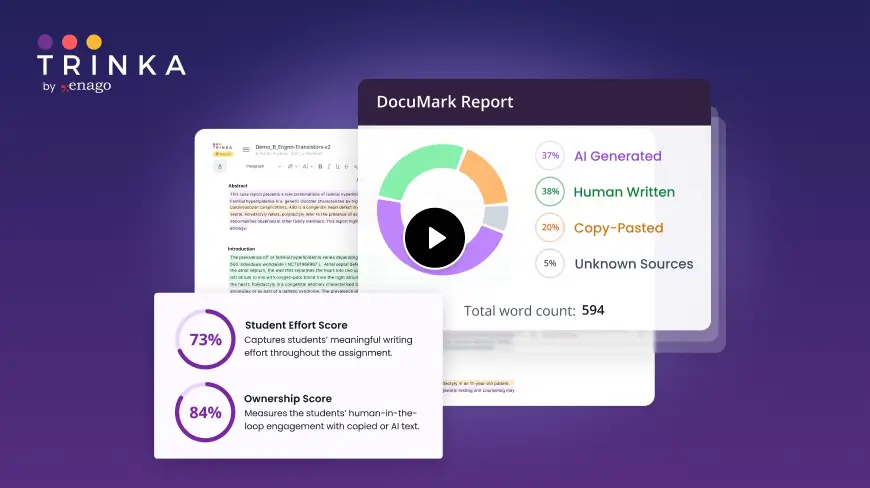
DocuMark: Responsible AI Use for Academic Integrity
Knowing your institution's AI policy is step one. DocuMark helps enforce it fairly by empowering universities to manage AI-generated content, prevent cheating, and support student writing through responsible AI use.
Common Questions About TU Darmstadt's AI Policies
TU Darmstadt has defined AI policies in 12 of 12 categories, with an overall coverage score of 100%.
When AI use is permitted, TU Darmstadt requires or strongly expects transparency about that use. Students are told to identify AI-generated content and cite it according to the applicable citation standard, and a Mechanical Engineering thesis guideline requires a documented appendix listing AI tools and purposes. Computer Science guidance for programming projects also requires transparent disclosure and documentation of generative AI use.
TU Darmstadt's guidance emphasizes responsibility and burden of proof for users of AI-generated content, but it does not define a university-wide AI detection regime in the provided sources. A student information page states that online examinations can use anti-cheating software, but this is not presented as AI-specific detection guidance.
TU Darmstadt requires attention to data protection and confidentiality when using generative AI. The guidance warns users not to enter personal data or other sensitive/confidential information into public AI systems and recommends using approved or privacy-compliant tools where possible. The library guidance also points users to legal limits involving data protection, copyright, and licenses.