Teaching & Learning
- Tuskegee University does not provide a uniform university-wide AI rule for coursework and assignments in the provided sources
- The library guideline says students should check with their course instructor or professor about what AI use is acceptable for specific work, and university academic honesty rules prohibit dishonest work, including plagiarism and cheating
Students should be advised to consult their course instructor or professor to confirm what uses of AI are acceptable and not acceptable in their specific work.
Honesty in academics, as well as in other matters, is expected of everyone at Tuskegee University. It is the obligation of all to adhere to this standard. Individuals are not expected to cheat or be dishonest, not to create the appearance of being dishonest, and not to contribute to or condone the dishonesty of others. Dishonesty, such as cheating, plagiarism, forgery, or knowingly furnishing false information to officials of the University will not be tolerated. The penalty could include failure in the course and possible dismissal or suspension from the University.
- For testing conducted through Academic Testing Services, only authorized items may be used during exams, and electronic devices are not allowed in the testing center
- The provided sources do not contain an AI-specific exam rule, but they do set exam conditions that would bar use of unauthorized AI-capable devices during testing in that setting
• Mobile phones, smart watches, and any other electronic devices are not allowed in the testing center and must be placed in the designated area (lockers).
• Only items authorized by the testing services, testing administrators, the College’s ADA Coordinators, and instructors may be utilized during testing.
• The Academic Testing Services staff continuously monitor testers while testing is in progress. All testing sessions may be recorded.
- Students are told to verify citations and sources and to consult their instructor about acceptable AI use in their work
- The library guideline supports AI for concept exploration and provides AI literacy guidance, but it does not establish a university-wide student learning-assistance policy
Patrons will receive guidance on responsible AI use through consultations, the online library catalog, information literacy instruction that includes AI literacy, and other library resources.
• Using AI tools to explore concepts, generate ideas, and develop outlines for projects, services, or initiatives, as well as to assist with event planning, communication materials, internal documentation, and professional development.
Students should be advised to consult their course instructor or professor to confirm what uses of AI are acceptable and not acceptable in their specific work. Also make them aware that some AI tools may produce inaccurate citations or made-up sources. These citations and sources should be verified using relevant and reliable resources.
Research
- AI-generated content must be reviewed, cannot be presented as original work without appropriate acknowledgment, and inaccurate citations or made-up sources must be verified
- The library guideline allows AI to support academic writing-related work only with review and proper acknowledgment, but it is internal library guidance rather than a university-wide policy
This guideline is intended for use across all Tuskegee University Library Services units,
It is intended to provide internal guidance and best practices and does not constitute a university-wide AI policy.
The use of AI tools and AI-generated content must align with the university’s academic integrity policy (Academic Regulations and Procedures, p. 26), ensuring that such content is reviewed and not presented as original work without appropriate acknowledgment. This includes properly acknowledging the use of AI-generated content in academic work and ensuring that its use aligns with academic integrity standards.
Also make them aware that some AI tools may produce inaccurate citations or made-up sources. These citations and sources should be verified using relevant and reliable resources.
- The data confidentiality policy separately classifies research data on human subjects as confidential information requiring the highest protection
- The library guideline permits AI for basic data organization or simple analysis only when no sensitive or identifying information is involved, and it permits analysis of survey responses only when data is not confidential or sensitive and identifiers are removed
• Supporting basic data organization or simple analysis where no sensitive or identifying information is involved
• Analyzing data or survey responses is permitted only when the data is not confidential or sensitive and all identifying information has been removed.
Confidential information includes sensitive personal and institutional information, and must be given the highest level of protection against unauthorized access, modification or destruction.
Examples of personal Confidential information include information protected under privacy laws (including, without limitation, the Family Educational Rights and Privacy Act and the Gramm-Leach-Bliley Act), information concerning the pay and benefits of University employees, personal identification information or medical/health information pertaining to members of the University community, and data collected in the course of research on human subjects.
- The provided sources do not set AI-specific rules for grant proposals, IRB applications, or formal research ethics declarations
- They do require protection of confidential research-on-human-subjects data and state that AI-generated academic content must align with academic integrity standards, be reviewed, and not be presented as original work without appropriate acknowledgment
The use of AI tools and AI-generated content must align with the university’s academic integrity policy (Academic Regulations and Procedures, p. 26), ensuring that such content is reviewed and not presented as original work without appropriate acknowledgment. This includes properly acknowledging the use of AI-generated content in academic work and ensuring that its use aligns with academic integrity standards.
Examples of personal Confidential information include information protected under privacy laws (including, without limitation, the Family Educational Rights and Privacy Act and the Gramm-Leach-Bliley Act), information concerning the pay and benefits of University employees, personal identification information or medical/health information pertaining to members of the University community, and data collected in the course of research on human subjects.
Academic Integrity
- It also says AI use should be clearly disclosed when appropriate and that library staff should maintain records of the AI tools used and reviews of outputs
- The library guideline requires transparency when AI meaningfully contributes to work-related documents or products and says AI-generated academic content must be properly acknowledged
Tuskegee University Library Services will follow university policies and Competency 1.4 of ACRL’s AI Competencies for Academic Library Workers, promoting transparency in AI use, including how data is selected, how systems function, how outputs can be understood, and when AI use should be clearly disclosed (ACRL, 2025).
Library Services staff should maintain records of the AI tools used, their purpose, and any review of outputs, and provide this information to appropriate institutional authorities upon request.
When AI has meaningfully contributed to a work-related document or product, the content must not be presented as fully human-created. Where appropriate, the use of AI tools should be documented to support transparency, review, and accountability.
The use of AI tools and AI-generated content must align with the university’s academic integrity policy (Academic Regulations and Procedures, p. 26), ensuring that such content is reviewed and not presented as original work without appropriate acknowledgment. This includes properly acknowledging the use of AI-generated content in academic work and ensuring that its use aligns with academic integrity standards.
- The provided sources do not mention AI detection tools
- Enforcement is addressed through the university's academic honesty process: dishonest work, including cheating and plagiarism, is not tolerated, penalties can include course failure, dismissal, or suspension, and charges are heard by the Committee on Academic Honesty
Dishonesty, such as cheating, plagiarism, forgery, or knowingly furnishing false information to officials of the University will not be tolerated. The penalty could include failure in the course and possible dismissal or suspension from the University.
A Committee on Academic Honesty consisting of one faculty member from each College, and three students will be appointed by the Provost upon the recommendation of the College Deans and Dean of Students to hear charges of academic dishonesty.
When an instructor has reason(s) to believe that a student has been dishonest or has aided in dishonest acts, he/she immediately informs the student and follows up with a written statement of the charges to the student, the head of the department, and Dean of the College in which the student is enrolled.
Institutional & Administrative
- Tuskegee's explicit AI guidance for staff appears in the library services guideline rather than a university-wide faculty/staff policy
- Library staff may use AI for routine administrative tasks, drafting written materials, concept generation, and some formal documents, but outputs must be reviewed, some uses require subject-matter-expert or human review, and certain high-impact uses are prohibited without human review
This guideline is intended for use across all Tuskegee University Library Services units,
It is intended to provide internal guidance and best practices and does not constitute a university-wide AI policy.
• Using AI to assist with routine administrative tasks, draft and improve written materials (e.g., emails, reports, announcements), and summarize content for general understanding (not to be used as the sole basis for decisions).
• Using AI tools to explore concepts, generate ideas, and develop outlines for projects, services, or initiatives, as well as to assist with event planning, communication materials, internal documentation, and professional development.
• Drafting policies, procedures, reports, or other formal institutional documents; all outputs must be carefully reviewed by a subject matter expert to ensure accuracy and compliance before use
• Using AI to evaluate individuals (e.g., hiring or performance appraisal) or to make decisions that significantly affect individuals without human review.
- Tuskegee's library guideline prohibits entering personally identifiable, confidential, sensitive, restricted, or non-public university information into AI tools and requires staff to review privacy settings, minimize data, and consult OIT when unsure
- It also ties AI use to institutional data classification standards and requires AI tools or vendors used in library services to be evaluated and, where applicable, recommended for approval; the university's data confidentiality policy defines confidential information categories that require the highest protection
Personal, sensitive, or internal information must not be entered into AI tools for library or university work. Staff should use only the information necessary and remove or redact identifying details as part of data minimization practices and consult library administration or the Office of Information Technology (OIT) when in doubt. AI use must comply with applicable privacy laws and university policies, including FERPA, HIPAA (where applicable), and institutional data classification standards.
Use caution when entering information into AI tools, as data may be stored or reused; avoid including sensitive, confidential, or institutional data unless the tool is approved and secure.
• Entering personally identifiable information (PII), confidential, sensitive, restricted, or non-public university information into AI tools is not permitted.
Before adopting any AI tool for library service work, staff should review the evaluation rubric to determine (See appendix) whether the tool or vendor should be recommended to the Director of Library Services or the Library Services AI Committee for approval.
AI features used by software or third-party services must be identified and evaluated carefully.
1. All information covered by this policy is to be classified among one of three categories, according to the level of security required. In descending order of sensitivity, these categories (or “security classifications”) are “Confidential,” “Internal Use Only,” and “Public.”
Confidential information includes sensitive personal and institutional information, and must be given the highest level of protection against unauthorized access, modification or destruction.
- Tuskegee shows evidence of AI governance activity and institutional AI planning, but the clearest formal governance language in the provided sources is within Library Services rather than a university-wide policy
- The university announced workshops on AI readiness, risk management, privacy, governance, and responsible implementation, and the library guideline establishes a Library Services AI Committee, annual review, and an approval process for AI tools
Tuskegee University is introducing a series of workshops to help students, faculty and staff understand how to use AI responsibly, use it in everyday life and how to properly add it to your workflow.
She discussed responsible use of AI, including AI readiness, risk management, privacy, governance and responsible implementation.
Before adopting any AI tool for library service work, staff should review the evaluation rubric to determine (See appendix) whether the tool or vendor should be recommended to the Director of Library Services or the Library Services AI Committee for approval.
This guideline provides general direction for the responsible use of AI tools in library services and does not replace university policies or legal requirements. It will be reviewed annually by the Library Services AI Committee to maintain relevance and effectiveness.
DocuMark: Responsible AI Use for Academic Integrity
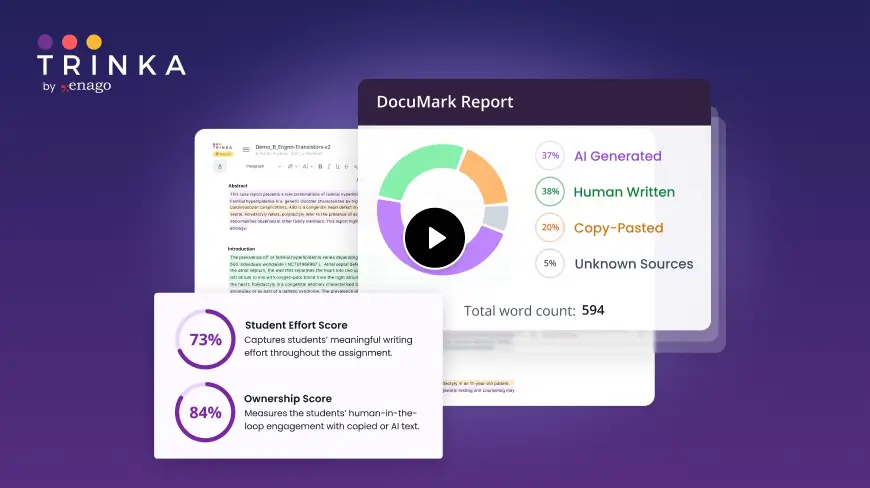
Knowing your institution's AI policy is step one. DocuMark helps enforce it fairly by empowering universities to manage AI-generated content, prevent cheating, and support student writing through responsible AI use.
Common Questions About Tuskegee University's AI Policies
Tuskegee University has defined AI policies in 11 of 12 categories, with an overall coverage score of 92%.
The library guideline requires transparency when AI meaningfully contributes to work-related documents or products and says AI-generated academic content must be properly acknowledged. It also says AI use should be clearly disclosed when appropriate and that library staff should maintain records of the AI tools used and reviews of outputs.
The provided sources do not mention AI detection tools. Enforcement is addressed through the university's academic honesty process: dishonest work, including cheating and plagiarism, is not tolerated, penalties can include course failure, dismissal, or suspension, and charges are heard by the Committee on Academic Honesty.
Tuskegee's library guideline prohibits entering personally identifiable, confidential, sensitive, restricted, or non-public university information into AI tools and requires staff to review privacy settings, minimize data, and consult OIT when unsure. It also ties AI use to institutional data classification standards and requires AI tools or vendors used in library services to be evaluated and, where applicable, recommended for approval; the university's data confidentiality policy defines confidential information categories that require the highest protection.