Teaching & Learning
- For work submitted for assessment, students are expected to prepare the work themselves and work independently on individual assessments
- The unauthorised or unacknowledged use of artificial intelligence tools to generate content for assessed work is prohibited and treated as plagiarism
The University expects that all students undertake their
studies with integrity and submit assessments for grading
that have been prepared by themselves.
Ensure you work independently on all
individual formative and summative
assessments.
The Court is invited to approve an amendment to the Code of Practice on Student Discipline
(Academic) for Academic Year 2023/2024, which states that the unauthorized /
unacknowledged use of artificial intelligence tools will be treated as a form of plagiarism
and will therefore be dealt with in the same way as plagiarism/collusion.
“Plagiarism through the use of artificial intelligence tools is defined as the unauthorised or
unacknowledged use of artificial intelligence tools to generate content for work submitted for
assessment.”
- The university applies its AI misconduct rule to work submitted for assessment
- It requires students to complete assessments honestly, and unauthorised or unacknowledged AI-generated content in assessed work is treated as plagiarism
Complete all your academic courses
and assessments honestly.
The Court is invited to approve an amendment to the Code of Practice on Student Discipline
(Academic) for Academic Year 2023/2024, which states that the unauthorized /
unacknowledged use of artificial intelligence tools will be treated as a form of plagiarism
and will therefore be dealt with in the same way as plagiarism/collusion.
“Plagiarism through the use of artificial intelligence tools is defined as the unauthorised or
unacknowledged use of artificial intelligence tools to generate content for work submitted for
assessment.”
- The university does not define a separate rule on using AI for private study support, tutoring, or revision
- The only explicit statement in the provided sources is that when GenAI tools are used in assessments and other learning activities, they must be appropriately referenced and cited
Reference and cite appropriately sources
(e.g., tables, figures and images) used in
assessments and other learning activities,
including the use of Generative Artificial
Intelligence (GenAI) tools e.g., ChatGPT.
- For assessed work, unauthorised or unacknowledged use of AI tools, including coding assistance, is prohibited and treated as plagiarism
- The university identifies code assistance as a capability of AI tools and states that such tools could be used by students to generate content for assessment
• Generative tools, such as jenni.ai, perplexity.ai, dall-e-2.ai, GitHub Co-Pilot, ChatGPT
4.2.1. Generative AI tools such as ChatGPT can perform a wide range of language-related tasks well,
such as translation, summarising, writing an essay, answering a question, producing “human-like” responses. These tools can also assist with coding tasks by providing code snippets and
examples in various programming languages. ChatGPT, and similar applications could,
therefore, be used by students to generate content that will be submitted for assessment.
The Court is invited to approve an amendment to the Code of Practice on Student Discipline
(Academic) for Academic Year 2023/2024, which states that the unauthorized /
unacknowledged use of artificial intelligence tools will be treated as a form of plagiarism
and will therefore be dealt with in the same way as plagiarism/collusion.
Research
- However, the provided sources do not define AI-specific rules for grant proposals, ethics applications, or other research integrity declarations
- The research governance material sets university-wide expectations that research integrity applies across the full research life cycle and to all individuals involved in research
Research integrity applies throughout the research life cycle, from the initial idea or concept to the
publication of research outcomes.
These guidelines describe the standards of good research conduct
which are required by the University and which are intended to satisfy the requirements of all funding
bodies. They apply to all individuals involved in research, including visiting researchers, research
support staff, students and research managers and professional support staff.
The onus is on researchers to establish that they have met the highest standard that could reasonably
be expected of them.
Academic Integrity
- If AI use is unacknowledged in work submitted for assessment, it is treated as plagiarism
- Students must reference and cite GenAI tools when they are used in assessments and other learning activities
Reference and cite appropriately in
your work, acknowledging the work
and ideas of others.
Reference and cite appropriately sources
(e.g., tables, figures and images) used in
assessments and other learning activities,
including the use of Generative Artificial
Intelligence (GenAI) tools e.g., ChatGPT.
The Court is invited to approve an amendment to the Code of Practice on Student Discipline
(Academic) for Academic Year 2023/2024, which states that the unauthorized /
unacknowledged use of artificial intelligence tools will be treated as a form of plagiarism
and will therefore be dealt with in the same way as plagiarism/collusion.
The unauthorised or unacknowledged use of artificial intelligence tools in work submitted for
assessment can be regarded as plagiarism because it involves presenting work or ideas
generated by an AI tool as one's own, without proper attribution or acknowledgement of the
source.
- The university states that unauthorised or unacknowledged AI use in assessed work is handled as plagiarism or collusion under existing academic misconduct processes
- It also states that AI detection is difficult and cannot definitively prove use, and for plagiarism allegations against postgraduate research graduates it may use the university plagiarism software checker such as TurnitinUK
The Court is invited to approve an amendment to the Code of Practice on Student Discipline
(Academic) for Academic Year 2023/2024, which states that the unauthorized /
unacknowledged use of artificial intelligence tools will be treated as a form of plagiarism
and will therefore be dealt with in the same way as plagiarism/collusion.
It is difficult to detect and, as with any other tools used to investigate cases of academic
misconduct, impossible to definitively prove that ChatGPT (or similar tools) have been used in
the generation of text. Some detection tools have been released and others are under
development, but these AI tools are constantly being developed and refined, making detection
a race that cannot be won. It is a more efficient use of time to focus on assessment design than
on detection.
Addressing the use of AI tools, particularly generative AI tools such as ChatGPT, under this
definition ensures that the current Code of Practice on Student Discipline can be utilised to
address unauthorised or unacknowledged use of AI in work submitted for assessment, with
clear guidance on how Schools can deal with it, as set out in Section 4.2 of the Code, “School
dealing with alleged Plagiarism/Collusion by students in taught courses at level 1-5”.
• Where the accusation relates to plagiarism, collusion or contract cheating, put the
thesis through the University’s plagiarism software checker (eg TurnitinUK) and
prepare a report on its findings. The Graduate’s permission is not required for this to
go through the plagiarism software checker;
Institutional & Administrative
- The university approved a formal amendment to its academic misconduct framework to address developments in AI tools for the 2023/24 academic year
- The material shows this was considered through the Quality Assurance Committee, Senate, and Court, but the provided sources do not set out a broader institution-wide AI strategy beyond this policy change
POLICY AMENDMENTS TO ADDRESS DEVELOPMENTS IN ARTIFICIAL INTELLIGENCE TOOLS
This paper outlines a proposed amendment to the Code of Practice on Student Discipline
(Academic), for AY 2023-24, to address developments in Artificial Intelligence tools.
Previously
considered/approved by
Quality Assurance Committee 29 March 2023
Senate 19 April 2023
Further consideration/
approval required by
Court 21 June 2023
The Court is invited to approve an amendment to the Code of Practice on Student Discipline
(Academic) for Academic Year 2023/2024, which states that the unauthorized /
unacknowledged use of artificial intelligence tools will be treated as a form of plagiarism
and will therefore be dealt with in the same way as plagiarism/collusion.
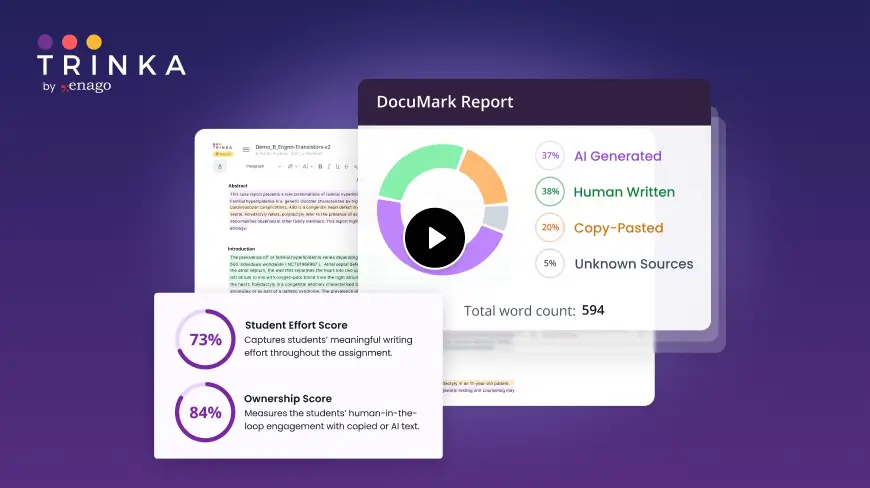
DocuMark: Responsible AI Use for Academic Integrity
Knowing your institution's AI policy is step one. DocuMark helps enforce it fairly by empowering universities to manage AI-generated content, prevent cheating, and support student writing through responsible AI use.
Common Questions About University of Aberdeen's AI Policies
University of Aberdeen has defined AI policies in 8 of 12 categories, with an overall coverage score of 67%.
Students must reference and cite GenAI tools when they are used in assessments and other learning activities. If AI use is unacknowledged in work submitted for assessment, it is treated as plagiarism.
The university states that unauthorised or unacknowledged AI use in assessed work is handled as plagiarism or collusion under existing academic misconduct processes. It also states that AI detection is difficult and cannot definitively prove use, and for plagiarism allegations against postgraduate research graduates it may use the university plagiarism software checker such as TurnitinUK.
No explicit data protection or approved AI platform policy is currently defined in the available policy sources.