Teaching & Learning
- Use of generative AI in assessed coursework is permitted only when it aligns with assessment requirements and any tutor or module guidance
- The university also states that not all use needs to be declared, but AI use may need to be acknowledged and should be checked against module instructions
- Students remain responsible for the accuracy and integrity of submitted work, must not present AI-generated material as their own, and misuse can be treated as academic misconduct
Whatever your use of AI, if it directly contributes to creating something intended for assessment, you should check your tutors / assignment support materials for guidance.
The key difference lies in the intended use and the extent to which the generated text contributes to the final assignment.
Submitting AI-generated text as your own work without proper acknowledgment or permission from your tutor can be considered plagiarism and may constitute academic misconduct.
Even if a tool creates something for you, you are still responsible for checking its content, referencing any ideas taken from it, and ensuring your submitted work reflects your own understanding and meets the required standard.
Using generative AI tools to help create assignments without following your tutor's guidance or being transparent can be considered misconduct.
As a broad recommendation, if your use of AI generated text or images has significantly impacted your final work then this should be acknowledged.
We do not expect every interaction with AI to be disclosed. For example, if you've used it to test your understanding, generate ideas, or get feedback before writing in your own words, this may not need to be declared.
- For formal assessments, students are told to follow the specific instructions given by tutors or assignment materials
- The university materials refer generally to work intended for assessment, but do not set a distinct university-wide AI rule specifically for exams, quizzes, or proctored tests beyond that guidance
Whatever your use of AI, if it directly contributes to creating something intended for assessment, you should check your tutors / assignment support materials for guidance.
Use of AI in completed work should align with assessment requirements and any guidance or restrictions from your tutor.
- Some study-oriented uses do not need to be disclosed
- It warns students not to rely on AI as a sole source and says they remain responsible for checking accuracy, bias, and quality
- The university permits and encourages students to use AI as a study support tool for explanation, revision, idea generation, practice, and feedback, provided they use it critically and verify outputs
Used thoughtfully, these tools can support your study in many ways:
• Explaining difficult concepts in simpler terms
• Helping you revise and test your understanding
• Suggesting ideas or structures to get you started
• Providing feedback on your writing style, tone or grammar
• Supporting planning, note-making, and summarising
You can use AI to support your own understanding and development, but not to replace the need to think critically, research independently, and produce your own work.
Generative AI can support your independent learning if you use it to practise, get feedback, or understand difficult concepts.
We do not expect every interaction with AI to be disclosed. For example, if you've used it to test your understanding, generate ideas, or get feedback before writing in your own words, this may not need to be declared.
Don't use AI tools as your only source of information. Always check what it tells you against trusted sources such as your module materials, lecture notes, reading lists or academic databases.
- However, it does not set a separate university-wide rule specifically governing AI-assisted coding or programming assignments beyond those general requirements
- The university provides specific guidance on Microsoft Copilot as an available AI tool and states that AI use in assessed work must follow tutor or assessment guidance
Whatever your use of AI, if it directly contributes to creating something intended for assessment, you should check your tutors / assignment support materials for guidance.
University staff and students have access to Copilot Chat as part of Abertay's Microsoft subscription. This tool provides AI-powered assistance based on prompts and can support tasks such as drafting, summarising and asking questions. It can be a useful tool for study and productivity, but it should still be used critically and responsibly.
Research
- Based on the verified source text provided here, this category is not defined
- The university has a formal research policy on generative AI, but the provided source list does not supply extractable policy text stating the rules for using AI in drafting, editing, or formatting research manuscripts
not defined
- Therefore, this category is not defined beyond the general data-protection warning
- The university warns students not to upload personal, confidential, unpublished, or sensitive material into public AI tools and says use of such tools may involve data storage and reuse by providers
- The provided source list indicates a separate research AI policy exists, but no extractable text is available here setting explicit university research rules for AI-based data collection, analysis, or synthetic data generation
Do not upload personal, confidential, sensitive or unpublished information to public AI tools.
Many AI tools store prompts and responses, and some use them to train future models.
Do not paste in:
• your own personal data, passwords or university account details
• identifiable information about other people
• confidential coursework feedback, emails or private conversations
• research data that has not been anonymised or ethically approved for sharing
- Accordingly, this category is not defined from the verified source text provided
- The source list shows that the university has research-related AI policy and equality impact assessment documents, but the provided source text here does not include extractable statements on AI use in grant proposals, ethics applications, or research integrity declarations
not defined
Academic Integrity
- It also states that not every minor learning-related interaction with AI must be disclosed
- Students may be required to acknowledge AI use when it significantly shapes submitted work, and any use in completed work must follow tutor or assessment guidance
- The university says AI outputs should not normally be cited as authoritative sources, but AI-generated text or images can be acknowledged, for example in a note or appendix, and direct quotations from AI should be clearly marked
As a broad recommendation, if your use of AI generated text or images has significantly impacted your final work then this should be acknowledged.
Use of AI in completed work should align with assessment requirements and any guidance or restrictions from your tutor.
If you've used an AI tool to help generate ideas, structure your work, or create text or images that appear in your final submission, you may need to acknowledge this depending on the level of use and your tutor's expectations.
At Abertay, AI tools such as ChatGPT are not generally considered reliable or citable sources of academic evidence. This is because they do not produce stable, traceable content and may generate inaccurate or unverified information.
You should not normally reference AI as a source in the same way you would reference a book, journal article or website.
However, if you include AI-generated text, images or substantial ideas in assessed work, you may be expected to acknowledge how the tool was used.
If you quote directly from an AI tool, this should be made clear in the text.
We do not expect every interaction with AI to be disclosed. For example, if you've used it to test your understanding, generate ideas, or get feedback before writing in your own words, this may not need to be declared.
- The provided sources do not state a university position on AI detection tools such as Turnitin or GPTZero
- Undisclosed or unauthorized AI-assisted work can be treated as plagiarism or academic misconduct under the university's academic integrity processes
- The university emphasizes student responsibility for submitted work and says misuse of generative AI in assignments may trigger misconduct procedures
Submitting AI-generated text as your own work without proper acknowledgment or permission from your tutor can be considered plagiarism and may constitute academic misconduct.
Using generative AI tools to help create assignments without following your tutor's guidance or being transparent can be considered misconduct.
Contract cheating can involve, but is not limited to;
- Buying or commissioning an essay, assignment or dissertation from an essay mill or other source, including artificial intelligence (AI) generators, and submitting all or part of it as your own work.
Where a student has committed academic misconduct, as determined by the Academic Misconduct Procedure, one of the following penalties may be applied:
Institutional & Administrative
- The university states that staff have access to Microsoft Copilot through the institutional subscription and should use it critically and responsibly
- The provided source text does not include extractable policy rules for faculty use of AI in grading, feedback, lesson planning, recommendation letters, or administrative communications, so a fuller staff-use policy is not defined here
University staff and students have access to Copilot Chat as part of Abertay's Microsoft subscription. This tool provides AI-powered assistance based on prompts and can support tasks such as drafting, summarising and asking questions. It can be a useful tool for study and productivity, but it should still be used critically and responsibly.
- It identifies Microsoft Copilot Chat as available through the university's Microsoft subscription, while warning that users must still apply critical judgment and use AI responsibly
- The university instructs users not to enter personal, confidential, sensitive, or unpublished information into public AI tools and explains that many AI systems retain prompts and may reuse them for training
Do not upload personal, confidential, sensitive or unpublished information to public AI tools.
Many AI tools store prompts and responses, and some use them to train future models.
Do not paste in:
• your own personal data, passwords or university account details
• identifiable information about other people
• confidential coursework feedback, emails or private conversations
• research data that has not been anonymised or ethically approved for sharing
University staff and students have access to Copilot Chat as part of Abertay's Microsoft subscription.
It can be a useful tool for study and productivity, but it should still be used critically and responsibly.
- The university presents generative AI as part of a broader digital environment and provides institutionally published guidance focused on responsible, critical, and transparent use
- The source list also includes digital strategy and research policy documents, but the verified source text provided here does not include extractable statements about governance bodies, formal AI principles, or an institution-wide AI roadmap beyond general guidance and access to Copilot
At Abertay University, we support the responsible and informed use of generative AI as part of learning, teaching and digital development.
This guidance has been created to help you understand what generative AI is, how it can support your studies, and how to use it safely, ethically and effectively.
University staff and students have access to Copilot Chat as part of Abertay's Microsoft subscription.
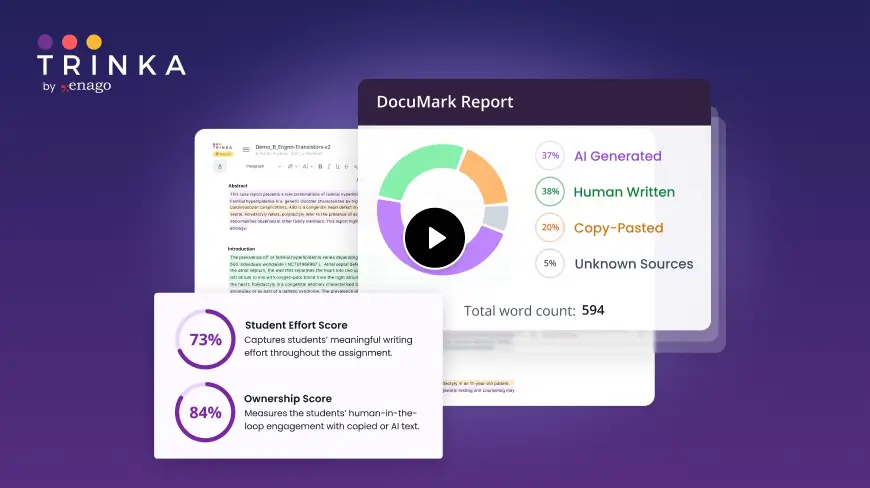
DocuMark: Responsible AI Use for Academic Integrity
Knowing your institution's AI policy is step one. DocuMark helps enforce it fairly by empowering universities to manage AI-generated content, prevent cheating, and support student writing through responsible AI use.
Common Questions About University of Abertay's AI Policies
University of Abertay has defined AI policies in 12 of 12 categories, with an overall coverage score of 100%.
Students may be required to acknowledge AI use when it significantly shapes submitted work, and any use in completed work must follow tutor or assessment guidance. The university says AI outputs should not normally be cited as authoritative sources, but AI-generated text or images can be acknowledged, for example in a note or appendix, and direct quotations from AI should be clearly marked. It also states that not every minor learning-related interaction with AI must be disclosed.
Undisclosed or unauthorized AI-assisted work can be treated as plagiarism or academic misconduct under the university's academic integrity processes. The university emphasizes student responsibility for submitted work and says misuse of generative AI in assignments may trigger misconduct procedures. The provided sources do not state a university position on AI detection tools such as Turnitin or GPTZero.
The university instructs users not to enter personal, confidential, sensitive, or unpublished information into public AI tools and explains that many AI systems retain prompts and may reuse them for training. It identifies Microsoft Copilot Chat as available through the university's Microsoft subscription, while warning that users must still apply critical judgment and use AI responsibly.