Teaching & Learning
- The policy applies to assessments generally, including coursework
- For taught undergraduate and taught postgraduate assessments, using AI to complete or contribute to an assessment and then submitting that output as the student's own work is prohibited and treated as academic misconduct
These regulations and procedures take effect from January 2015 and apply to all undergraduate and taught postgraduate programmes.
ii. Commissioning – also known as “contract cheating” involves requesting another person or using AI to complete an assessment, or contribute to an assessment, such that the output of that commissioning in whole or part is then submitted as the student's own work.
- Online assessments are handled under the same misconduct rules as traditional assessments
- The university prohibits the use of unauthorized electronic devices and unauthorized programs during examinations or in-class assessments, and treats such conduct as academic misconduct
2.3 In addition to the above, the following relates specifically to conduct during examinations or in-class assessments and will also be considered to be academic misconduct:
ii. the use of an unauthorised electronic device;
iii. the use of unauthorised programmes on allowed electronic devices, including algorithms on calculators that have been programmed prior to the assessment;
2.4 Academic misconduct within an online learning environment will be dealt with in the same way as for more traditional learning methods.
- However, it does not define a specific policy on using AI for private, non-graded study assistance
- The university provides AI literacy guidance for learners and frames AI engagement for learning as something that should be thoughtful, responsible, and ethically aware
The aim of this tutorial is to equip learners with a critical understanding of Artificial Intelligence (AI) technologies with a focus on Generative AI (GAI). It seeks to build not only technical proficiency but also adaptability to apply knowledge of AI literacy in real-world context for problem-solving whilst being aware of ethical practices.
Co-designed with students, the LEAP Online team and researchers in learning and information technologies, this framework with its four-step approach (i) Prepare (ii) Understand (iii) Apply (iv) Responsible use, ensures that learners build on their existing academic, ICT and digital literacy skills as they progress through foundational, in-depth, practical and responsible aspects of AI technologies integration for learning, research and professional development.
Research
- The AI literacy framework mentions AI integration for research, but does not set a specific rule for research writing
- The provided taught-programme misconduct regulations do not govern research degree students, and no explicit policy in the provided sources defines whether AI may be used for drafting, editing, or improving theses, dissertations, or manuscripts
These regulations and procedures take effect from January 2015 and apply to all undergraduate and taught postgraduate programmes. Research degree students and staff are subject to the Code of Practice and Procedures for Investigating and Resolving Allegations of Misconduct in Research.
Co-designed with students, the LEAP Online team and researchers in learning and information technologies, this framework with its four-step approach (i) Prepare (ii) Understand (iii) Apply (iv) Responsible use, ensures that learners build on their existing academic, ICT and digital literacy skills as they progress through foundational, in-depth, practical and responsible aspects of AI technologies integration for learning, research and professional development.
- The only explicit rule in the provided sources is that fabrication or amendment of data presented as legitimately gathered is academic misconduct
- No explicit policy is defined for use of AI in research data collection, analysis, statistics, or synthetic data generation beyond that misconduct prohibition
iv. Fabrication of data refers to the falsification of data (either qualitative or quantitative), through invention or amendment, which is then presented by the student as if it had been legitimately gathered in line with the norms of the discipline concerned.
These regulations and procedures take effect from January 2015 and apply to all undergraduate and taught postgraduate programmes. Research degree students and staff are subject to the Code of Practice and Procedures for Investigating and Resolving Allegations of Misconduct in Research.
- The AI literacy framework encourages ethical and responsible use of AI, but does not set explicit requirements for grant proposals, ethics applications, or integrity declarations
- For research degree students and staff, the provided taught-programme regulations defer research misconduct matters to a separate research misconduct code rather than defining AI-specific research ethics or integrity rules here
These regulations and procedures take effect from January 2015 and apply to all undergraduate and taught postgraduate programmes. Research degree students and staff are subject to the Code of Practice and Procedures for Investigating and Resolving Allegations of Misconduct in Research.
The aim of this tutorial is to equip learners with a critical understanding of Artificial Intelligence (AI) technologies with a focus on Generative AI (GAI). It seeks to build not only technical proficiency but also adaptability to apply knowledge of AI literacy in real-world context for problem-solving whilst being aware of ethical practices.
Academic Integrity
- For taught assessments, failing to acknowledge another person's work is treated as plagiarism
- The university requires acknowledgement of sources to avoid plagiarism, including material taken from the internet, but the provided sources do not define a specific AI disclosure or AI citation statement requirement
i. Plagiarism may be defined as the representation of another person’s work, without acknowledgement of the source, as the student’s own for the purposes of satisfying assessment requirements. This includes information taken from the internet as well as published works. Examples of plagiarism are:
- copying the work of another person (including a fellow student) without acknowledging the source through the appropriate form of citation;
- the summarising of another person’s work by simply changing a few words or altering the order of presentation, without acknowledgement;
- the use of ideas or intellectual data of another person without acknowledgement of the source, or the submission or presentation of work as if it were the student’s own, which are substantially the ideas or intellectual data of another person;
- The provided sources define a range of penalties and procedures for minor and serious offences, but do not state a policy position on AI detection tools specifically
- Suspected academic misconduct is identified by marking tutors, invigilators, and in some cases external examiners or those reviewing appeals or mitigating circumstances, and is then handled through formal university procedures
3.1.1 Marking Tutors, Invigilators, and exceptionally External Examiners and those considering appeals or mitigating circumstances evidence, are responsible for the identification of suspected cases of academic misconduct.
ANNEX C: Range of Penalties
3.3 Procedure for dealing with minor offences
3.4 Procedure for dealing with Serious Offences
Institutional & Administrative
- The provided sources do not define a policy on faculty or staff use of AI for grading, feedback, lesson planning, recommendation letters, or administrative communications
- The only staff-related statement in the provided materials is that staff may identify suspected academic misconduct and that staff are subject to a separate research misconduct code
Research degree students and staff are subject to the Code of Practice and Procedures for Investigating and Resolving Allegations of Misconduct in Research.
3.1.1 Marking Tutors, Invigilators, and exceptionally External Examiners and those considering appeals or mitigating circumstances evidence, are responsible for the identification of suspected cases of academic misconduct.
- However, the provided sources do not define a broader institutional AI governance structure, committee, or university-wide AI strategy roadmap
- The university has an AI literacy framework intended to guide learners' responsible and innovative engagement with AI for learning, research, and professional development
The aim of this tutorial is to equip learners with a critical understanding of Artificial Intelligence (AI) technologies with a focus on Generative AI (GAI). It seeks to build not only technical proficiency but also adaptability to apply knowledge of AI literacy in real-world context for problem-solving whilst being aware of ethical practices.
Co-designed with students, the LEAP Online team and researchers in learning and information technologies, this framework with its four-step approach (i) Prepare (ii) Understand (iii) Apply (iv) Responsible use, ensures that learners build on their existing academic, ICT and digital literacy skills as they progress through foundational, in-depth, practical and responsible aspects of AI technologies integration for learning, research and professional development.
By working through the framework, which is designed to be a guide and a catalyst for thoughtful, responsible and innovative engagement with AI, learners can expect to develop five key GAME attributes – Adaptability, Lifelong Learning, Problem Solving, Self-Awareness and Confidence.
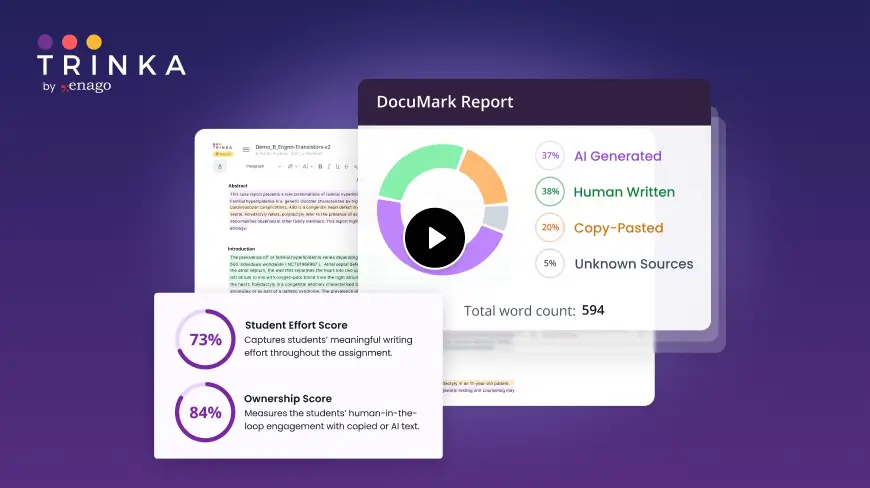
DocuMark: Responsible AI Use for Academic Integrity
Knowing your institution's AI policy is step one. DocuMark helps enforce it fairly by empowering universities to manage AI-generated content, prevent cheating, and support student writing through responsible AI use.
Common Questions About University of Bolton's AI Policies
University of Bolton has defined AI policies in 10 of 12 categories, with an overall coverage score of 83%.
The university requires acknowledgement of sources to avoid plagiarism, including material taken from the internet, but the provided sources do not define a specific AI disclosure or AI citation statement requirement. For taught assessments, failing to acknowledge another person's work is treated as plagiarism.
Suspected academic misconduct is identified by marking tutors, invigilators, and in some cases external examiners or those reviewing appeals or mitigating circumstances, and is then handled through formal university procedures. The provided sources define a range of penalties and procedures for minor and serious offences, but do not state a policy position on AI detection tools specifically.
No explicit data protection or approved AI platform policy is currently defined in the available policy sources.