Teaching & Learning
- AI use in summative assignments is generally permitted unless the assessment brief or rubric explicitly prohibits it, but students must follow the university’s general AI guidance and check the rubric if unsure
- The university permits limited assistance such as idea generation, structuring, grammar help, and planning, but prohibits using AI to generate complete assignments or whole sections, copy AI output directly, or replace the student’s own critical thinking and analysis
The University recognises the educational value of Generative Artificial Intelligence (GenAI) tools when
used appropriately. To ensure fairness and uphold academic standards, students must follow the
guidance below when using such tools. Unless explicitly prohibited in the assessment brief or rubric,
students should assume that the use of GenAI in summative assignments is permitted, but only in
line with the general guidance below. Always check the assessment rubric if unsure.
Typical acceptable uses (unless explicitly prohibited in the assessment brief or rubric):
• Generating ideas or outlines for a topic
• Summarising lecture notes for revision
• Improving grammar or clarity of self-written text
• Brainstorming structure or key points
Unacceptable uses (unless explicitly authorised in the assessment brief or rubric):
• Using GenAI to write whole sections of an assignment
• Copying and pasting material directly from GenAI
• Paraphrasing source material using AI to avoid citation
• Generating citations or references that were not read/verified
• Submitting AI-generated images or code as original work
AI shall not be used for the following purposes:
• Generating complete assignments, essays, or research papers.
• Substituting the critical thinking and analysis required in academic work.
• Any form of cheating or academic dishonesty as defined by the university's
Academic Integrity Policy and Procedures.
- The exam rules also require students to switch off and surrender unauthorised electronic devices, and invigilators may inspect or confiscate suspected smart devices
- In examinations, unauthorised technology is prohibited, and use or possession of unauthorised material or technology during an examination is treated as academic misconduct
This includes the
possession or use of unauthorised material or technology
during an examination and accessing unseen assessment
materials in advance of an examination. For example, this
includes the circumvention of proctoring software such as
ExamSoft.
All other items and materials are unauthorised and are not permitted at the
examination desk or on or about the student’s person.
Students bringing electronic devices into the examination room must ensure that
alarms/ other sounds are cancelled and the device is switched off*. The use of any
type of alarm clock is prohibited.
Any item suspected of being an electronic or smart device—or an accessory to one—
may be inspected and, if necessary, confiscated by an invigilator. This includes, but is
not limited to, watches, Fitbits, pens, glasses, wristbands, and other wearable items.
Students must switch off and hand in mobile phones and other unauthorised electronic
devices, to a member of staff upon entering the examination room.
- Students are required to use AI responsibly, check accuracy, and understand its limitations
- The university permits students to use AI for non-graded study support such as revision, brainstorming, grammar support, planning, literature review, and sourcing materials
AI tools may include the following purposes:
• To assist and inform you with:
▪ Initial research, planning and output development.
▪ A literature review and sourcing academic materials.
▪ Structuring output
▪ Data analysis and interpretation in research
▪ Enhancing creativity and generating ideas
▪ Grammar and spell checking.
Understand the AI tool’s limitations and therefore use it in conjunction with other
sources to ensure the information you present is credible and reliable. You need to
check the accuracy of all information generated by AI tools.
Typical acceptable uses (unless explicitly prohibited in the assessment brief or rubric):
• Generating ideas or outlines for a topic
• Summarising lecture notes for revision
• Improving grammar or clarity of self-written text
• Brainstorming structure or key points
- Beyond that restriction, no broader university-wide programming-specific AI rules are defined in the provided sources
- The university states that submitting AI-generated code as original work is not allowed unless explicitly authorised in the assessment brief or rubric
Unacceptable uses (unless explicitly authorised in the assessment brief or rubric):
• Using GenAI to write whole sections of an assignment
• Copying and pasting material directly from GenAI
• Paraphrasing source material using AI to avoid citation
• Generating citations or references that were not read/verified
• Submitting AI-generated images or code as original work
Research
- The university prohibits AI from generating complete research papers, but allows more limited support such as literature review assistance, structuring, grammar and spelling help, and planning
- Where AI-generated text or output is used, students must cite, reference, and clearly disclose where and how AI assistance was used; longer works such as dissertations should place the declaration in the methodology or appendix
AI tools may include the following purposes:
• To assist and inform you with:
▪ Initial research, planning and output development.
▪ A literature review and sourcing academic materials.
▪ Structuring output
▪ Data analysis and interpretation in research
▪ Enhancing creativity and generating ideas
▪ Grammar and spell checking.
Any use of AI must be properly referenced – see Appendix to this policy.
AI shall not be used for the following purposes:
• Generating complete assignments, essays, or research papers.
Ensure that you appropriately cite and reference any text or output generated by AI in
your work, along with any other sources you use. You should indicate clearly where
in your work you have used AI-generated material. This disclosure should include
the nature and extent of any AI assistance.
Any use of GenAI must be acknowledged. For short assignments, include a declaration at the end of the
document. For longer assessments such as dissertations or projects, this should be in the methodology
or appendix section.
- The university permits AI for data analysis and interpretation in research, but requires users to verify accuracy and use AI alongside other sources
- The academic integrity policy also treats falsified or fabricated data as misconduct and frames breaches involving confidentiality, personal data, and research subjects as research integrity breaches
AI tools may include the following purposes:
• To assist and inform you with:
▪ Initial research, planning and output development.
▪ A literature review and sourcing academic materials.
▪ Structuring output
▪ Data analysis and interpretation in research
Understand the AI tool’s limitations and therefore use it in conjunction with other
sources to ensure the information you present is credible and reliable. You need to
check the accuracy of all information generated by AI tools.
Falsification Any attempt to knowingly present and/or make use of fictitious
or distorted data, evidence, references, experimental results or
other material in assignments.
23. Breaches of Academic Integrity in research include any of the above breaches in
relation to examinations, supervised research and coursework including a failure to
comply with regulatory, legal and professional obligations such as a breach of
confidentiality, infringement of intellectual property rights, failure to take due care for
participants in research or of personal data, and abuse of research subjects or
materials (including artefacts).
- The university defines breaches of ethical standards in research as academic integrity matters and requires compliance with institutional and discipline-specific ethical guidelines
- The provided sources do not set AI-specific rules for grant proposals, IRB applications, or ethics declarations, but they do state that research-related breaches can include confidentiality, personal data, and participant-protection failures
Breaching ethical
standards
Examples include but are not limited to:
i. Collecting data without first securing formal ethical
approval.
ii. Collecting data for ethically approved studies without
obtaining informed consent from the participants.
iii. Falsifying data or fabricating fake data.
iv. Breaching participant confidentiality.
22.Ethical standards, particularly in research, are extremely important, and a breach of
these standards should be investigated as with any other breach of academic
integrity. This is relevant to both postgraduate research students and undergraduate
students carrying out research on taught modules. A breach of ethical standards
covers failing to comply with ethical obligations when carrying out academic work as
set out in any Institutional and discipline-specific Ethical Guidelines, such as failing to
obtain free and informed consent.
23. Breaches of Academic Integrity in research include any of the above breaches in
relation to examinations, supervised research and coursework including a failure to
comply with regulatory, legal and professional obligations such as a breach of
confidentiality, infringement of intellectual property rights, failure to take due care for
participants in research or of personal data, and abuse of research subjects or
materials (including artefacts).
Academic Integrity
- Students must properly reference AI use, clearly indicate where AI-generated material appears in their work, and disclose the nature and extent of AI assistance
- Any GenAI use must also be acknowledged through a declaration, with shorter work using an end declaration and longer assessments such as dissertations or projects placing it in the methodology or appendix; AI-generated content should be cited using the discipline’s standard referencing style
Any use of AI must be properly referenced – see Appendix to this policy.
Ensure that you appropriately cite and reference any text or output generated by AI in
your work, along with any other sources you use. You should indicate clearly where
in your work you have used AI-generated material. This disclosure should include
the nature and extent of any AI assistance.
Any use of GenAI must be acknowledged. For short assignments, include a declaration at the end of the
document. For longer assessments such as dissertations or projects, this should be in the methodology
or appendix section.
Referencing AI Tools
Where AI-generated content is included, cite the tool using your discipline’s standard referencing style.
Example (Harvard): OpenAI. (2025). Response generated using ChatGPT on [date] via
https://chat.openai.com
A typical reference would be:
OpenAI ChatGPT (2023) ChatGPT response to Your Name, 10 July 2023.
In your text you would include (OpenAI ChatGPT, 2023).
- The university states that AI detectors are not used within its VLEs, and if staff use them elsewhere, the results cannot by themselves trigger an academic misconduct referral
- Students may be required to demonstrate understanding of submitted work through an oral discussion or authorship viva, and breaches of the AI policy are handled under the Academic Integrity Policy and Procedures
AI detectors are not used within the University’s VLEs. If any are used by staff elsewhere, their results will
never be used on their own to refer a case for academic misconduct investigation (see paragraph 25).
Students may be asked to demonstrate their understanding of submitted work, especially where GenAI
use is suspected. This may include an oral discussion or authorship viva.
Any breaches of this policy will be dealt with using the Academic Integrity
Policy and Procedures
Institutional & Administrative
- The academic AI policy says it aims to guide both students and staff on ethical and responsible AI use in academic work, but the provided sources do not define specific rules for faculty or staff uses such as grading, feedback, lesson planning, recommendation letters, or administrative communications
1.1 This policy aims to guide students and staff on the ethical and responsible use of
artificial intelligence (AI) in academic work. It seeks to harness the benefits of AI
while maintaining academic standards and integrity.
- The provided sources do not identify approved AI platforms, but they do impose data-handling restrictions relevant to technology use
- University data must be processed on university-owned devices or software platforms, staff using personal devices must use remote access or online software only, personal-device users cannot download university data, and data sharing must avoid GDPR breaches and unnecessary disclosure
5.1 Processing University Data
Our Cyber Essentials accreditation requires that University data is processed on University-owned
devices or software platforms. Staff needing to work from a personal device must therefore sign into
the Staff Remote Access system before working with any data or use online software only.
When using a personal device, staff can:
• Use web-based versions of applications such as Teams, SharePoint, and Outlook
• Use the online editors for Word, Excel, and other documents
• Use the Staff Remote Access system for complete safety and security
When using a personal device, staff cannot:
• Download any University data
It is anticipated that during routine business there will be a requirement to share data with colleagues
and external agencies. Before doing so, ensure that you are aware of the sensitivity of the data, and
who the intended audience is. Do not share more than required and ensure that sharing will not cause
a breach of GDPR, Copyright, or other elements of section 1. Guidance can be sought from IT Services
or Legal Services.
- The sources do not define a broader institutional AI strategy, committee structure beyond this policy ownership, or a future AI adoption roadmap
- The university has a formal academic AI policy owned by the University Assessment Learning and Teaching Committee, with termly review, and it says the policy was informed by external sector principles
Academic Artificial Intelligence Policy
Policy owner: University Assessment Learning and Teaching Committee
Implementation date: 1
st March 2024
Review date: Each Term
This policy draws on those developed at Deakin University, Australia and the University of Edinburgh, UK, the
addition, the “Russell Group principles on the use of generative AI tools in education” was considered.
a. This policy is produced by the University Assessment, Learning and Teaching
Committee (UALTC).
DocuMark: Responsible AI Use for Academic Integrity
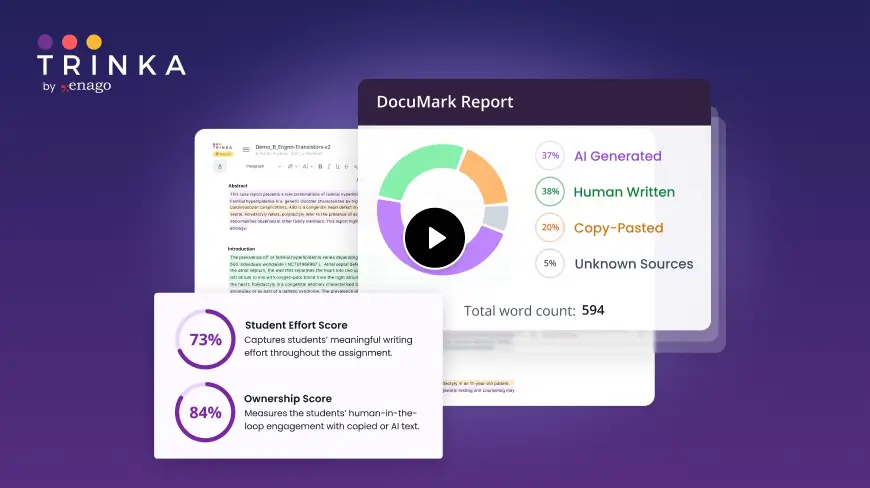
Knowing your institution's AI policy is step one. DocuMark helps enforce it fairly by empowering universities to manage AI-generated content, prevent cheating, and support student writing through responsible AI use.
Common Questions About University of Buckingham's AI Policies
University of Buckingham has defined AI policies in 12 of 12 categories, with an overall coverage score of 100%.
Students must properly reference AI use, clearly indicate where AI-generated material appears in their work, and disclose the nature and extent of AI assistance. Any GenAI use must also be acknowledged through a declaration, with shorter work using an end declaration and longer assessments such as dissertations or projects placing it in the methodology or appendix; AI-generated content should be cited using the discipline’s standard referencing style.
The university states that AI detectors are not used within its VLEs, and if staff use them elsewhere, the results cannot by themselves trigger an academic misconduct referral. Students may be required to demonstrate understanding of submitted work through an oral discussion or authorship viva, and breaches of the AI policy are handled under the Academic Integrity Policy and Procedures.
The provided sources do not identify approved AI platforms, but they do impose data-handling restrictions relevant to technology use. University data must be processed on university-owned devices or software platforms, staff using personal devices must use remote access or online software only, personal-device users cannot download university data, and data sharing must avoid GDPR breaches and unnecessary disclosure.