Teaching & Learning
- UC Merced generally defers generative AI rules for coursework and assignments to individual instructors and their course syllabi
- Campus guidance indicates students generally may not use AI chatbots to complete academic work unless they have explicit permission from their instructor, and instructors are encouraged to provide a course-specific generative AI policy
“Generally, you cannot use AI chatbots... to complete your academic work at UC Merced, unless you have been given explicit permission from your instructor.”
“UC Merced does not have an institutional policy on its use by students. For that reason, it’s imperative that you provide your students with a policy on the use of generative AI that’s specific to your own classroom.”
- For Public Health Ph.D
- qualifying examinations, students are prohibited from using generative AI tools (including ChatGPT) to create content for exam responses
- The handbook separately permits AI grammar-checking tools (e.g., Microsoft Word Editor, Grammarly) for proofreading and refining mechanics
students may not work together on the exam, nor may they use generative AI tools (e.g., ChatGPT) to create any content for their exam responses.
However, students may use AI grammar-checking tools such as Microsoft Word Editor or Grammarly to proofread and refine their grammar, spelling, and punctuation.
Research
- The same handbook permits AI grammar-checking tools (e.g., Microsoft Word Editor, Grammarly) for proofreading and refining mechanics for those documents
- In the Public Health graduate handbook, students are prohibited from using generative AI tools (including ChatGPT) to create content for dissertation proposals and dissertations
Students may not use generative AI tools (e.g., ChatGPT) to create any content for their dissertation proposal; however, students may use AI grammar-checking tools such as Microsoft Word Editor or Grammarly to proofread and refine their grammar, spelling, and punctuation.
Students may not use generative AI tools (e.g., ChatGPT) to create any content for their dissertation. However, students may use AI grammar-checking tools such as Microsoft Word Editor or Grammarly to proofread and refine their grammar, spelling, and punctuation.
Academic Integrity
- University academic integrity guidance states that taking content from an AI chatbot and presenting it as one's own work is considered plagiarism
“Taking content from an AI chatbot and presenting it as your own would be considered plagiarism.”
Institutional & Administrative
- UC Merced provides faculty, staff, and students access to certain supported AI tools and services and indicates that safeguards are in place when logging into these supported tools with UC Merced credentials
- Separately, the UC Merced Information Security Office and campus privacy office publish advisory guidance for employees contemplating using ChatGPT as part of their work, emphasizing that the key concern is what data is typed into and shared with the vendor
The following AI services are generally available to the UC Merced community and supported by the Office of Information Technology. When logging in to these tools with your UC Merced credentials, appropriate safeguards are in place to ensure the protection and privacy of institutional data.
This advisory contains guidelines that the Information Security Office and campus privacy office recommends while using the chat program ChatGPT and similar Large Language Models (LLMs). This advisory is not exhaustive but serves as the starting point if you are contemplating using ChatGPT as part of your work at UC Merced.
The problem is not how the person is using ChatGPT, but what data is being typed in and shared with the AI model vendor.
- UC Merced lists supported/approved AI tools and indicates approved data protection levels for those tools
- For tools not covered by UC Merced or UC contracts, the university states a standard practice to not share certain sensitive data (including PII, PHI, protected student records, or other P3/P4 data) without consultation
- A separate joint information security and privacy advisory specifically advises not sharing Protection Level 4 sensitive institutional information with ChatGPT and recommends consultation for incorporating ChatGPT/LLMs into business operations
The following AI services are generally available to the UC Merced community and supported by the Office of Information Technology. When logging in to these tools with your UC Merced credentials, appropriate safeguards are in place to ensure the protection and privacy of institutional data.
The Office of Information Technology maintains an expanding catalog of supported AI tools, including the types of institutional data permissible for each (see table above). Please consider using these supported tools where appropriate, as agreements have been reached with these suppliers to ensure the proper protection and use of our institutional data.
As a standard practice, never share Personally Identifiable Information (PII), Personal Health Information (PHI), protected student records, or other data classified as P3 or P4 with any AI tool without consultation to determine appropriateness and any necessary safeguards.
We specifically advise that you do not share sensitive institutional information classified as Protection Level 4 per UC Data Classification Standard with ChatGPT. This information includes: Sensitive Personally Identifiable Information (PII), Social security numbers, Protected health information (PHI), notification triggering information, payment card information.
If you have questions about the use of ChatGPT or are thinking of incorporating ChatGPT and similar AI models in your business operations, please contact the Chief information Security Officer and Campus Privacy Officer for a consultation.
- The UC Merced AI website also announces the formation of a UC Merced AI Advisory Council as an initiative to guide and support integration of AI across the university
- UC Merced states an institutional intent to embrace AI responsibly in alignment with strategic goals and references UC Responsible AI Principles as guidance for adoption and use of AI tools
UC Merced aims to embrace AI in a responsible manner that is consistent with our strategic goals to advance knowledge, develop scholars and leaders, and cultivate a culture of dignity and respect for all.
The University of California has developed a set of Responsible AI Principles to guide the use and adoption of AI tools in support of the university’s mission.
We are excited to announce the formation of the UC Merced AI Advisory Council, a strategic initiative designed to guide and support our university’s integration of Artificial...
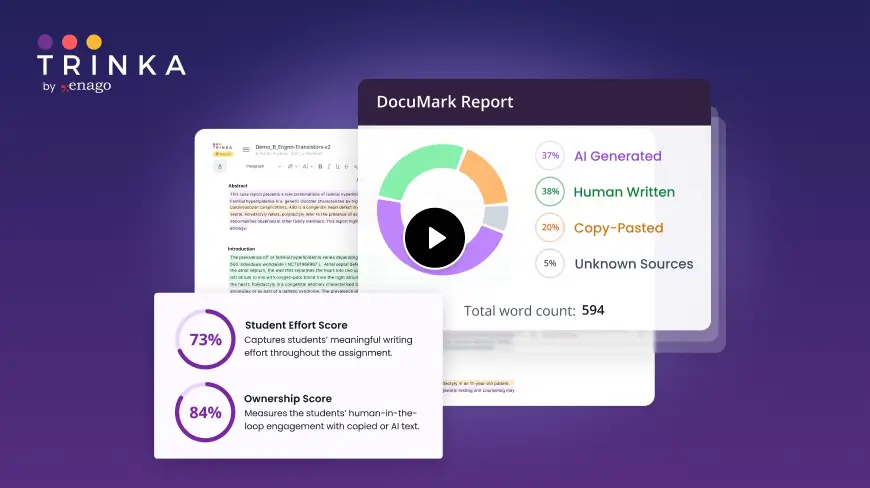
DocuMark: Responsible AI Use for Academic Integrity
Knowing your institution's AI policy is step one. DocuMark helps enforce it fairly by empowering universities to manage AI-generated content, prevent cheating, and support student writing through responsible AI use.
Common Questions About University of California, Merced's AI Policies
University of California, Merced has defined AI policies in 7 of 12 categories, with an overall coverage score of 58%.
University academic integrity guidance states that taking content from an AI chatbot and presenting it as one's own work is considered plagiarism.
No explicit detection or enforcement process is currently defined in the available policy sources.
UC Merced lists supported/approved AI tools and indicates approved data protection levels for those tools. For tools not covered by UC Merced or UC contracts, the university states a standard practice to not share certain sensitive data (including PII, PHI, protected student records, or other P3/P4 data) without consultation. A separate joint information security and privacy advisory specifically advises not sharing Protection Level 4 sensitive institutional information with ChatGPT and recommends consultation for incorporating ChatGPT/LLMs into business operations.